

ADVERTISEMENT

US opens safety probe into Boeing after Alaska Airlines incident

Published Jan 12, 2024 12:48 am

NEW YORK, United States - The US Federal Aviation Administration (FAA) announced Thursday it is launching a safety probe into Boeing following last week's near-catastrophic incident on an Alaska Airlines-operated 737 MAX.
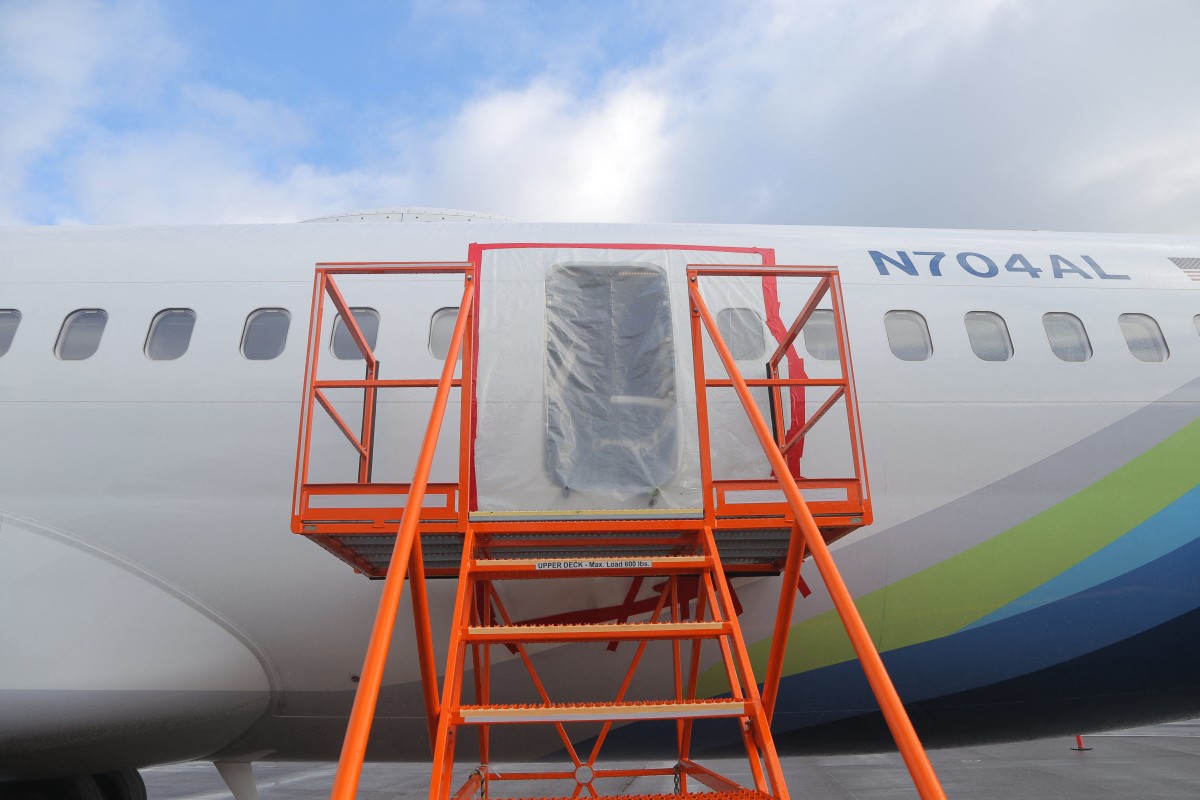
349T72U-Preview.jpg
This handout picture provided by the NTSB on January 8, 2024 shows the investigation involving Alaska Airlines Flight 1282 on a Boeing 737-9 MAX in Portland, Oregon on January 7, 2024. US aviation authorities said January 7, 2024 the door plug of an airplane panel that blew out during an Alaska Airlines flight has been found, a part that could potentially help with the investigations into the cause of the accident. (Photo by Handout / NTSB / AFP)
XGTY

"This incident should have never happened and it cannot happen again," the FAA said in a statement, after a panel known as a "door plug" blew out of the plane over the western US state of Oregon.

There were no fatalities or serious injuries after Alaska Airlines safely executed an emergency landing in the January 5 incident, but investigators with the National Transportation Safety Board have said the episode could have resulted in serious harm.

The FAA probe -- which could result in a financial penalty on Boeing -- marks an escalation by the agency into the episode, the first major in-flight safety issue on a Boeing plane since the fatal 2018 and 2019 737 MAX crashes that led to a lengthy grounding of the aircraft.

Besides the incident itself, the FAA also said it was investigating "additional discrepancies on other Boeing 737-9 airplanes," according to a letter to the company that gave it 10 days to respond.

That is an allusion to reports from Alaska and United Airlines of "loose" hardware on delivered planes found in preliminary investigations of the jets.

"Boeing's manufacturing practices need to comply with the high safety standards they're legally accountable to meet," the FAA said in a statement.

The letter cited a statute requiring Boeing to ensure that "completed products" are "in a condition for safe operation."

The agency said Boeing's response to the FAA should include the "root cause" of the incident, actions to prevent a recurrence and any relevant mitigating circumstances.

Boeing said Thursday that it would "cooperate fully and transparently" with the investigations.

Aviation consultant Jeff Guzzetti, a former head of the FAA's investigation division who also worked at the NTSB, said the "sweeping" language in the FAA letter suggests the probe could be broadened to Boeing's production processes, including into other planes besides the MAX.

Boeing will need to spell out its investigative findings, even if it has not determined a root cause, said Guzzetti, adding that the probe could take months and result in fines.

Guzzetti said he is hoping that the Alaska Airlines problem was a "one off" but "if it turns out to be many aircraft, that will be disturbing to me."

- 'Quality escape' -


US regulators have grounded 171 737 MAX 9 planes with the same configuration as the jet involved in last Friday's incident.

Earlier this week, Boeing Chief Executive Dave Calhoun took responsibility for the incident, vowing "complete transparency" as the aviation giant tries to pivot from its latest crisis.

In an interview with CNBC on Wednesday, Calhoun described the incident as a "quality escape," and said the company was still in fact-finding mode.

"We're going to want to know what broke down in our gauntlet of inspections, what broke down in the original work that allowed for that escape to happen," Calhoun said.

The affected door plug panel is used to fill an unneeded emergency exit in planes, and NTSB investigators have suggested that the part was not affixed adequately.

The FAA has been working with Boeing on inspection instructions for the 737 MAX 9 planes before they can be returned to service.

Alaska has canceled flights on the aircraft through Saturday, January 13, resulting in between 110 and 150 flight cancellations per day, the company said Wednesday.

Shares of Boeing fell 1.8 percent in afternoon trading.

Related Tags

WORLDNEWS
ADVERTISEMENT
.most-popular .layout-ratio{ padding-bottom: 79.13%; } @media (min-width: 768px) and (max-width: 1024px) { .widget-title { font-size: 15px !important; } }

{{ articles_filter_1561_widget.title }}

.most-popular .layout-ratio{ padding-bottom: 79.13%; } @media (min-width: 768px) and (max-width: 1024px) { .widget-title { font-size: 15px !important; } }

{{ articles_filter_1562_widget.title }}

.most-popular .layout-ratio{ padding-bottom: 79.13%; } @media (min-width: 768px) and (max-width: 1024px) { .widget-title { font-size: 15px !important; } }

{{ articles_filter_1563_widget.title }}

{{ articles_filter_1564_widget.title }}

.mb-article-details { position: relative; } .mb-article-details .article-body-preview, .mb-article-details .article-body-summary{ font-size: 17px; line-height: 30px; font-family: "Libre Caslon Text", serif; color: #000; } .mb-article-details .article-body-preview iframe , .mb-article-details .article-body-summary iframe{ width: 100%; margin: auto; } .read-more-background { background: linear-gradient(180deg, color(display-p3 1.000 1.000 1.000 / 0) 13.75%, color(display-p3 1.000 1.000 1.000 / 0.8) 30.79%, color(display-p3 1.000 1.000 1.000) 72.5%); position: absolute; height: 200px; width: 100%; bottom: 0; display: flex; justify-content: center; align-items: center; padding: 0; } .read-more-background a{ color: #000; } .read-more-btn { padding: 17px 45px; font-family: Inter; font-weight: 700; font-size: 18px; line-height: 16px; text-align: center; vertical-align: middle; border: 1px solid black; background-color: white; } .hidden { display: none; }
function initializeAllSwipers() { // Get all hidden inputs with cms_article_id document.querySelectorAll('[id^="cms_article_id_"]').forEach(function (input) { const cmsArticleId = input.value; const articleSelector = '#article-' + cmsArticleId + ' .body_images'; const swiperElement = document.querySelector(articleSelector); if (swiperElement && !swiperElement.classList.contains('swiper-initialized')) { new Swiper(articleSelector, { loop: true, pagination: false, navigation: { nextEl: '#article-' + cmsArticleId + ' .swiper-button-next', prevEl: '#article-' + cmsArticleId + ' .swiper-button-prev', }, }); } }); } setTimeout(initializeAllSwipers, 3000); const intersectionObserver = new IntersectionObserver( (entries) => { entries.forEach((entry) => { if (entry.isIntersecting) { const newUrl = entry.target.getAttribute("data-url"); if (newUrl) { history.pushState(null, null, newUrl); let article = entry.target; // Extract metadata const author = article.querySelector('.author-section').textContent.replace('By', '').trim(); const section = article.querySelector('.section-info ').textContent.replace(' ', ' '); const title = article.querySelector('.article-title h1').textContent; // Parse URL for Chartbeat path format const parsedUrl = new URL(newUrl, window.location.origin); const cleanUrl = parsedUrl.host + parsedUrl.pathname; // Update Chartbeat configuration if (typeof window._sf_async_config !== 'undefined') { window._sf_async_config.path = cleanUrl; window._sf_async_config.sections = section; window._sf_async_config.authors = author; } // Track virtual page view with Chartbeat if (typeof pSUPERFLY !== 'undefined' && typeof pSUPERFLY.virtualPage === 'function') { try { pSUPERFLY.virtualPage({ path: cleanUrl, title: title, sections: section, authors: author }); } catch (error) { console.error('ping error', error); } } // Optional: Update document title if (title && title !== document.title) { document.title = title; } } } }); }, { threshold: 0.1 } ); function showArticleBody(button) { const article = button.closest("article"); const summary = article.querySelector(".article-body-summary"); const body = article.querySelector(".article-body-preview"); const readMoreSection = article.querySelector(".read-more-background"); // Hide summary and read-more section summary.style.display = "none"; readMoreSection.style.display = "none"; // Show the full article body body.classList.remove("hidden"); } document.addEventListener("DOMContentLoaded", () => { let loadCount = 0; // Track how many times articles are loaded const offset = [1, 2, 3, 4, 5, 6, 7, 8, 9, 10]; // Offset values const currentUrl = window.location.pathname.substring(1); let isLoading = false; // Prevent multiple calls if (!currentUrl) { console.log("Current URL is invalid."); return; } const sentinel = document.getElementById("load-more-sentinel"); if (!sentinel) { console.log("Sentinel element not found."); return; } function isSentinelVisible() { const rect = sentinel.getBoundingClientRect(); return ( rect.top < window.innerHeight && rect.bottom >= 0 ); } function onScroll() { if (isLoading) return; if (isSentinelVisible()) { if (loadCount >= offset.length) { console.log("Maximum load attempts reached."); window.removeEventListener("scroll", onScroll); return; } isLoading = true; const currentOffset = offset[loadCount]; window.loadMoreItems().then(() => { let article = document.querySelector('#widget_1690 > div:nth-last-of-type(2) article'); intersectionObserver.observe(article) loadCount++; }).catch(error => { console.error("Error loading more items:", error); }).finally(() => { isLoading = false; }); } } window.addEventListener("scroll", onScroll); });

Sign up by email to receive news.