ADVERTISEMENT

Devotees express satisfaction over Traslacion 2024

Published Jan 10, 2024 09:56 am
411155905_346258171688641_3763532586927129739_n.jpg
 Photo taken by Bong Son/MANILA BULLETIN

Devotees who joined the Traslacion on Jan. 9 expressed satisfaction over the security and preparatory measures for Black Nazarene Feast activities.

Gian, 39, who has been a devotee for nine years, said he was able to climb the "andas" and touch the glass case of the Black Nazarene. 

"Mabilis nga. Mas organized na kaysa noong mga nakaraan. Siguro napaghandaan talaga nila kasi matagal ding natigil (It's fast. It's more organized than in the past. Maybe they really prepared because it was suspended for a long time).”

The Quiapo Church said a total of 6,113,598 devotees were recorded in Quiapo Church, Quirino Grandstand, and during the procession. 

"Hindi masyadong nakakapagod kasi karamihan sa mga deboto sumusunod sila. Pag sinabing pumila nang maayos, nasusunod (It's not too tiring because most devotees follow. When told to line up properly, they obey)," he added.

Meanwhile, Roxanne, 38, said she did not encounter as many struggles in this year's procession as the ones held in pre-pandemic time.

"Mahirap naman talaga makalapit sa imahe pero ngayong taon, mas maayos kasi hindi tulad dati na lahat gusto sumampa. Parang ang gusto na lang talaga ng iba makita 'yung imahe o 'yung bimpo nila maipunas man lang kahit doon sa salamin niya (It's really hard to get close to the image but this year, it's better because it's not like before when everyone wants to climb the carriage. It seems like some devotees just want to see the image or their towels be wiped on the glass case),"

"Hindi naman. Lahat naman ng nandito hindi natatakot kasi kung may pananampalataya ka sa Itim na Poong Nazareno, wala kang katatakutan pagpunta mo rito (Not really. Maybe everyone here is not afraid because if you have faith in the Black Nazarene, you have nothing to fear when you come here)," she said when when asked if she was afraid of contracting Covid-19.

Procession time

Devotees chanted “Viva, Nazareno” as the image of the Black Nazarene arrived at the Quiapo Church at exactly 7:44 p.m. after a 15-hour procession from Quirino Grandstand in Ermita.

The Quiapo Church said that the exact duration of this year's procession was 14:59:10, considered as the fastest for Traslacion in recent history.

417615403_1079149243115820_1833824667700458684_n.jpg
Photo from Quiapo Church/MANILA BULLETIN

Meanwhile, to accommodate millions of devotees, several rescue crews were also deployed to provide them the medical assistance they needed. 

The Quiapo Church recorded a total of 749 catered patients, 343 of whom were assisted by the Manila Disaster Risk Reduction Management Office (DRRMO).
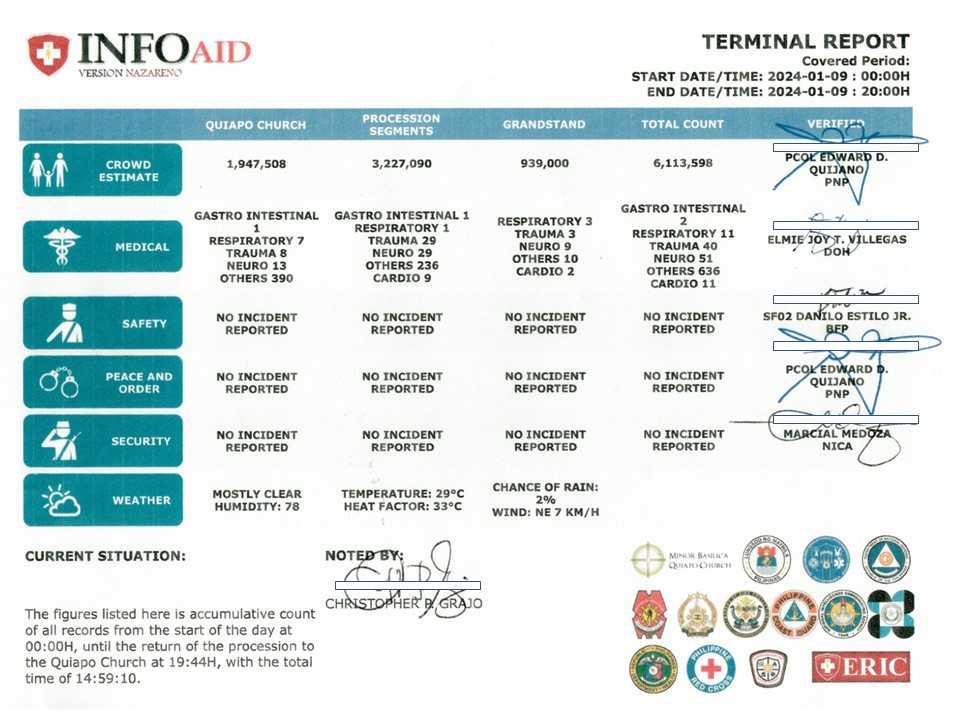
417264508_2417663411752519_5163312414795765098_n.jpg
Report submitted by Quiapo Church/ MANILA BULLETIN

According to Manila DRRMO Chief Arnel Angeles, they had successfully attended to the devotees who experienced medical issues.

He also reported that a woman who lost her pulse when she fainted in the middle of the crowd but was revived because of the swift action of the rescue and medical personnel.

Truckloads of trash

The procession also left a huge amount of trash on the streets where the procession passed. 

The Manila Department of Public Services (DPS) and personnel of the Metropolitan Manila Development Authority (MMDA) immediately conducted the clean-up drive the moment the andas of the Black Nazarene left the Quirino Grandstand.

DPS said 128 metric tons of garbage or 46 truckloads were collected at 7 p.m. on Tuesday.

It also conducted a flushing operation during its second day of clean-up drive on Wednesday, Jan. 10.

It said that in this year's feast of Black Nazarene from Jan. 6 to 10, it collected 468 metric tons or 158 truckloads of trash, which is more than the collected garbage in previous processions.

Due to the loads of garbage left along the Traslacion route, DPS’ cleaning operation is still ongoing.

Related Tags

Traslacion 2024 metronews
ADVERTISEMENT
.most-popular .layout-ratio{ padding-bottom: 79.13%; } @media (min-width: 768px) and (max-width: 1024px) { .widget-title { font-size: 15px !important; } }

{{ articles_filter_1561_widget.title }}

.most-popular .layout-ratio{ padding-bottom: 79.13%; } @media (min-width: 768px) and (max-width: 1024px) { .widget-title { font-size: 15px !important; } }

{{ articles_filter_1562_widget.title }}

.most-popular .layout-ratio{ padding-bottom: 79.13%; } @media (min-width: 768px) and (max-width: 1024px) { .widget-title { font-size: 15px !important; } }

{{ articles_filter_1563_widget.title }}

{{ articles_filter_1564_widget.title }}

.mb-article-details { position: relative; } .mb-article-details .article-body-preview, .mb-article-details .article-body-summary{ font-size: 17px; line-height: 30px; font-family: "Libre Caslon Text", serif; color: #000; } .mb-article-details .article-body-preview iframe , .mb-article-details .article-body-summary iframe{ width: 100%; margin: auto; } .read-more-background { background: linear-gradient(180deg, color(display-p3 1.000 1.000 1.000 / 0) 13.75%, color(display-p3 1.000 1.000 1.000 / 0.8) 30.79%, color(display-p3 1.000 1.000 1.000) 72.5%); position: absolute; height: 200px; width: 100%; bottom: 0; display: flex; justify-content: center; align-items: center; padding: 0; } .read-more-background a{ color: #000; } .read-more-btn { padding: 17px 45px; font-family: Inter; font-weight: 700; font-size: 18px; line-height: 16px; text-align: center; vertical-align: middle; border: 1px solid black; background-color: white; } .hidden { display: none; }
function initializeAllSwipers() { // Get all hidden inputs with cms_article_id document.querySelectorAll('[id^="cms_article_id_"]').forEach(function (input) { const cmsArticleId = input.value; const articleSelector = '#article-' + cmsArticleId + ' .body_images'; const swiperElement = document.querySelector(articleSelector); if (swiperElement && !swiperElement.classList.contains('swiper-initialized')) { new Swiper(articleSelector, { loop: true, pagination: false, navigation: { nextEl: '#article-' + cmsArticleId + ' .swiper-button-next', prevEl: '#article-' + cmsArticleId + ' .swiper-button-prev', }, }); } }); } setTimeout(initializeAllSwipers, 3000); const intersectionObserver = new IntersectionObserver( (entries) => { entries.forEach((entry) => { if (entry.isIntersecting) { const newUrl = entry.target.getAttribute("data-url"); if (newUrl) { history.pushState(null, null, newUrl); let article = entry.target; // Extract metadata const author = article.querySelector('.author-section').textContent.replace('By', '').trim(); const section = article.querySelector('.section-info ').textContent.replace(' ', ' '); const title = article.querySelector('.article-title h1').textContent; // Parse URL for Chartbeat path format const parsedUrl = new URL(newUrl, window.location.origin); const cleanUrl = parsedUrl.host + parsedUrl.pathname; // Update Chartbeat configuration if (typeof window._sf_async_config !== 'undefined') { window._sf_async_config.path = cleanUrl; window._sf_async_config.sections = section; window._sf_async_config.authors = author; } // Track virtual page view with Chartbeat if (typeof pSUPERFLY !== 'undefined' && typeof pSUPERFLY.virtualPage === 'function') { try { pSUPERFLY.virtualPage({ path: cleanUrl, title: title, sections: section, authors: author }); } catch (error) { console.error('ping error', error); } } // Optional: Update document title if (title && title !== document.title) { document.title = title; } } } }); }, { threshold: 0.1 } ); function showArticleBody(button) { const article = button.closest("article"); const summary = article.querySelector(".article-body-summary"); const body = article.querySelector(".article-body-preview"); const readMoreSection = article.querySelector(".read-more-background"); // Hide summary and read-more section summary.style.display = "none"; readMoreSection.style.display = "none"; // Show the full article body body.classList.remove("hidden"); } document.addEventListener("DOMContentLoaded", () => { let loadCount = 0; // Track how many times articles are loaded const offset = [1, 2, 3, 4, 5, 6, 7, 8, 9, 10]; // Offset values const currentUrl = window.location.pathname.substring(1); let isLoading = false; // Prevent multiple calls if (!currentUrl) { console.log("Current URL is invalid."); return; } const sentinel = document.getElementById("load-more-sentinel"); if (!sentinel) { console.log("Sentinel element not found."); return; } function isSentinelVisible() { const rect = sentinel.getBoundingClientRect(); return ( rect.top < window.innerHeight && rect.bottom >= 0 ); } function onScroll() { if (isLoading) return; if (isSentinelVisible()) { if (loadCount >= offset.length) { console.log("Maximum load attempts reached."); window.removeEventListener("scroll", onScroll); return; } isLoading = true; const currentOffset = offset[loadCount]; window.loadMoreItems().then(() => { let article = document.querySelector('#widget_1690 > div:nth-last-of-type(2) article'); intersectionObserver.observe(article) loadCount++; }).catch(error => { console.error("Error loading more items:", error); }).finally(() => { isLoading = false; }); } } window.addEventListener("scroll", onScroll); });

Sign up by email to receive news.