







Meeting Mr. Malcolm Gladwell


HEARD IT THROUGH THE GRIPE-VINE: OUR NEW ABNORMAL

With full disclosure, I’ll confess I’m more of a fiction reader; and so when I was asked to moderate the Monday morning mini presscon for noted author and New Yorker columnist Malcolm Gladwell, I had to scramble and read up on him over the weekend. I knew Mr. Gladwell was flying in to be the keynote speaker at the SM Supermalls Tenant-Partner Summit, an activity that would formally kick off this year’s 65th SM Anniversary. But while I had been invited to attend the talk, no one had said a word about the presscon and my meeting the man – until the moderating was mentioned to me Friday lunchtime.
Confession #2 is that I’m happy I had to do this Gladwell cramming. For he really is quite unique as a social commentator, and as one reviewer noted, “he spots the interesting, where others only see the obvious.” He’s been quoted as saying that his books are no more than connecting interesting research with interesting stories; but that’s being self-deprecating, as there is something alchemical or magical with how he makes the connections between research and story-telling, and it’s a special gift!
Starting with Tipping Point in 2000, on to Blink, Outliers, What the Dog Saw, David & Goliath, Talking to Strangers, and The Bomber Mafia; Gladwell has turned non-fiction writing into something akin to crime fiction, where we unravel a mystery, but this time starting from an observation on real life or history, and then he keeps “digging” until a unique, fascinating story is weaved from the single thread he started with.
 MALCOLM GLADWELL, best-selling author and journalist: A quiet, but friendly person
On our walk to the function room where the press con was held, I asked him if this connected in any way to his love for spy novels – he counts Lee Child’s Jack Reacher and John LeCarre’s George Smiley among his literary “heroes.” And he smiled, saying that elements of crime fiction do come into play whenever he’s writing his books, as he likes the idea of surprise, and how it engages his readers in a way that most non-fiction writers don’t bother to consider or inject.
At the presscon, I was struck by something that Gladwell brought up. He cited the case of an aquarium being shown to American children, and then to Korean children. The American children only remembered the biggest fish; while the Koreans would talk about the rocks, the smaller fish, and see the aquarium in its entirety. Gladwell said he’d like to study this further, understand why the Asian mind works in this way.
He could easily understand how the American kids reacted in the way they did, as they’re weaned on the notion of bigger is better, that it’s a matter of who makes the biggest splash. He found this Asian mindset so intriguing, and hoped to do research on it, thinking it could be the seeds of a book to come.
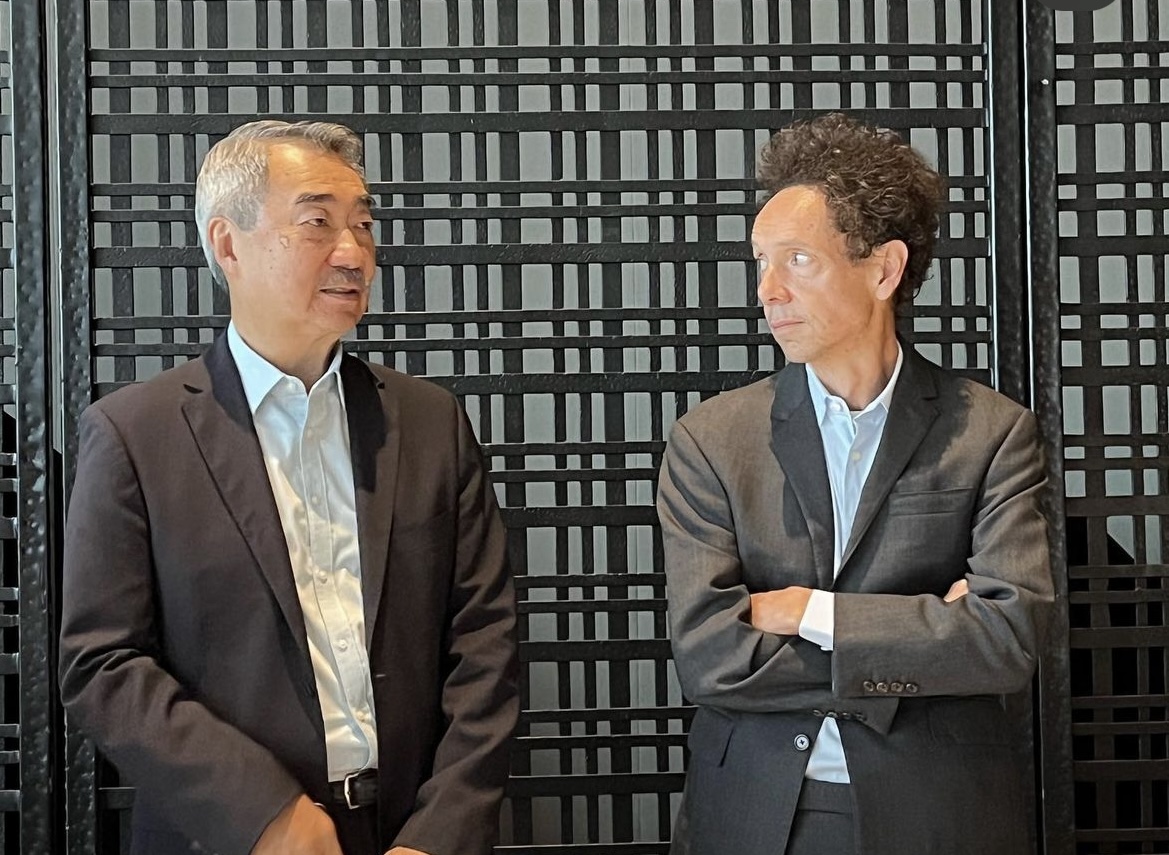 HANS SY and Malcolm Gladwell at the the SM Supermalls’ welcome breakfast. (Photo from Grace Magno)
Queried on the emergence of more sophisticated AI, Gladwell spoke of professions such as doctors and architects; how in these professions, there existed a data role and a human role. If AI can assist on the data role, giving more time for these professionals to concentrate on the human role, then he saw AI as a boon, of major help.
One journalist asked Gladwell which one book he’d recommend to a Filipino reader who’s had no exposure to any of his works. Laughing, Malcolm said he’d still recommend that said reader go through all his books. Then, thinking about it, he pointed to Outliers as the best introduction, the one of most practical use.
During his talk at the summit, Gladwell brought up influencer Kai Cennat’s Union Square brouhaha and Taylor Swift’s fan base to bring home points about authenticity, spontaneity, and inclusivity. He referred to these three as elements that all retail brands should now seriously explore, if they want to stay relevant with the emerging youth market.
He also spoke about the shift from “hierarchy,” as the basis on which relationships and social activity are founded, to “network.” If hierarchy was the guiding principle of most people over the age of 30, that does not hold true for the ones under 30 or for the children of the digital age. With this demographic, it’s all about the inclusivity of “network.”
What was interesting to note during the summit was how enthusiastic and excited the audience was to have Gladwell in the room. SM Supermalls President Steven Tan likened Gladwell to a rockstar for this crowd; and SM Prime Holdings President Jeffrey Lim closed the afternoon’s activities thanking the tenants for being the partners they are, and remarking on how both sides are truly invested in ensuring the success of each other.