







Rizal PPO get 'institutionalized' status from PGS


The Rizal Police Provincial Office (Rizal PPO) on Thursday, Sept. 7, became the first provincial office in the Calabarzon (Cavite-Laguna-Batangas-Rizal-Quezon) region to receive an "Institutionalized" status in the recently concluded Conferment of Performance Governance System (PGS).
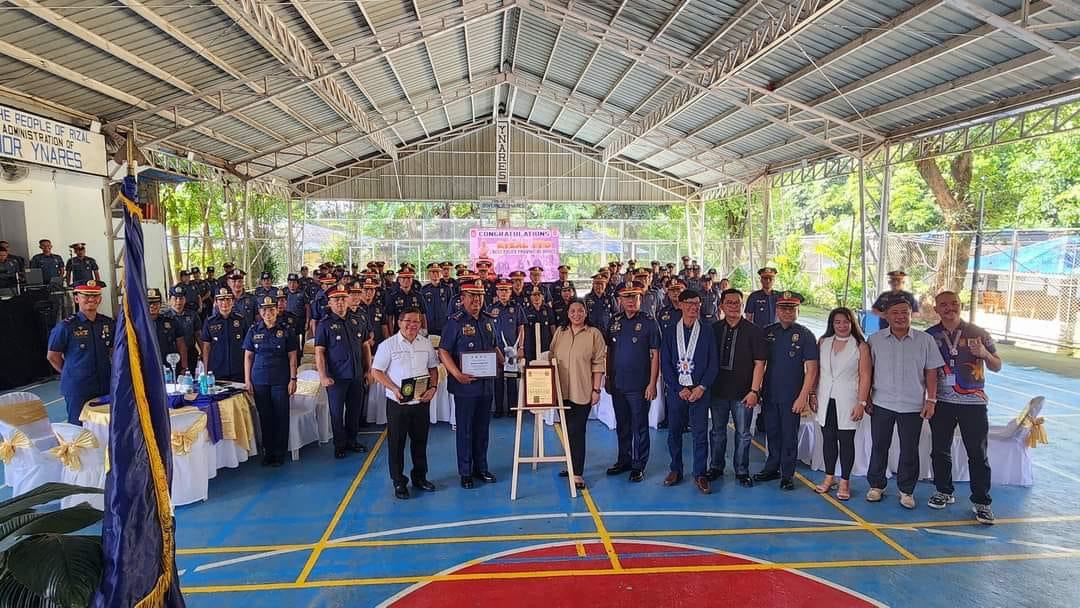
(Photo from Rizal PPO)
The PGS is described as a holistic and collaborative framework for designing, executing, monitoring, and sustaining roadmaps for reform.
Held at Camp Licerio I. Gernonimo in Taytay, Rizal, the event was attended by Rizal Governor Nina Ynares and other top police officials of the province.
The Rizal PPO, headed by PCol. Rainerio De Chavez, received the Silver Eagle Award after garnering 91.11 percent in the evaluation. PBGen. Gregory Bogñalbal administered the conferment and extended the congratulatory message of Police Regional Office (PRO) Calabarzon Regional Director PBGen Carlito Gaces to Rizal PNP.
Ynares expressed her gratitude and support to the personnel of the Rizal PPO for displaying excellence and gallantry in their jobs.
"I would like to extend my deepest gratitude to every member of the Philippine National Police (PNP) Rizal for their courage, sacrifice, and unwavering sense of duty. Thank you for your invaluable service and for making a positive impact on the lives of countless individuals. I am confident that you will continue to excel in your mission." she said.
Certificates of Recognition and Plaque of Appreciation were also given to the Provincial Advisory Group for Police Transformation and Development (PAGPTD) led by Rene Logatoc in recognition of their utmost support and performance during the process in giving the Rizal PPO the Silver Eagle Award.
The "institutionalized" status of Rizal PPO is geared towards the attainment of the plans and programs of the PNP's PATROLPLAN 2030:
- To enhance the focus and coordination of police functions and operations through a national internal security policy and strategy;
- To re-engineer the police system towards strengthening police oversight; remove institutionalized mechanisms that undermine unity of command and internal management authority in the PNP, which renders the organization vulnerable to undue politicization and corruption;
- To fortify the institutional capabilities of the PNP by improving administrative and operational coherence and efficiency; and to strengthen the police stations with the end goal of enhancing the quality of police services and relationships with the community;
- To streamline institutional mechanisms and procedures in order to promote speedy access to justice and legal protection; ensure police neutrality and non-discrimination; and foster respect for human rights and gender neutrality;
- To strengthen institutional mechanisms for the recruitment, training, and maintenance of a corps of competent, well-compensated, and motivated professional police force imbued with integrity, industry, and a high sense of duty and honor; and
- To clarify and instill a culture of public accountability in the PNP and among its personnel.
PNP's PATROLPLAN 2030 also has 12 Key Result Areas:
1. NATIONAL POLICY & INSTITUTIONAL DEVELOPMENT – to formulate and implement a national internal security policy and strategy; rationalize the overall institutional framework of the police system; improve the functional delineation and coordination between law enforcement agencies and the conventional police institutions; remove institutional mechanisms that render the PNP vulnerable to politicization and erode its unity of command and internal management authority; strengthen the National Police Commission (NAPOLCOM) as body tasked with the formulation of rules, regulations and standards for the entire police system; adopt mechanisms for institutional continuity and stability, particularly in police leadership; and firmly establish a self-administering and managing professional PNP.
2. POLICE OPERATIONS – to initiate reforms in rules and procedures in the conduct of police operations; provide police stations with the appropriate work tools and strengthen crime research to support more effective crime management operations.
3. FACILITIES DEVELOPMENT – to upgrade physical facilities and equipment in support to police field operations, including the updating of police equipment standards and the development of a multi-year financing and procurement plan; development and upgrading of the facilities, equipment, and physical set-up of the PNP Crime Laboratory; and the provision of model infrastructure for police stations and substations. An important component of this program is the improvement of capacities for the management and preservation of police evidence.
4. HUMAN RESOURCES MANAGEMENT & DEVELOPMENT – to initiate policy reforms in human resource development and improve the human resources management systems including staffing, recruitment and selection, personnel administration, career development and promotion, police remuneration, and police education and training, performance monitoring and evaluation, and police discipline. Two important components of this program include the reengineering of the institutional framework of police education and training and particularly strengthening the capacities and organization of the Philippine Public Safety College, integrating all police training therein, and strengthening police education and training curricula; and the establishment of a PNP Pension and Insurance Corporation.
5. ADMINISTRATIVE & FINANCIAL MANAGEMENT – to reform and strengthen the resource generation capacity of the PNP, streamline and improve the entire financial management system by infusing more appropriate tools that will allow systematic linkage between strategic and operational plans, budget prioritization and detail formulation, and decentralize administrative and financial management to the appropriate enterprise units in the field, while strengthening and integrating oversight administrative and financial management functions.
6. STRATEGIC PLANNING & PERFORMANCE MANAGEMENT – to design and institutionalize a strategic planning system within the PNP; strengthen operational planning capacities of mission-critical units; develop results- based monitoring and evaluation systems which will be run at the operational and oversight levels of the PNP organization. An essential component of this program will be the formulation and implementation of a Crime Indicators System that will identify an appropriate set of indicators that will guide the monitoring and evaluation of the country’s crime situation and its performance, and the corresponding procedures for data generation and reporting.
7. INFORMATION & COMMUNICATION TECHNOLOGY – to develop and implement a PNP Integrated Crime Management Information System, or CMIS. The system will be designed to work as part of the broader criminal justice information system architecture. The PNP CMIS will operate at the police station level providing transaction processing modules that will feed into a crime database, tracking, and monitoring system that will enable crime mapping and analysis at station and higher geographical levels.
8. DEMONSTRATION OF EXCELLENCE THROUGH DEVELOPMENT OF BEST PRACTICES – to demonstrate the effectiveness of the fundamental institutional and system reforms by combining them with a more comprehensive locality or community-based peace and order planning and management that will involve various stakeholders.
9. PUBLIC INFORMATION AND ADVOCACY – to support the implementation of the transformation program from start to finish by providing broad and stakeholder information, education and advocacy strategies and interventions which will engender active cooperation and support.
10. REFORM MANAGEMENT – take the lead in implementing the medium-term reform program by enhancing the institutional framework and operating mechanisms of the PNP; prepare plans and manage the entire change management and day-to-day reform development, content synchronization, and implementation of management processes.
11. ANTI-CORRUPTION – Envisioned to prevent the misuse of power and position in the PNP organization which undermines the integrity of police personnel along with the promotion of police integrity and morality as primer law enforcers.
12. PROMOTION OF HUMAN RIGHTS – Aimed to promote human rights as a basic value in the conduct of operations and in accordance with the international standards of human rights and policing.