

ADVERTISEMENT

Climbing Centre is Hangzhou's answer to Beijing's Bird's Nest

Published Sep 22, 2023 07:05 am

At A Glance

  • China has once again flaunted its immense wealth and power with its state-of-the-art venues for the 19th Asian Games here.
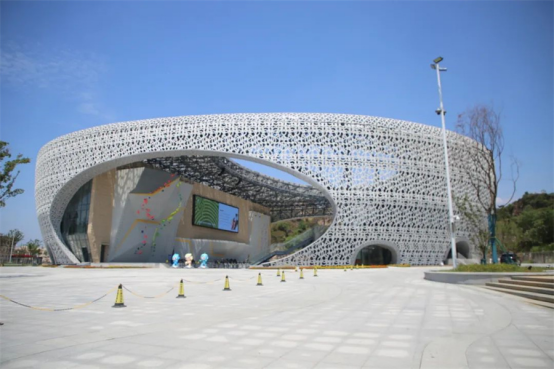
HANGZHOU, China – China has once again flaunted its immense wealth and power with its state-of-the-art venues for the 19th Asian Games here.

W020220723625820397363.png
 Yangshan Sport Climbing Centre (Hangzhou 19th Asian Games website)

During the 2008 Beijing Olympics, the world’s second-most populous country with a population of more than 1.4 billion unwrapped several great architectural designs for a number of playing venues.

One of them is the eye-catching Bird’s Nest Stadium.

For this year’s edition of the biggest regional sportsfest, China produced several stunningly beautiful venues, including the Yangshan Sport Climbing Centre in Shaoxing, Zhenjiang province.

It’s a big wow for everybody as it is a marvel of a design.

Why? It is built meticulously in the shape of a silk-worm cocoon plus a breathtaking background.

So intricate its design that it has already collected a number of international awards.

A local reporter here said it is a perfect blend of the local landscape and culture.


GREEN GAMES


With the nation’s vast energy sources and smart technology – not to mention thousands of volunteers from playing venues to the dining halls and main media center – this year’s edition is also being called Green Games.

That’s because some of the renewable electricity used at playing venues is photovoltaic energy.

Photovoltaic is the process of conversion of light into electricity – normally on generation and photosensors.


SPACIOUS MEDIA CENTER


The main media center is more than twice as big as the basketball court as thousands of reporters from print, TV, radio and international wire agencies from various countries are here to cover the exploits of Asian and Middle East athletes.

As expected, the MMC is equipped with ultra modern technology and manned by very friendly personnel although it is sometimes difficult to communicate with them.


MEDALS AND MASCOTS


Named Shan Shui, Asian Games medals depict the beautiful landscape of the city with the ancient bridge the most prominent.

On Friday, the Games’ mascots – three sports-playing robots – visited the Media Center to show everybody that some players took selfies with them. They are Congcong (yellow color), Lianlian (green) and Chenchen (blue) – all of them are linked to a UNESCO Heritage Site in the city.

While Congcong represents the archaeological ruins of Liangzhu City, Lianlian is for the city's West Lake and Chenchen is for the Grand Canal, science and technology.

Related Tags

hangzhou asian games
ADVERTISEMENT
.most-popular .layout-ratio{ padding-bottom: 79.13%; } @media (min-width: 768px) and (max-width: 1024px) { .widget-title { font-size: 15px !important; } }

{{ articles_filter_1561_widget.title }}

.most-popular .layout-ratio{ padding-bottom: 79.13%; } @media (min-width: 768px) and (max-width: 1024px) { .widget-title { font-size: 15px !important; } }

{{ articles_filter_1562_widget.title }}

.most-popular .layout-ratio{ padding-bottom: 79.13%; } @media (min-width: 768px) and (max-width: 1024px) { .widget-title { font-size: 15px !important; } }

{{ articles_filter_1563_widget.title }}

{{ articles_filter_1564_widget.title }}

.mb-article-details { position: relative; } .mb-article-details .article-body-preview, .mb-article-details .article-body-summary{ font-size: 17px; line-height: 30px; font-family: "Libre Caslon Text", serif; color: #000; } .mb-article-details .article-body-preview iframe , .mb-article-details .article-body-summary iframe{ width: 100%; margin: auto; } .read-more-background { background: linear-gradient(180deg, color(display-p3 1.000 1.000 1.000 / 0) 13.75%, color(display-p3 1.000 1.000 1.000 / 0.8) 30.79%, color(display-p3 1.000 1.000 1.000) 72.5%); position: absolute; height: 200px; width: 100%; bottom: 0; display: flex; justify-content: center; align-items: center; padding: 0; } .read-more-background a{ color: #000; } .read-more-btn { padding: 17px 45px; font-family: Inter; font-weight: 700; font-size: 18px; line-height: 16px; text-align: center; vertical-align: middle; border: 1px solid black; background-color: white; } .hidden { display: none; }
function initializeAllSwipers() { // Get all hidden inputs with cms_article_id document.querySelectorAll('[id^="cms_article_id_"]').forEach(function (input) { const cmsArticleId = input.value; const articleSelector = '#article-' + cmsArticleId + ' .body_images'; const swiperElement = document.querySelector(articleSelector); if (swiperElement && !swiperElement.classList.contains('swiper-initialized')) { new Swiper(articleSelector, { loop: true, pagination: false, navigation: { nextEl: '#article-' + cmsArticleId + ' .swiper-button-next', prevEl: '#article-' + cmsArticleId + ' .swiper-button-prev', }, }); } }); } setTimeout(initializeAllSwipers, 3000); const intersectionObserver = new IntersectionObserver( (entries) => { entries.forEach((entry) => { if (entry.isIntersecting) { const newUrl = entry.target.getAttribute("data-url"); if (newUrl) { history.pushState(null, null, newUrl); let article = entry.target; // Extract metadata const author = article.querySelector('.author-section').textContent.replace('By', '').trim(); const section = article.querySelector('.section-info ').textContent.replace(' ', ' '); const title = article.querySelector('.article-title h1').textContent; // Parse URL for Chartbeat path format const parsedUrl = new URL(newUrl, window.location.origin); const cleanUrl = parsedUrl.host + parsedUrl.pathname; // Update Chartbeat configuration if (typeof window._sf_async_config !== 'undefined') { window._sf_async_config.path = cleanUrl; window._sf_async_config.sections = section; window._sf_async_config.authors = author; } // Track virtual page view with Chartbeat if (typeof pSUPERFLY !== 'undefined' && typeof pSUPERFLY.virtualPage === 'function') { try { pSUPERFLY.virtualPage({ path: cleanUrl, title: title, sections: section, authors: author }); } catch (error) { console.error('ping error', error); } } // Optional: Update document title if (title && title !== document.title) { document.title = title; } } } }); }, { threshold: 0.1 } ); function showArticleBody(button) { const article = button.closest("article"); const summary = article.querySelector(".article-body-summary"); const body = article.querySelector(".article-body-preview"); const readMoreSection = article.querySelector(".read-more-background"); // Hide summary and read-more section summary.style.display = "none"; readMoreSection.style.display = "none"; // Show the full article body body.classList.remove("hidden"); } document.addEventListener("DOMContentLoaded", () => { let loadCount = 0; // Track how many times articles are loaded const offset = [1, 2, 3, 4, 5, 6, 7, 8, 9, 10]; // Offset values const currentUrl = window.location.pathname.substring(1); let isLoading = false; // Prevent multiple calls if (!currentUrl) { console.log("Current URL is invalid."); return; } const sentinel = document.getElementById("load-more-sentinel"); if (!sentinel) { console.log("Sentinel element not found."); return; } function isSentinelVisible() { const rect = sentinel.getBoundingClientRect(); return ( rect.top < window.innerHeight && rect.bottom >= 0 ); } function onScroll() { if (isLoading) return; if (isSentinelVisible()) { if (loadCount >= offset.length) { console.log("Maximum load attempts reached."); window.removeEventListener("scroll", onScroll); return; } isLoading = true; const currentOffset = offset[loadCount]; window.loadMoreItems().then(() => { let article = document.querySelector('#widget_1690 > div:nth-last-of-type(2) article'); intersectionObserver.observe(article) loadCount++; }).catch(error => { console.error("Error loading more items:", error); }).finally(() => { isLoading = false; }); } } window.addEventListener("scroll", onScroll); });

Sign up by email to receive news.