







Where your Stargazer, Creta and Ioniq 5 are made
Hyundai Motor Manufacturing Indonesia


Do you know where your Hyundai comes from? Chances are, most have not given it a thought. Yet Hyundai Motor Philippines Inc. invited us to see their manufacturing facility about an hour and 30-minutes drive out of Jakarta. Located in Cikarang, Bekasi Regency, the Hyundai Motor Manufacturing Indonesia (HMMI) facility sits on a massive 70-hectare plot of land in a huge industrial complex and can put out 150,000 units a year.

Safety Training Center
Our first stop was the Safety Training Center is where everyone taught and reminded about industrial safety specific to the automotive manufacturing process. The interesting thing about this area is that not only do they state what is inherently dangerous, they also show you through practical and virtual demonstrations in different areas what happens when things go wrong in an industrial setting.
These ranged from demonstrations of what sound levels are damaging to your hearing, simulations of working at high altitudes and falling from those altitudes with and without harnesses, simulations of smoke and how to follow markers on the walls in the dark around obstacles to reach the exit, and even how to safely lift weights or heavy items without injuring oneself.
After all this, we moved on to the manufacturing tour proper. It is of interest to note that the whole facility is air conditioned for the comfort of all the workers as it can get pretty hot and humid.

Press Shop
The first area we entered was the Press Shop, this is essentially where flat, blank metal sheets cut to size specifically for the different body panels and reinforcement are shaped into familiar looking parts using a huge stamp that applies 54,000 tons of pressure and can put out 500 panels per hour.

Body Shop
Our next stop was the Body Shop, this is the area of the plant that’s 100% run by robots and assembles the stamped panels, via accurate spot welds into parts of the vehicles chassis and panels. This area is divided into the Floor Line and Side Line, both of which assembles the floor, sides, and roof of the vehicle. It’s followed by the Build Line which then assembles these different parts of the chassis and body into what looks like a vehicle shell we are familiar with. These are inspected before moving to the Paint Shop. This is where the assembled chassis is repeatedly dunked into a series of baths, anti-corrosion and solutions to make paint cling to the panels, followed by painting by robots.
There is a separate EV Line where the Ioniq 5 is assembled from its base components after which it meets up with the line going to the Assembly Shop.

Assembly Shop
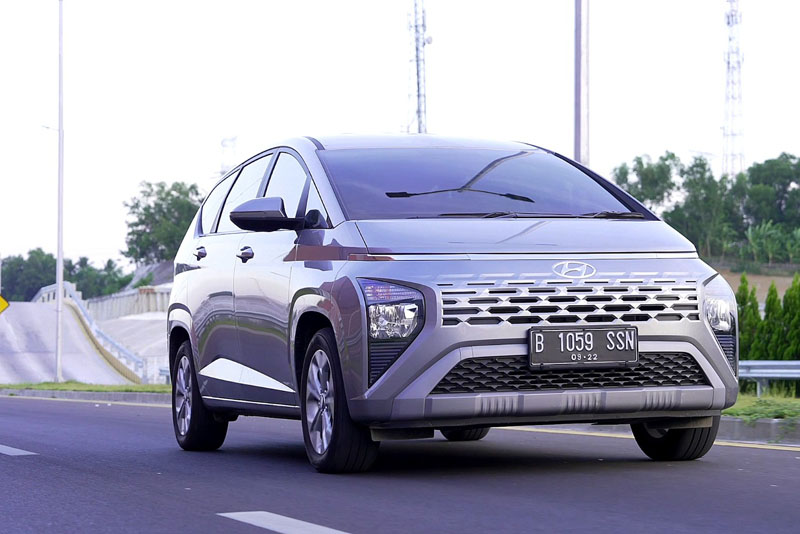
This is where the painted empty shells of the Stargazer, Creta and Ioniq 5 coming on a conveyor from the Paint Shop to get put together and become running vehicles. The parts that go into assembling a Hyundai are 50% imported and 50% locally sourced/manufactured components.
This area has different stages, the Trim Line, where the wiring harnesses are laid out, the interior finishes like the windscreens, headliner, dashboards, seats and other interior fittings are installed, the doors and components in the doors are pre-assembled and installed after all interior items are in place.
The engine for the Creta and Stargazer are locally made and assembled at the Engine Shop and come to the Chassis Line ready to be mated to the vehicle from underneath and this is also near the same area that installs the under-chassis components like the suspension, brakes and wheels. This is also where the Ioniq 5’s battery pack is installed as it too comprises the floor of the EV.

Final Line
The Final Line is where they check all installed components from the front to the back. After that is the OK Line where they inspect fit and finish, and put in a battery, the fluids needed — brake fluid, coolant, fuel (the engine has oil as it is already been run from it’s own inspection). This is when the vehicle comes to life when it is started and moves on to the Test Line on it’s on own power where wheels are aligned, headlights are properly aimed and car electronics are inspected and finally, the vehicle is road tested on a track behind the facility.
This tour gives a sense of the magnitude of Hyundai’s commitment to their customers by putting up a manufacturing plant that can serve the region.