

ADVERTISEMENT

Fewer Filipinos believe PH in right direction — OCTA

Published Sep 14, 2023 02:49 am

At A Glance

  • OCTA pointed out that the percentage of adult Filipinos who think the country is headed in the right direction has been declining since October last year.
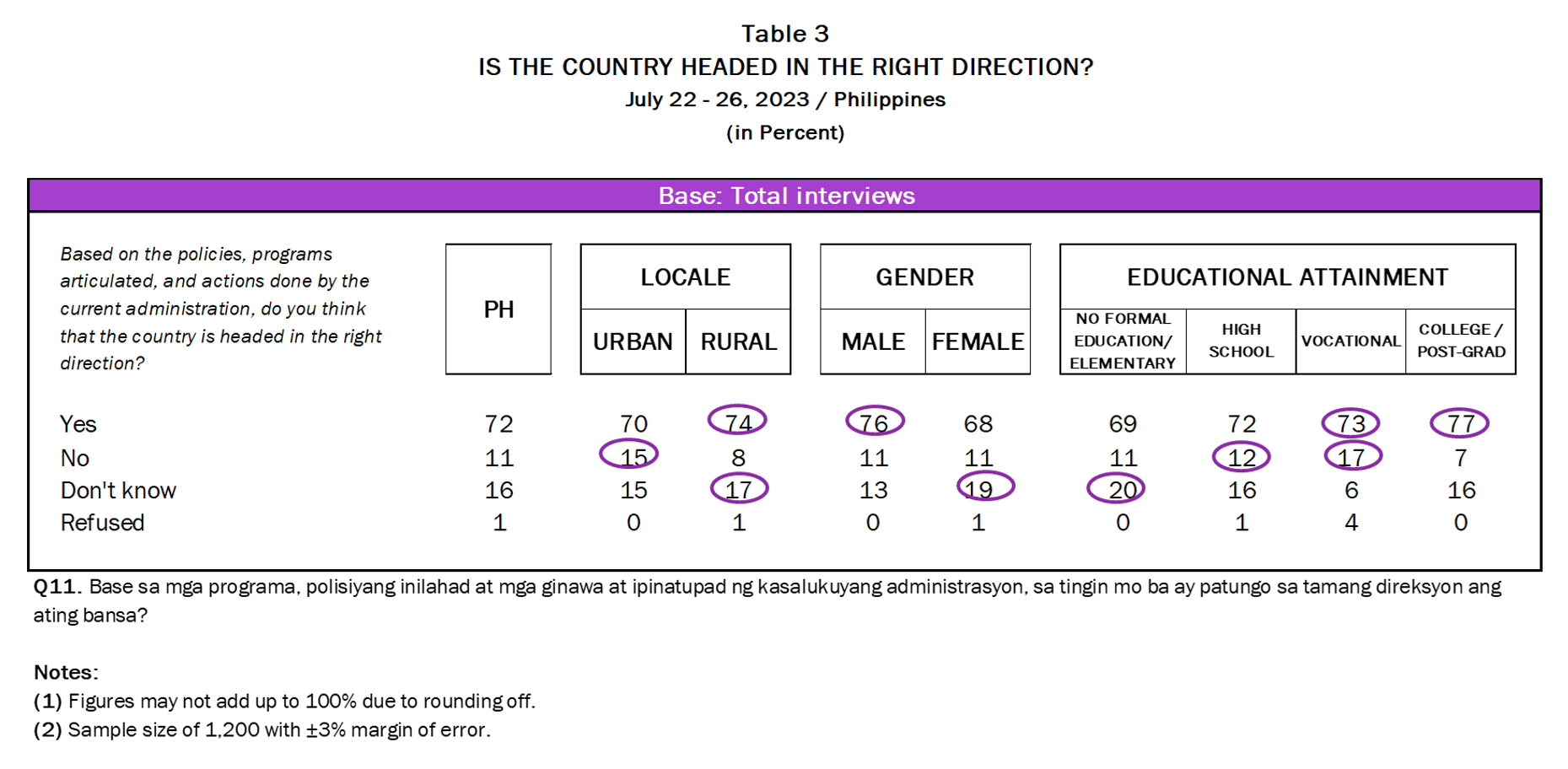
IMG_3282.jpeg
OCTA Research’s Second Quarter 2023 Tugon ng Masa survey results (Manila Bulletin)

Seventy-two percent of adult Filipinos believe that the country is moving in the right direction because of the current administration’s policies and actions in July 2023, down from a peak of 85 percent in October 2022, according to OCTA’s “Tugon ng Masa” (TNM) survey results released on Thursday, Sept. 14.

OCTA pointed out that the percentage of adult Filipinos who think the country is headed in the right direction has been declining since October last year.

“While most adult Filipinos (72 percent) still believe that the country is headed in the right direction, this is a 13 percent decline from a high of 85 percent based on the TNM survey conducted last October 2022,” it said.

“Moreover, the percentage of adult Filipinos who think the country is headed in the right direction decreased from 76 percent last March 2023 to 72 percent for a total of four percentage points,” it added.

Meanwhile, the percentage of adult Filipinos that think the country is headed in the “wrong direction” stayed the same from 10 percent in March 2023 to 11 percent in July 2023.

OCTA said 16 percent had no response and 1 percent had refused to give an answer in the latest survey.

Highest levels of belief in Mindanao, Metro Manila

OCTA noted that Mindanao (78 percent) has the highest percentage of adult Filipinos who believe the country is heading in the right direction, followed by Metro Manila (74 percent).

Meanwhile, 71 percent of adult Filipinos in Balance Luzon and 65 percent in Visayas believe the country is on the right track.

In contrast, Visayas has the highest proportion of adult Filipinos who believe the country is heading in the wrong direction (26 percent).

Highest ‘right direction’ belief among classes ABC, D

OCTA also pointed out that across socioeconomic classes, Class ABC (74 percent) has the highest percentage of adult Filipinos who believe the country is on the right track, followed by Class D (72 percent), while 70 percent in Class E believe the country is on the right track.

Meanwhile, Class ABC (15 percent) has the highest percentage of adult Filipinos who believe the country is heading in the wrong direction, followed by Class D (11 percent).

“Adult Filipinos belonging to class E (21 percent) are more indecisive or uncertain about where the country is headed than any other socio-economic class,” OCTA also said.

18-24-year-olds have highest level of ‘right direction’ belief

According to OCTA, a high percentage of Filipinos aged 18-24 (78 percent), 25-34 (74 percent), 55-64 (73 percent), and 65-74 (76 percent) believe the country is on the right track.

Meanwhile, Filipinos aged 25-34 (12 percent), 35-44 (12 percent), and 45-54 (14 percent), believe the country is heading in the wrong direction.

“Adult Filipinos aged 75 years old and up (33 percent) are more indecisive or uncertain about the trajectory of where the country is headed than adult Filipinos aged 74 years old and below,” OCTA pointed out.

Furthermore, more adult Filipinos living in rural areas (74 percent) than in urban areas (70 percent) believe the country is headed in the right direction, and males (76 percent) believe the country is headed in the right direction than females (68 percent).

“Regarding perceptions based on highest educational attainment, adult Filipinos who think the country is headed in the right direction range from 69 percent to 77 percent,” OCTA said.

“The highest percentage of Adult Filipinos who believe the country is headed in the right direction belongs to those with college or post-grad education (77 percent). In contrast, the lowest percentage belongs to adult Filipinos with no formal education or elementary education,” it added.

The Second Quarter 2023 Tugon ng Masa survey was conducted from July 22 to 26, with 1,200 respondents nationwide.

Related Tags

tugon ng masa survey OCTA Research
ADVERTISEMENT
.most-popular .layout-ratio{ padding-bottom: 79.13%; } @media (min-width: 768px) and (max-width: 1024px) { .widget-title { font-size: 15px !important; } }

{{ articles_filter_1561_widget.title }}

.most-popular .layout-ratio{ padding-bottom: 79.13%; } @media (min-width: 768px) and (max-width: 1024px) { .widget-title { font-size: 15px !important; } }

{{ articles_filter_1562_widget.title }}

.most-popular .layout-ratio{ padding-bottom: 79.13%; } @media (min-width: 768px) and (max-width: 1024px) { .widget-title { font-size: 15px !important; } }

{{ articles_filter_1563_widget.title }}

{{ articles_filter_1564_widget.title }}

.mb-article-details { position: relative; } .mb-article-details .article-body-preview, .mb-article-details .article-body-summary{ font-size: 17px; line-height: 30px; font-family: "Libre Caslon Text", serif; color: #000; } .mb-article-details .article-body-preview iframe , .mb-article-details .article-body-summary iframe{ width: 100%; margin: auto; } .read-more-background { background: linear-gradient(180deg, color(display-p3 1.000 1.000 1.000 / 0) 13.75%, color(display-p3 1.000 1.000 1.000 / 0.8) 30.79%, color(display-p3 1.000 1.000 1.000) 72.5%); position: absolute; height: 200px; width: 100%; bottom: 0; display: flex; justify-content: center; align-items: center; padding: 0; } .read-more-background a{ color: #000; } .read-more-btn { padding: 17px 45px; font-family: Inter; font-weight: 700; font-size: 18px; line-height: 16px; text-align: center; vertical-align: middle; border: 1px solid black; background-color: white; } .hidden { display: none; }
function initializeAllSwipers() { // Get all hidden inputs with cms_article_id document.querySelectorAll('[id^="cms_article_id_"]').forEach(function (input) { const cmsArticleId = input.value; const articleSelector = '#article-' + cmsArticleId + ' .body_images'; const swiperElement = document.querySelector(articleSelector); if (swiperElement && !swiperElement.classList.contains('swiper-initialized')) { new Swiper(articleSelector, { loop: true, pagination: false, navigation: { nextEl: '#article-' + cmsArticleId + ' .swiper-button-next', prevEl: '#article-' + cmsArticleId + ' .swiper-button-prev', }, }); } }); } setTimeout(initializeAllSwipers, 3000); const intersectionObserver = new IntersectionObserver( (entries) => { entries.forEach((entry) => { if (entry.isIntersecting) { const newUrl = entry.target.getAttribute("data-url"); if (newUrl) { history.pushState(null, null, newUrl); let article = entry.target; // Extract metadata const author = article.querySelector('.author-section').textContent.replace('By', '').trim(); const section = article.querySelector('.section-info ').textContent.replace(' ', ' '); const title = article.querySelector('.article-title h1').textContent; // Parse URL for Chartbeat path format const parsedUrl = new URL(newUrl, window.location.origin); const cleanUrl = parsedUrl.host + parsedUrl.pathname; // Update Chartbeat configuration if (typeof window._sf_async_config !== 'undefined') { window._sf_async_config.path = cleanUrl; window._sf_async_config.sections = section; window._sf_async_config.authors = author; } // Track virtual page view with Chartbeat if (typeof pSUPERFLY !== 'undefined' && typeof pSUPERFLY.virtualPage === 'function') { try { pSUPERFLY.virtualPage({ path: cleanUrl, title: title, sections: section, authors: author }); } catch (error) { console.error('ping error', error); } } // Optional: Update document title if (title && title !== document.title) { document.title = title; } } } }); }, { threshold: 0.1 } ); function showArticleBody(button) { const article = button.closest("article"); const summary = article.querySelector(".article-body-summary"); const body = article.querySelector(".article-body-preview"); const readMoreSection = article.querySelector(".read-more-background"); // Hide summary and read-more section summary.style.display = "none"; readMoreSection.style.display = "none"; // Show the full article body body.classList.remove("hidden"); } document.addEventListener("DOMContentLoaded", () => { let loadCount = 0; // Track how many times articles are loaded const offset = [1, 2, 3, 4, 5, 6, 7, 8, 9, 10]; // Offset values const currentUrl = window.location.pathname.substring(1); let isLoading = false; // Prevent multiple calls if (!currentUrl) { console.log("Current URL is invalid."); return; } const sentinel = document.getElementById("load-more-sentinel"); if (!sentinel) { console.log("Sentinel element not found."); return; } function isSentinelVisible() { const rect = sentinel.getBoundingClientRect(); return ( rect.top < window.innerHeight && rect.bottom >= 0 ); } function onScroll() { if (isLoading) return; if (isSentinelVisible()) { if (loadCount >= offset.length) { console.log("Maximum load attempts reached."); window.removeEventListener("scroll", onScroll); return; } isLoading = true; const currentOffset = offset[loadCount]; window.loadMoreItems().then(() => { let article = document.querySelector('#widget_1690 > div:nth-last-of-type(2) article'); intersectionObserver.observe(article) loadCount++; }).catch(error => { console.error("Error loading more items:", error); }).finally(() => { isLoading = false; }); } } window.addEventListener("scroll", onScroll); });

Sign up by email to receive news.