ADVERTISEMENT

Alleged bodies of 'non-human beings' shown in Mexican Congress

Published Sep 14, 2023 02:46 am
33V664L-Preview.jpg
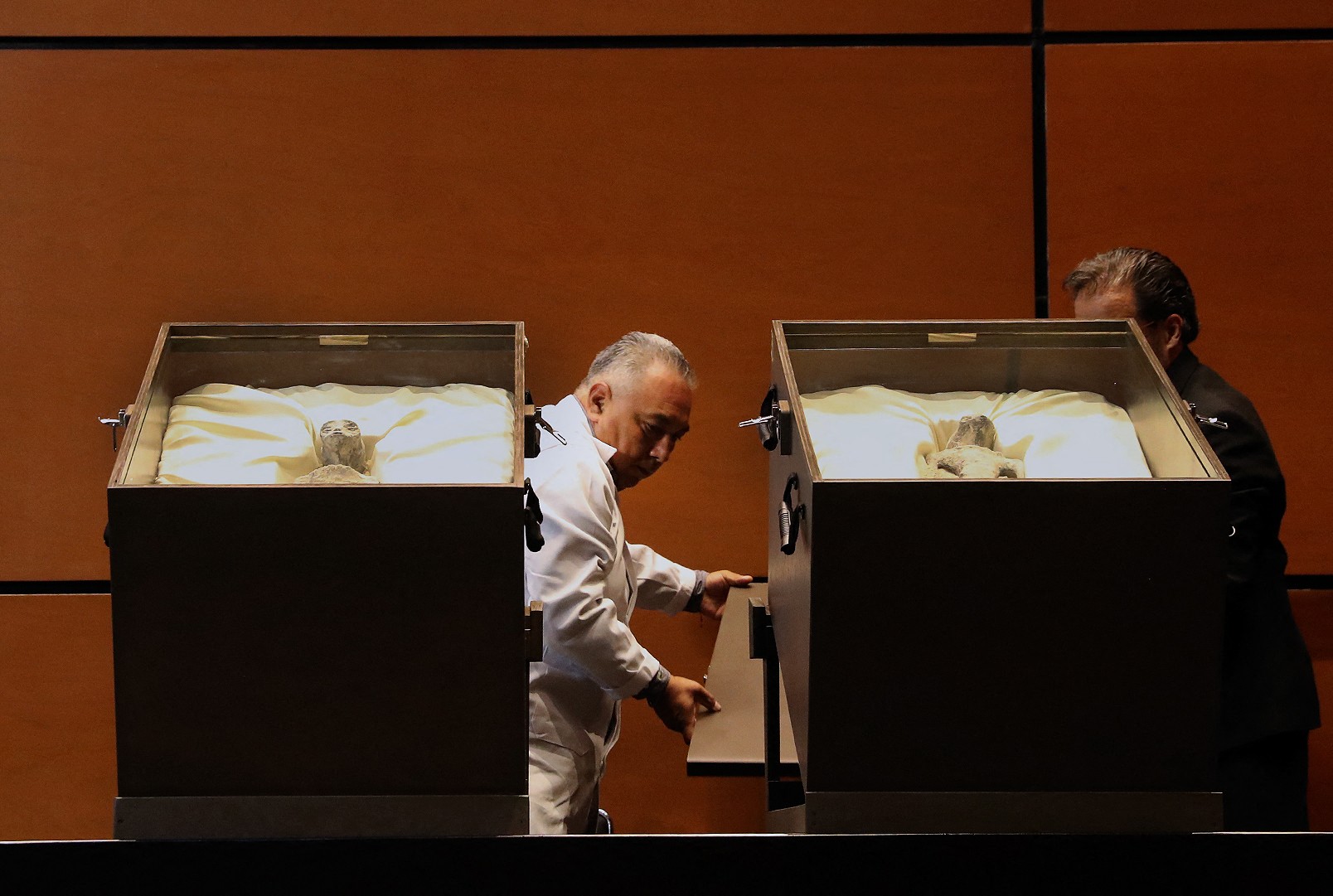
A handout picture released by the press office of the Mexican Congress shows alleged bodies of two "non-human" beings exhibited at the Mexican Congress in Mexico City on September 12, 2023. The alleged bodies of two "non-human" beings were presented during a congressional hearing in Mexico, generating a mixture of surprise, disbelief and ridicule on social media Wednesday. (Photo by Handout / Mexico's Congress / AFP)

MEXICO CITY, Mexico– The alleged bodies of two "non-human beings" were presented during a congressional hearing in Mexico, generating a mixture of surprise, disbelief and ridicule on social media on Wednesday.

The purported mummified remains were exhibited in two small display cases on Tuesday -- the first time the Mexican Congress has officially addressed the issue of possible extraterrestrial life.

The alleged corpses, which had a grayish color and facial features similar to humans, were brought by Jaime Maussan, a controversial Mexican journalist and researcher who reported finding them in Peru in 2017.

"They are non-human beings. We don't want to call them extraterrestrials because we don't know," Maussan said during the session called by ruling party lawmaker Sergio Gutierrez, who defended the event as being in the "public interest."

Maussan cited carbon dating analysis by the National Autonomous University of Mexico that he said showed "these beings are around 1,000 years old."

The university's physics institute confirmed in a statement that it had carried out tests but only to determine the age and not the origin of the specimens.

Its laboratory "distances itself from any subsequent use, interpretation or misrepresentation made with the results it issues," a statement said.

During the hearing, Gutierrez asked the speakers to swear to tell the truth.

He said Maussan requested the session after a US congressional committee in July was told by a former intelligence official that humans were not alone in the universe and American authorities were covering up the evidence.

In May, the US space agency NASA held its first public meeting on the issue, and urged a more rigorous scientific approach to clarify the origin of so-called unidentified anomalous phenomena (UAPs).

The Mexican hearing generated both astonishment and mockery, including jokes accompanied by photos of the alien creature in the movie "E.T."

The event "shows the contempt that this country has for science," one user wrote on the social media platform X, formerly called Twitter.

Others shared videos of the event with the words "The Martians have arrived," while there was a tongue-in-cheek call for Maussan to be named "president of intergalactic relations."

Related Tags

WORLDNEWS
ADVERTISEMENT
.most-popular .layout-ratio{ padding-bottom: 79.13%; } @media (min-width: 768px) and (max-width: 1024px) { .widget-title { font-size: 15px !important; } }

{{ articles_filter_1561_widget.title }}

.most-popular .layout-ratio{ padding-bottom: 79.13%; } @media (min-width: 768px) and (max-width: 1024px) { .widget-title { font-size: 15px !important; } }

{{ articles_filter_1562_widget.title }}

.most-popular .layout-ratio{ padding-bottom: 79.13%; } @media (min-width: 768px) and (max-width: 1024px) { .widget-title { font-size: 15px !important; } }

{{ articles_filter_1563_widget.title }}

{{ articles_filter_1564_widget.title }}

.mb-article-details { position: relative; } .mb-article-details .article-body-preview, .mb-article-details .article-body-summary{ font-size: 17px; line-height: 30px; font-family: "Libre Caslon Text", serif; color: #000; } .mb-article-details .article-body-preview iframe , .mb-article-details .article-body-summary iframe{ width: 100%; margin: auto; } .read-more-background { background: linear-gradient(180deg, color(display-p3 1.000 1.000 1.000 / 0) 13.75%, color(display-p3 1.000 1.000 1.000 / 0.8) 30.79%, color(display-p3 1.000 1.000 1.000) 72.5%); position: absolute; height: 200px; width: 100%; bottom: 0; display: flex; justify-content: center; align-items: center; padding: 0; } .read-more-background a{ color: #000; } .read-more-btn { padding: 17px 45px; font-family: Inter; font-weight: 700; font-size: 18px; line-height: 16px; text-align: center; vertical-align: middle; border: 1px solid black; background-color: white; } .hidden { display: none; }
function initializeAllSwipers() { // Get all hidden inputs with cms_article_id document.querySelectorAll('[id^="cms_article_id_"]').forEach(function (input) { const cmsArticleId = input.value; const articleSelector = '#article-' + cmsArticleId + ' .body_images'; const swiperElement = document.querySelector(articleSelector); if (swiperElement && !swiperElement.classList.contains('swiper-initialized')) { new Swiper(articleSelector, { loop: true, pagination: false, navigation: { nextEl: '#article-' + cmsArticleId + ' .swiper-button-next', prevEl: '#article-' + cmsArticleId + ' .swiper-button-prev', }, }); } }); } setTimeout(initializeAllSwipers, 3000); const intersectionObserver = new IntersectionObserver( (entries) => { entries.forEach((entry) => { if (entry.isIntersecting) { const newUrl = entry.target.getAttribute("data-url"); if (newUrl) { history.pushState(null, null, newUrl); let article = entry.target; // Extract metadata const author = article.querySelector('.author-section').textContent.replace('By', '').trim(); const section = article.querySelector('.section-info ').textContent.replace(' ', ' '); const title = article.querySelector('.article-title h1').textContent; // Parse URL for Chartbeat path format const parsedUrl = new URL(newUrl, window.location.origin); const cleanUrl = parsedUrl.host + parsedUrl.pathname; // Update Chartbeat configuration if (typeof window._sf_async_config !== 'undefined') { window._sf_async_config.path = cleanUrl; window._sf_async_config.sections = section; window._sf_async_config.authors = author; } // Track virtual page view with Chartbeat if (typeof pSUPERFLY !== 'undefined' && typeof pSUPERFLY.virtualPage === 'function') { try { pSUPERFLY.virtualPage({ path: cleanUrl, title: title, sections: section, authors: author }); } catch (error) { console.error('ping error', error); } } // Optional: Update document title if (title && title !== document.title) { document.title = title; } } } }); }, { threshold: 0.1 } ); function showArticleBody(button) { const article = button.closest("article"); const summary = article.querySelector(".article-body-summary"); const body = article.querySelector(".article-body-preview"); const readMoreSection = article.querySelector(".read-more-background"); // Hide summary and read-more section summary.style.display = "none"; readMoreSection.style.display = "none"; // Show the full article body body.classList.remove("hidden"); } document.addEventListener("DOMContentLoaded", () => { let loadCount = 0; // Track how many times articles are loaded const offset = [1, 2, 3, 4, 5, 6, 7, 8, 9, 10]; // Offset values const currentUrl = window.location.pathname.substring(1); let isLoading = false; // Prevent multiple calls if (!currentUrl) { console.log("Current URL is invalid."); return; } const sentinel = document.getElementById("load-more-sentinel"); if (!sentinel) { console.log("Sentinel element not found."); return; } function isSentinelVisible() { const rect = sentinel.getBoundingClientRect(); return ( rect.top < window.innerHeight && rect.bottom >= 0 ); } function onScroll() { if (isLoading) return; if (isSentinelVisible()) { if (loadCount >= offset.length) { console.log("Maximum load attempts reached."); window.removeEventListener("scroll", onScroll); return; } isLoading = true; const currentOffset = offset[loadCount]; window.loadMoreItems().then(() => { let article = document.querySelector('#widget_1690 > div:nth-last-of-type(2) article'); intersectionObserver.observe(article) loadCount++; }).catch(error => { console.error("Error loading more items:", error); }).finally(() => { isLoading = false; }); } } window.addEventListener("scroll", onScroll); });

Sign up by email to receive news.