

ADVERTISEMENT

29 STEM students qualify for DOST's Bangon Marawi program

Published Aug 9, 2023 08:42 am

The Department of Science and Technology – Science Education Institute (DOST-SEI) announced that 29 students have qualified for its Bangon Marawi Program in Science and Technology Human Resource Development (STHRD), a scholarship program for those affected by the armed conflict or were displaced from their communities during the Marawi siege in 2017.
n449a.jpg
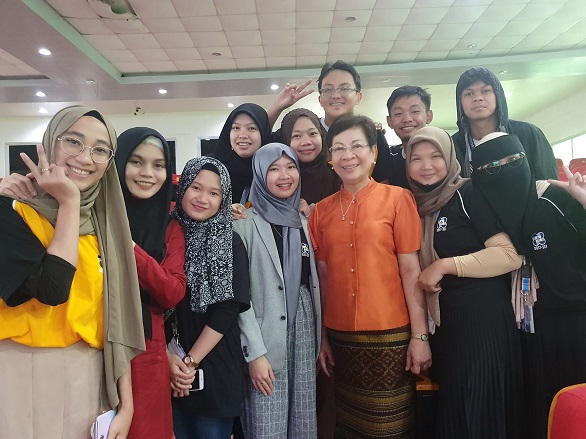
In this file photo of DOST-SEI, Director Josette Biyo welcomes new Bangon Marawi scholars at the scholars’ orientation and contract signing held on January 31, 2023, at the Mindanao State University (MSU)-Marawi Main Campus. (Photo courtesy of DOST-SEI)

DOST-SEI said that the scholarship is for qualified second-year students enrolled in science, technology, engineering, and mathematics (STEM) courses.

In addition, four more potential qualifiers – whose names do not appear on the published list – are also under consideration, pending resubmission of requirements for further evaluation.

A total of 65 students enrolled in priority S&T programs at Mindanao State University-Main Campus (MSU-Main Campus), MSU-Iligan Institute of Technology (MSU-IIT) and MSU-Lanao National College of Arts and Trades (MSU-LNCAT) took the pen-and-paper qualifying examination on March 7, 2023 at the MSU-Main Campus, Marawi City, Lanao del Sur.

With the aim to uplift the hopes of the youth after the Marawi siege, qualifiers who will avail of the grants will enjoy benefits including a monthly stipend of ₱7,000.00, learning materials and/or connectivity allowance of ₱10,000.00 per academic year, among others, starting in the First Semester of Academic Year 2022-2023. Scholars will be able to benefit from the scholarship for a maximum of four years as a retroactive grant.

“I believe that STEM could create solutions to various societal problems we have today, thus, while Bangon Marawi Program is here, I encourage all students to grab the opportunity to pursue significant STEM careers and contribute to reviving Marawi,” DOST-SEI Director Dr. Josette Biyo said.

Upon completion of their degree programs, scholars shall be working in their fields of specialization in the country, ideally in their home regions, for a period equivalent to the length of years in which they enjoyed the scholarship.

The Bangon Marawi Program is one of the Department’s responses to rebuilding the human and social infrastructures of Marawi City after the 2017 siege

Since 2018, the program has provided scholarships for Marawi students enrolled in STEM courses at the undergraduate and graduate levels and has produced 369 graduates with a bachelor’s degree, 14 in the master's program, and four PhD scholar-graduates.

Related Tags

dost-sei scholarship DOST-SEI dost-sei scholars Marawi Marawi siege
ADVERTISEMENT
.most-popular .layout-ratio{ padding-bottom: 79.13%; } @media (min-width: 768px) and (max-width: 1024px) { .widget-title { font-size: 15px !important; } }

{{ articles_filter_1561_widget.title }}

.most-popular .layout-ratio{ padding-bottom: 79.13%; } @media (min-width: 768px) and (max-width: 1024px) { .widget-title { font-size: 15px !important; } }

{{ articles_filter_1562_widget.title }}

.most-popular .layout-ratio{ padding-bottom: 79.13%; } @media (min-width: 768px) and (max-width: 1024px) { .widget-title { font-size: 15px !important; } }

{{ articles_filter_1563_widget.title }}

{{ articles_filter_1564_widget.title }}

.mb-article-details { position: relative; } .mb-article-details .article-body-preview, .mb-article-details .article-body-summary{ font-size: 17px; line-height: 30px; font-family: "Libre Caslon Text", serif; color: #000; } .mb-article-details .article-body-preview iframe , .mb-article-details .article-body-summary iframe{ width: 100%; margin: auto; } .read-more-background { background: linear-gradient(180deg, color(display-p3 1.000 1.000 1.000 / 0) 13.75%, color(display-p3 1.000 1.000 1.000 / 0.8) 30.79%, color(display-p3 1.000 1.000 1.000) 72.5%); position: absolute; height: 200px; width: 100%; bottom: 0; display: flex; justify-content: center; align-items: center; padding: 0; } .read-more-background a{ color: #000; } .read-more-btn { padding: 17px 45px; font-family: Inter; font-weight: 700; font-size: 18px; line-height: 16px; text-align: center; vertical-align: middle; border: 1px solid black; background-color: white; } .hidden { display: none; }
function initializeAllSwipers() { // Get all hidden inputs with cms_article_id document.querySelectorAll('[id^="cms_article_id_"]').forEach(function (input) { const cmsArticleId = input.value; const articleSelector = '#article-' + cmsArticleId + ' .body_images'; const swiperElement = document.querySelector(articleSelector); if (swiperElement && !swiperElement.classList.contains('swiper-initialized')) { new Swiper(articleSelector, { loop: true, pagination: false, navigation: { nextEl: '#article-' + cmsArticleId + ' .swiper-button-next', prevEl: '#article-' + cmsArticleId + ' .swiper-button-prev', }, }); } }); } setTimeout(initializeAllSwipers, 3000); const intersectionObserver = new IntersectionObserver( (entries) => { entries.forEach((entry) => { if (entry.isIntersecting) { const newUrl = entry.target.getAttribute("data-url"); if (newUrl) { history.pushState(null, null, newUrl); let article = entry.target; // Extract metadata const author = article.querySelector('.author-section').textContent.replace('By', '').trim(); const section = article.querySelector('.section-info ').textContent.replace(' ', ' '); const title = article.querySelector('.article-title h1').textContent; // Parse URL for Chartbeat path format const parsedUrl = new URL(newUrl, window.location.origin); const cleanUrl = parsedUrl.host + parsedUrl.pathname; // Update Chartbeat configuration if (typeof window._sf_async_config !== 'undefined') { window._sf_async_config.path = cleanUrl; window._sf_async_config.sections = section; window._sf_async_config.authors = author; } // Track virtual page view with Chartbeat if (typeof pSUPERFLY !== 'undefined' && typeof pSUPERFLY.virtualPage === 'function') { try { pSUPERFLY.virtualPage({ path: cleanUrl, title: title, sections: section, authors: author }); } catch (error) { console.error('ping error', error); } } // Optional: Update document title if (title && title !== document.title) { document.title = title; } } } }); }, { threshold: 0.1 } ); function showArticleBody(button) { const article = button.closest("article"); const summary = article.querySelector(".article-body-summary"); const body = article.querySelector(".article-body-preview"); const readMoreSection = article.querySelector(".read-more-background"); // Hide summary and read-more section summary.style.display = "none"; readMoreSection.style.display = "none"; // Show the full article body body.classList.remove("hidden"); } document.addEventListener("DOMContentLoaded", () => { let loadCount = 0; // Track how many times articles are loaded const offset = [1, 2, 3, 4, 5, 6, 7, 8, 9, 10]; // Offset values const currentUrl = window.location.pathname.substring(1); let isLoading = false; // Prevent multiple calls if (!currentUrl) { console.log("Current URL is invalid."); return; } const sentinel = document.getElementById("load-more-sentinel"); if (!sentinel) { console.log("Sentinel element not found."); return; } function isSentinelVisible() { const rect = sentinel.getBoundingClientRect(); return ( rect.top < window.innerHeight && rect.bottom >= 0 ); } function onScroll() { if (isLoading) return; if (isSentinelVisible()) { if (loadCount >= offset.length) { console.log("Maximum load attempts reached."); window.removeEventListener("scroll", onScroll); return; } isLoading = true; const currentOffset = offset[loadCount]; window.loadMoreItems().then(() => { let article = document.querySelector('#widget_1690 > div:nth-last-of-type(2) article'); intersectionObserver.observe(article) loadCount++; }).catch(error => { console.error("Error loading more items:", error); }).finally(() => { isLoading = false; }); } } window.addEventListener("scroll", onScroll); });

Sign up by email to receive news.