

ADVERTISEMENT

Mayon Volcano lava continues to flow slowly 2 months since its 'heightened' unrest

Published Aug 6, 2023 03:24 am

The “slow” lava effusion from Mayon Volcano continues, two months after its alert status was raised due “heightened magmatic unrest,” the Philippine Institute of Volcanology and Seismology (Phivolcs) said on Sunday, Aug. 6.

Mayon Volcano’s status was upgraded twice in June, first to level 2 (moderate unrest) on June 5 and then to level 3 (high-level unrest) on June 8.

In its monitoring between Saturday, Aug. 5, and Sunday, Aug. 6, Phivolcs observed a continuous “slow effusion of lava from the summit crater of Mayon Volcano,” which continued to feed the existing lava flows on the Bonga, Mi-isi, and Basud gullies on the southeastern, southern, and eastern flanks, respectively.

The distances between the lava flows and the crater have remained at about 3.4 km, 2.8 km, and 600 meters, respectively.
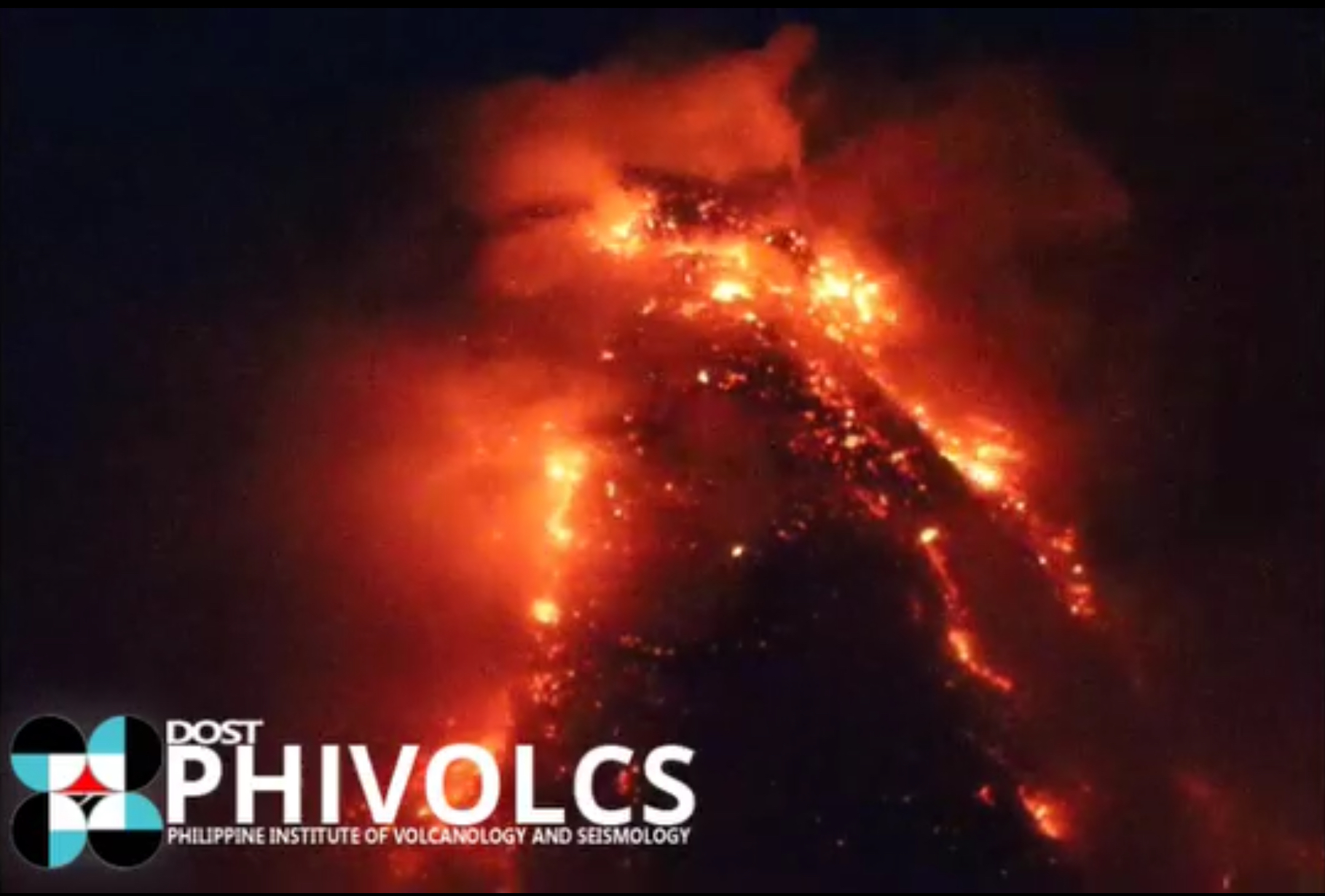
IMG_3111.jpeg

The lava effusion from the summit crater of the Mayon Volcano continued for the eighth consecutive week on July 31, 2023, feeding rockfall and lava flows in the Mi-isi, Bonga, and Basud gullies. (Screengrab from Phivolcs / Facebook)

Moreover, Phivolcs said that rockfall and pyroclastic density currents (PDCs) caused by the summit dome and lava flow margin collapses left debris four kilometers from the crater.

It also observed a “short-lived” lava ejection, which lasted 35 seconds and accompanied by seismic and infrasound signals, at 4:42 a.m. on Sunday.

Phivolcs noted that 185 low-frequency volcanic earthquakes, including 92 tremor events that lasted two to nine minutes, one PDC, and 152 rockfall events were recorded in the past 24 hours.

Alert Level 3

The Mayon Volcano is still on Alert Level 3, which means that a hazardous eruption is still possible within weeks or even days.

Communities near the restive volcano are recommended to maintain increased vigilance against lahars and sediment-laden stream flows along channels draining the volcano edifice, as heavy rainfall could cause channel-confined lahars and sediment-laden stream flows.

Since Mayon Volcano’s status was upgraded in June, Phivolcs strongly advised that entry into the six-kilometer permanent danger zone be strictly prohibited.

Furthermore, it warned that ash fall may occur in areas south of Mayon Volcano due to current wind patterns.

Phivolcs advised pilots to avoid flying near the volcano’s summit because ash from a sudden eruption can be dangerous to aircraft.

Related Tags

Mayon Volcano PHIVOLCS Alert Level 3
ADVERTISEMENT
.most-popular .layout-ratio{ padding-bottom: 79.13%; } @media (min-width: 768px) and (max-width: 1024px) { .widget-title { font-size: 15px !important; } }

{{ articles_filter_1561_widget.title }}

.most-popular .layout-ratio{ padding-bottom: 79.13%; } @media (min-width: 768px) and (max-width: 1024px) { .widget-title { font-size: 15px !important; } }

{{ articles_filter_1562_widget.title }}

.most-popular .layout-ratio{ padding-bottom: 79.13%; } @media (min-width: 768px) and (max-width: 1024px) { .widget-title { font-size: 15px !important; } }

{{ articles_filter_1563_widget.title }}

{{ articles_filter_1564_widget.title }}

.mb-article-details { position: relative; } .mb-article-details .article-body-preview, .mb-article-details .article-body-summary{ font-size: 17px; line-height: 30px; font-family: "Libre Caslon Text", serif; color: #000; } .mb-article-details .article-body-preview iframe , .mb-article-details .article-body-summary iframe{ width: 100%; margin: auto; } .read-more-background { background: linear-gradient(180deg, color(display-p3 1.000 1.000 1.000 / 0) 13.75%, color(display-p3 1.000 1.000 1.000 / 0.8) 30.79%, color(display-p3 1.000 1.000 1.000) 72.5%); position: absolute; height: 200px; width: 100%; bottom: 0; display: flex; justify-content: center; align-items: center; padding: 0; } .read-more-background a{ color: #000; } .read-more-btn { padding: 17px 45px; font-family: Inter; font-weight: 700; font-size: 18px; line-height: 16px; text-align: center; vertical-align: middle; border: 1px solid black; background-color: white; } .hidden { display: none; }
function initializeAllSwipers() { // Get all hidden inputs with cms_article_id document.querySelectorAll('[id^="cms_article_id_"]').forEach(function (input) { const cmsArticleId = input.value; const articleSelector = '#article-' + cmsArticleId + ' .body_images'; const swiperElement = document.querySelector(articleSelector); if (swiperElement && !swiperElement.classList.contains('swiper-initialized')) { new Swiper(articleSelector, { loop: true, pagination: false, navigation: { nextEl: '#article-' + cmsArticleId + ' .swiper-button-next', prevEl: '#article-' + cmsArticleId + ' .swiper-button-prev', }, }); } }); } setTimeout(initializeAllSwipers, 3000); const intersectionObserver = new IntersectionObserver( (entries) => { entries.forEach((entry) => { if (entry.isIntersecting) { const newUrl = entry.target.getAttribute("data-url"); if (newUrl) { history.pushState(null, null, newUrl); let article = entry.target; // Extract metadata const author = article.querySelector('.author-section').textContent.replace('By', '').trim(); const section = article.querySelector('.section-info ').textContent.replace(' ', ' '); const title = article.querySelector('.article-title h1').textContent; // Parse URL for Chartbeat path format const parsedUrl = new URL(newUrl, window.location.origin); const cleanUrl = parsedUrl.host + parsedUrl.pathname; // Update Chartbeat configuration if (typeof window._sf_async_config !== 'undefined') { window._sf_async_config.path = cleanUrl; window._sf_async_config.sections = section; window._sf_async_config.authors = author; } // Track virtual page view with Chartbeat if (typeof pSUPERFLY !== 'undefined' && typeof pSUPERFLY.virtualPage === 'function') { try { pSUPERFLY.virtualPage({ path: cleanUrl, title: title, sections: section, authors: author }); } catch (error) { console.error('ping error', error); } } // Optional: Update document title if (title && title !== document.title) { document.title = title; } } } }); }, { threshold: 0.1 } ); function showArticleBody(button) { const article = button.closest("article"); const summary = article.querySelector(".article-body-summary"); const body = article.querySelector(".article-body-preview"); const readMoreSection = article.querySelector(".read-more-background"); // Hide summary and read-more section summary.style.display = "none"; readMoreSection.style.display = "none"; // Show the full article body body.classList.remove("hidden"); } document.addEventListener("DOMContentLoaded", () => { let loadCount = 0; // Track how many times articles are loaded const offset = [1, 2, 3, 4, 5, 6, 7, 8, 9, 10]; // Offset values const currentUrl = window.location.pathname.substring(1); let isLoading = false; // Prevent multiple calls if (!currentUrl) { console.log("Current URL is invalid."); return; } const sentinel = document.getElementById("load-more-sentinel"); if (!sentinel) { console.log("Sentinel element not found."); return; } function isSentinelVisible() { const rect = sentinel.getBoundingClientRect(); return ( rect.top < window.innerHeight && rect.bottom >= 0 ); } function onScroll() { if (isLoading) return; if (isSentinelVisible()) { if (loadCount >= offset.length) { console.log("Maximum load attempts reached."); window.removeEventListener("scroll", onScroll); return; } isLoading = true; const currentOffset = offset[loadCount]; window.loadMoreItems().then(() => { let article = document.querySelector('#widget_1690 > div:nth-last-of-type(2) article'); intersectionObserver.observe(article) loadCount++; }).catch(error => { console.error("Error loading more items:", error); }).finally(() => { isLoading = false; }); } } window.addEventListener("scroll", onScroll); });

Sign up by email to receive news.