






 Philippines
National
Japan, Australia, EU envoys call out China's actions vs PH supply boats in WPS
Philippines
National
Japan, Australia, EU envoys call out China's actions vs PH supply boats in WPS
Japan, Australia, EU envoys call out China's actions vs PH supply boats in WPS
By Raymund Antonio and Raymund Antonio


China’s recent actions in Ayungin Shoal in the disputed West Philippine Sea (WPS) raised concerns in the international community as the ambassadors of Australia, Japan, and the European Union in the Philippines warned of its “destabilizing” effects on navigational safety.
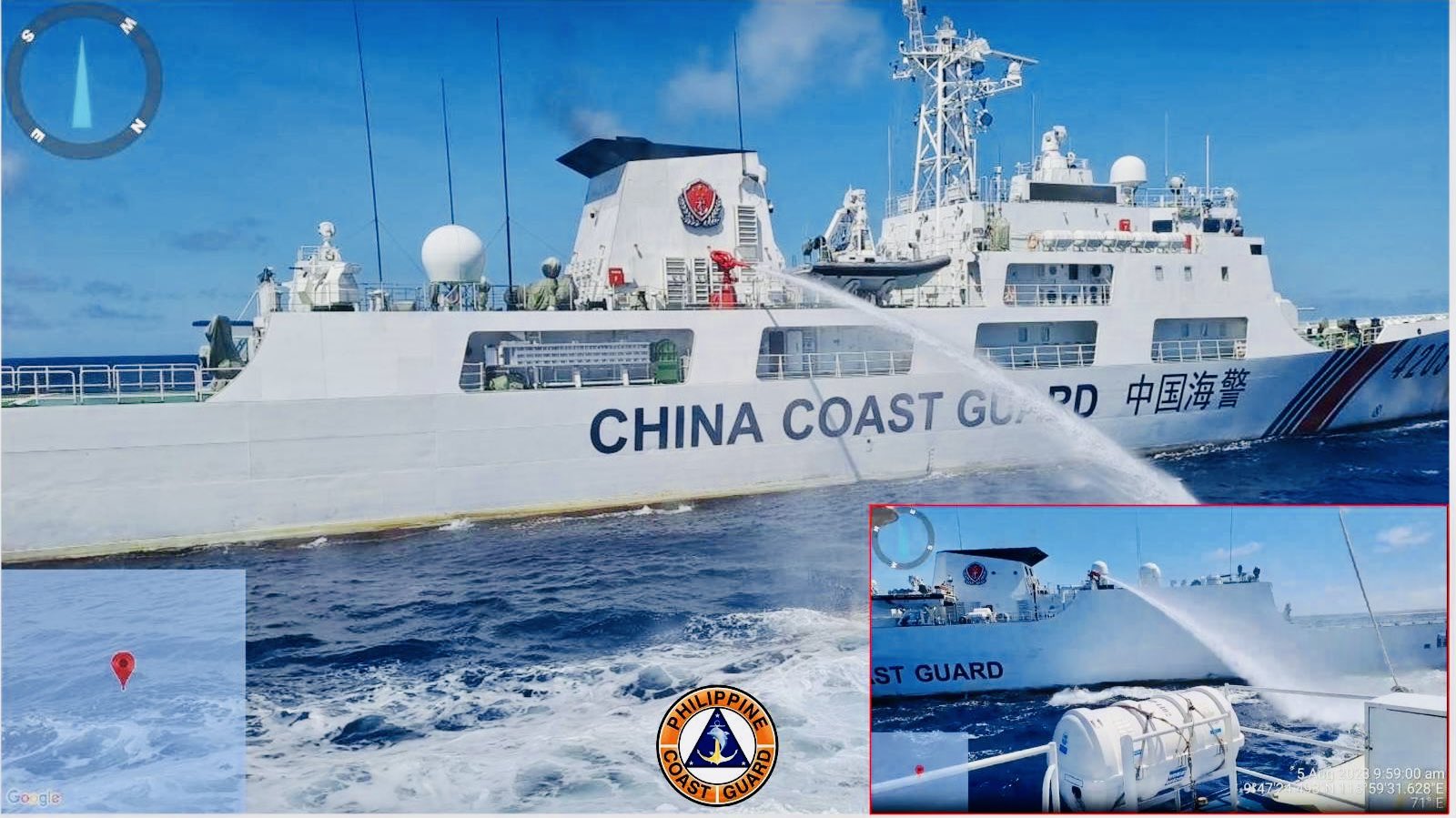 (Photo from the Philippine Coast Guard via Twitter)
Ambassadors Hae Kyong Yu of Australia and Kazuhiko Koshikawa of Japan issued separate statements on Sunday, Aug. 6, after a recent incident, in which the China Coast Guard (CCG) blocked and used water cannons against Philippine chartered supply boats “while en route to Ayungin Shoal for a routine troop rotation and resupply mission” to the BRP Sierra Madre.
“Australia is concerned by the latest actions directed against the Philippines, which are dangerous and destabilizing,” the Australian envoy tweeted.
“We reiterate our call for peace, stability, and respect for UNCLOS in the South China Sea - a vital international waterway,” she added.
UNCLOS is the United Nations Convention on the Law of the Sea.
Reposting a Philippine Coast Guard (PCG) officer’s report on what transpired at the Ayungin Shoal, the envoys of Japan and European Union also expressed support for the Philippines.
“Totally unacceptable: any harassment & actions which infringe on lawful activities of the sea and endanger the navigational safety. We strongly support PH’s position; upholding maritime order based on UNCLOS & 2016 Arbitral Award,” Kazuhiko said.
"Very concerned about dangerous action in South China Sea. EU stands with the Philippines in upholding the rules-based international order," EU Ambassador to the Philippines Luc Veron said in a Twitter post.
"The EU supports the legally binding nature of the 2016 South China Sea arbitration," he added.
The US State Department, in a statement, also criticized what it called China’s “dangerous actions” in the resource-rich South China Sea, and warned China of its defense treaty commitments with the Philippines.
The decades-long dispute between China and other claimants of the maritime areas in South China Sea seemed to have ended after the 2016 Arbitral Tribunal victory that invalidated the basis of Beijing’s claims in the region.
However, China refused to acknowledge the tribunal ruling, insisted on its ownership of the waters, islands, atolls, and features of the region, and repeatedly asked the United States, among other countries, not to interfere in regional matters.