






 Philippines
National
Angara vows to help increase proposed budgets for education, health for 2024
Philippines
National
Angara vows to help increase proposed budgets for education, health for 2024
Angara vows to help increase proposed budgets for education, health for 2024


The Senate Committee on Finance will strive hard to increase the budgets for education and health in the final version of the proposed P5.768-trillion national budget for 2024.
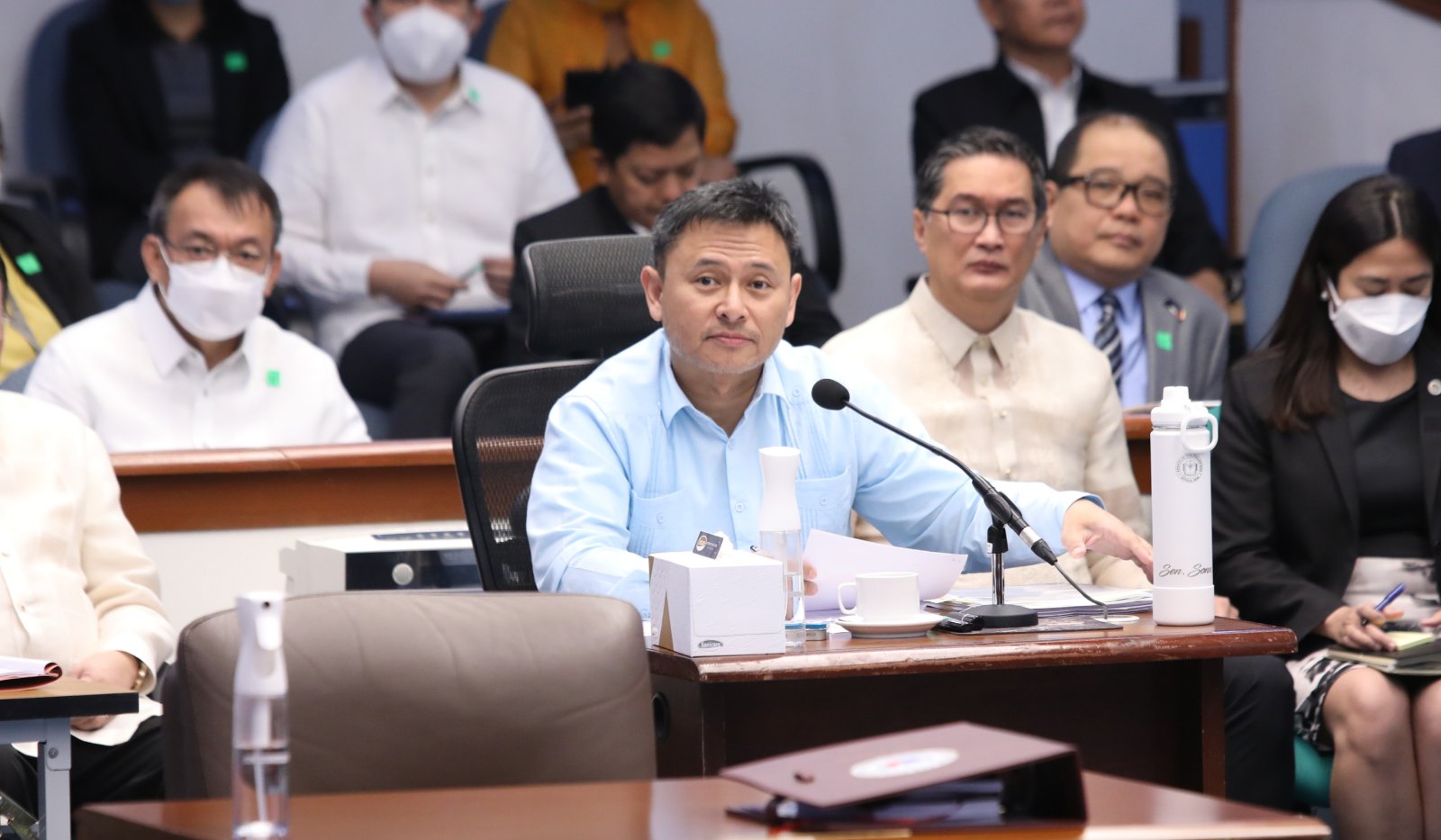
Sen. Sonny Angara, Senate finance committee chairman, during deliberations on the proposed 2023 national budget in the Senate. (Senate PRIB Photo)
Senator Juan Edgardo “Sonny” Angara, chairman of the finance panel, assured Congress has been consistently supporting the education and health sectors over the last four General Appropriations Act (GAA).
Angara said there will definitely be “reductions” from the budgets of some departments, agencies and offices due to removal of non-recurring expenses.
“These include infrastructure projects that are already implemented in the current year so the amounts for these are removed for next year’s budget proposals,” Angara said.
“But these budgets usually go up by the time we have gone through the budget process in the House and Senate,” the senator added.
House Deputy Speaker Ralph Recto had earlier raised the alarm after noting that the allotment for the Department of Health (DOH) for next year has been slashed by some P10-billion.
Under the proposed National Expenditure Program (NEP) for 2024, only P199-billion has been appropriated for the DOH, compared to its P209-billion allocation for this year.
Among the biggest casualties of the lowered DOH budget were the country’s four major specialty centers namely, the Lung Center of the Philippines, National Kidney and Transplant Institute (NKTI), Heart Center of the Philippines and Philippine Children’s Medical Center (PCMC).
Angara noted, however, that under the 2023 GAA, the four specialty hospitals operated by the DOH, plus the Philippine Institute of Traditional and Alternative Health Care, were allocated a total of almost P7-billion. This was an increase of P1.1 billion from the P5.8 billion they received in 2022 and a hike of P2 billion from the P4.9 billion proposed by the Executive branch in the 2023 NEP.
He said the same was true for the budget of the Medical Assistance for Indigent Patients (MAIP), which Congress has consistently increased.
Angara noted that in the 2024 NEP, the MAIP was provided with a proposed budget of P22.3 billion, down from the P32.6-billion under the 2023 GAA.
But during deliberations on the MAIP budget, Angara said the budget for MAIP under the 2023 NEP only contained P22.39 billion, but through the interventions of the members of Congress, the program ended up with the final amount of P32.6-billion.
“The increases in the budgets of the specialty hospitals, the MAIP and the health sector in general would benefit millions of Filipinos, especially the poor, for their medical and health care requirements,” the senator said.
“The budget for MAIP has increased annually from P9.4 billion in 2019 to P10.5 billion in 2020, P17 billion in 2021, P21.4 billion in 2022, and P32.6 billion in 2023. We expect a similar increase in the program in the final version of the 2024 budget,” he further said.
Meanwhile, lawmakers are expected to also work on increasing the budgets of the state universities and colleges (SUCs), including the University of the Philippines (UP) system, which has been consistently happening for three straight years.
“From P73.7 billion in 2020, this went up to P85.9 billion in 2021, P104.17 billion in 2022 and P107 billion in 2023. Similar to the health sector, we also expect increases in the budgets of the SUCs and UP once Congress is done deliberating on the 2024 NEP,” Angara said.
He said any possible reduction in the proposed 2024 budget of the UP system in the NEP “will be rectified and increased by the time December comes and we’ve been through the budgetary process.”