

ADVERTISEMENT

Scam Watch Pilipinas launches #KontraScamAttitude to combat cyber fraud

Four key attitudes to safeguard Filipinos online

Published Aug 23, 2023 08:17 am

At A Glance

  • Scam Watch Pilipinas (#ScamWatchPH) has launched an anti-scam education campaign called #KontraScamAttitude to help educate Filipinos against falling victim to cyber fraud. The campaign is a cybersecurity movement co-founded by Manila Bulletin and Truth360, with formal agreements signed with government agencies like DICT, CICC, NTC, and NPC.
  • The primary mission of Scam Watch Pilipinas is to bridge the cybersecurity knowledge gap among internet users in the Philippines. Jocel de Guzman, the Co-Lead Convenor and Founder and President of Truth360 Inc., emphasized this during a recent Security Conference.
  • De Guzman suggests that nurturing a "cybersecurity culture" in homes is essential. The campaign aims to shift online attitudes, urging individuals to be more vigilant by practicing "cyber hygiene."
  • Scam Watch Pilipinas offers multiple ways to engage with the public. It encourages people to incorporate the #KontraScamAttitude attitudes into their daily digital lives as a first line of defense against scams and to follow their Facebook page for updates and information.

Scam Watch Pilipinas or #ScamWatchPH launched its anti-scam education campaign called #KontraScamAttitude to prevent Filipinos to be victimized by cyber fraud.

#ScamWatchPH Co-Lead Convenor and Founder and President of reputation management firm Truth360 Inc. Jocel de Guzman revealed during the Security Conference (SecuCon) at the SMX recently that the primary role of Scam Watch Pilipinas is to address the cybersecurity knowledge gap among the internet users in the country.

“We need to start nurturing a cybersecurity culture in our homes to address the cybersecurity knowledge gap and the way to do that is to start practicing cyber hygiene in our digital life. The approach of Scam Watch Pilipinas in educating the public is to start with creating awareness on the need for online attitude adjustment to become more vigilant online,” De Guzman added.

#ScamWatchPH released four (4) attitudes needed to prevent netizens from becoming a victim of online scams:
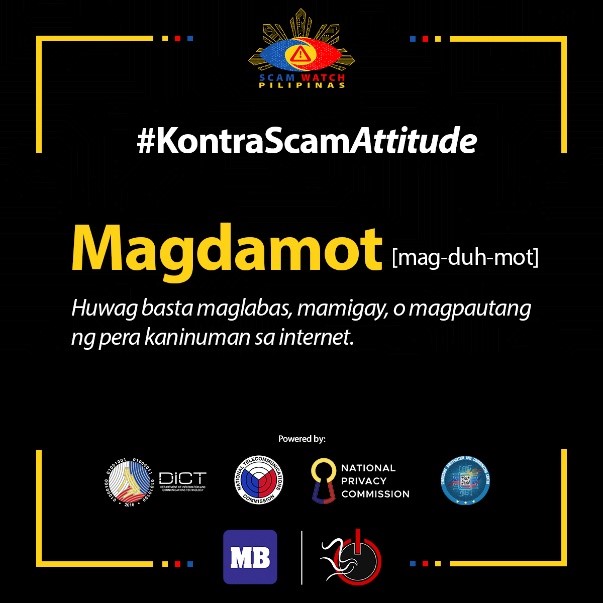
 

magdamot.jpg

MAGDAMOT (Be stingy). Never give or lend money online especially to people you don’t know, or you just met. Majority of messages in emails, SMS or social media that asks for money is a form of scam. The best way not be a victim of fraud is to be stingy online.
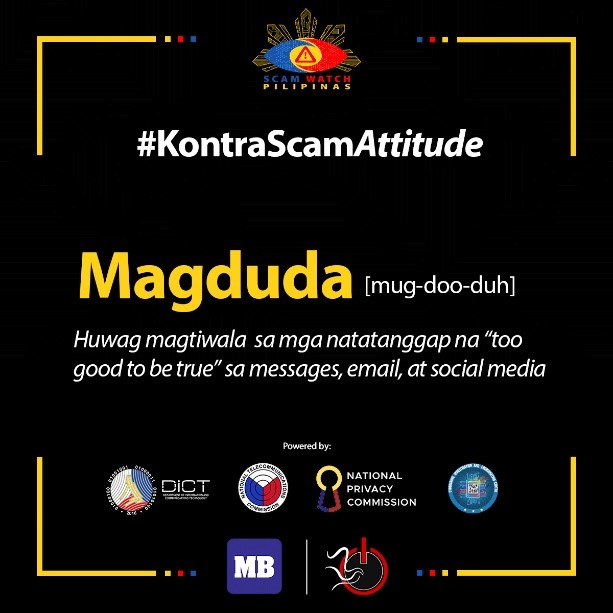
 

magduda.jpg

MAGDUDA (Be suspicious). Always be suspicious and never immediately trust “too good to be true offers” in messages, emails, and social media. Double check and always verify authenticity of the sender before giving out personal information. 

 

mang isnob.jpg

MANG-ISNOB (Be a snob). Ignore messages in SMS, emails and social media with threats or warning coming from banking, financial and e-commerce institutions especially if you know that you have no pending business or transaction with them. Always save the number of you family, friends, colleagues in your address book so you can ignore callers and SMS with unknown numbers.
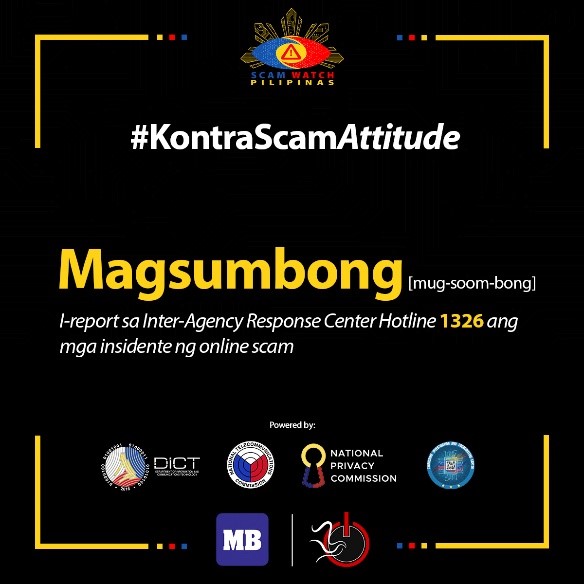
 

magsumbong.jpg

MAGSUMBONG (Report). Always report incidents of scam to the Inter-Agency Response Center (I-ARC) Hotline 1326. dditional I-ARC numbers are also available: 0947-714-7105 (SMART), 0966-976-5971 (Globe), and 0991-481-4225 (DITO). Incorporating each of the #KontraScamAttitude into the daily digital lives of Filipinos can create a formidable first line of defense against scams.

#ScamWatchPH is a cybersecurity movement, which was co-founded by Manila Bulletin and reputation management brand Truth360, intended to educate as many Filipinos as possible against cyber fraud and online scams, ensuring they are armed with the necessary knowledge to safeguard their virtual activities.

Last July 14, #ScamWatchPH signed a covenant with DICT, CICC, NTC and NPC that recognized and institutionalized the cybersecurity movement as the government’s national citizen arm to educate Filipinos with crucial knowledge to defend themselves against online scams while leveraging CICC's tools for preventing and suppressing cybercrimes. For more information and to stay updated on the latest cybersecurity news, follow and like the #ScamWatchPH FB Page at facebook.com/scamwatchpilipinas.

ADVERTISEMENT
.most-popular .layout-ratio{ padding-bottom: 79.13%; } @media (min-width: 768px) and (max-width: 1024px) { .widget-title { font-size: 15px !important; } }

{{ articles_filter_1561_widget.title }}

.most-popular .layout-ratio{ padding-bottom: 79.13%; } @media (min-width: 768px) and (max-width: 1024px) { .widget-title { font-size: 15px !important; } }

{{ static_articles_1562_widget.title }}

.most-popular .layout-ratio{ padding-bottom: 79.13%; } @media (min-width: 768px) and (max-width: 1024px) { .widget-title { font-size: 15px !important; } }

{{ articles_filter_1563_widget.title }}

{{ articles_filter_1564_widget.title }}

.mb-article-details { position: relative; } .mb-article-details .article-body-preview, .mb-article-details .article-body-summary{ font-size: 17px; line-height: 30px; font-family: "Libre Caslon Text", serif; color: #000; } .mb-article-details .article-body-preview iframe , .mb-article-details .article-body-summary iframe{ width: 100%; margin: auto; } .read-more-background { background: linear-gradient(180deg, color(display-p3 1.000 1.000 1.000 / 0) 13.75%, color(display-p3 1.000 1.000 1.000 / 0.8) 30.79%, color(display-p3 1.000 1.000 1.000) 72.5%); position: absolute; height: 200px; width: 100%; bottom: 0; display: flex; justify-content: center; align-items: center; padding: 0; } .read-more-background a{ color: #000; } .read-more-btn { padding: 17px 45px; font-family: Inter; font-weight: 700; font-size: 18px; line-height: 16px; text-align: center; vertical-align: middle; border: 1px solid black; background-color: white; } .hidden { display: none; }
function initializeAllSwipers() { // Get all hidden inputs with cms_article_id document.querySelectorAll('[id^="cms_article_id_"]').forEach(function (input) { const cmsArticleId = input.value; const articleSelector = '#article-' + cmsArticleId + ' .body_images'; const swiperElement = document.querySelector(articleSelector); if (swiperElement && !swiperElement.classList.contains('swiper-initialized')) { new Swiper(articleSelector, { loop: true, pagination: false, navigation: { nextEl: '#article-' + cmsArticleId + ' .swiper-button-next', prevEl: '#article-' + cmsArticleId + ' .swiper-button-prev', }, }); } }); } setTimeout(initializeAllSwipers, 3000); const intersectionObserver = new IntersectionObserver( (entries) => { entries.forEach((entry) => { if (entry.isIntersecting) { const newUrl = entry.target.getAttribute("data-url"); if (newUrl) { history.pushState(null, null, newUrl); let article = entry.target; // Extract metadata const author = article.querySelector('.author-section').textContent.replace('By', '').trim(); const section = article.querySelector('.section-info ').textContent.replace(' ', ' '); const title = article.querySelector('.article-title h1').textContent; // Parse URL for Chartbeat path format const parsedUrl = new URL(newUrl, window.location.origin); const cleanUrl = parsedUrl.host + parsedUrl.pathname; // Update Chartbeat configuration if (typeof window._sf_async_config !== 'undefined') { window._sf_async_config.path = cleanUrl; window._sf_async_config.sections = section; window._sf_async_config.authors = author; } // Track virtual page view with Chartbeat if (typeof pSUPERFLY !== 'undefined' && typeof pSUPERFLY.virtualPage === 'function') { try { pSUPERFLY.virtualPage({ path: cleanUrl, title: title, sections: section, authors: author }); } catch (error) { console.error('ping error', error); } } // Optional: Update document title if (title && title !== document.title) { document.title = title; } } } }); }, { threshold: 0.1 } ); function showArticleBody(button) { const article = button.closest("article"); const summary = article.querySelector(".article-body-summary"); const body = article.querySelector(".article-body-preview"); const readMoreSection = article.querySelector(".read-more-background"); // Hide summary and read-more section summary.style.display = "none"; readMoreSection.style.display = "none"; // Show the full article body body.classList.remove("hidden"); } document.addEventListener("DOMContentLoaded", () => { let loadCount = 0; // Track how many times articles are loaded const offset = [1, 2, 3, 4, 5, 6, 7, 8, 9, 10]; // Offset values const currentUrl = window.location.pathname.substring(1); let isLoading = false; // Prevent multiple calls if (!currentUrl) { console.log("Current URL is invalid."); return; } const sentinel = document.getElementById("load-more-sentinel"); if (!sentinel) { console.log("Sentinel element not found."); return; } function isSentinelVisible() { const rect = sentinel.getBoundingClientRect(); return ( rect.top < window.innerHeight && rect.bottom >= 0 ); } function onScroll() { if (isLoading) return; if (isSentinelVisible()) { if (loadCount >= offset.length) { console.log("Maximum load attempts reached."); window.removeEventListener("scroll", onScroll); return; } isLoading = true; const currentOffset = offset[loadCount]; window.loadMoreItems().then(() => { let article = document.querySelector('#widget_1690 > div:nth-last-of-type(2) article'); intersectionObserver.observe(article) loadCount++; }).catch(error => { console.error("Error loading more items:", error); }).finally(() => { isLoading = false; }); } } window.addEventListener("scroll", onScroll); });

Sign up by email to receive news.