







How optics plays a crucial role in PH's defense of WPS


At A Glance
- There was one key strategy that the Armed Forces of the Philippines (AFP) and Philippine Coast Guard (PCG) did to ensure the success of their follow-up rotation and reprovision (RORE) mission in Ayungin (Second Thomas) Shoal - it was optics or the way how the military and coast guard made public the harrassment of Chinese vessels on Philippine vessels during the previous August 5 resupply operation.
- PCG spokesperson for WPS Commodore Jay Tarriela pointed out that the condemnation from the international community received by China due to their aggressive behavior led to the deployment of fewer vessels to stop the follow up resupply mission.
- AFP spokesperson Col. Medel Aguilar said the sudden change in the behavior of China was a sign that "they probably have learned their lesson."
There was one key strategy that the Armed Forces of the Philippines (AFP) and Philippine Coast Guard (PCG) did to ensure the success of their follow-up rotation and reprovision (RORE) mission in Ayungin (Second Thomas) Shoal, Kalayaan Island Group (Spratly Islands) in the West Philippine Sea (WPS) on Tuesday, August 22.
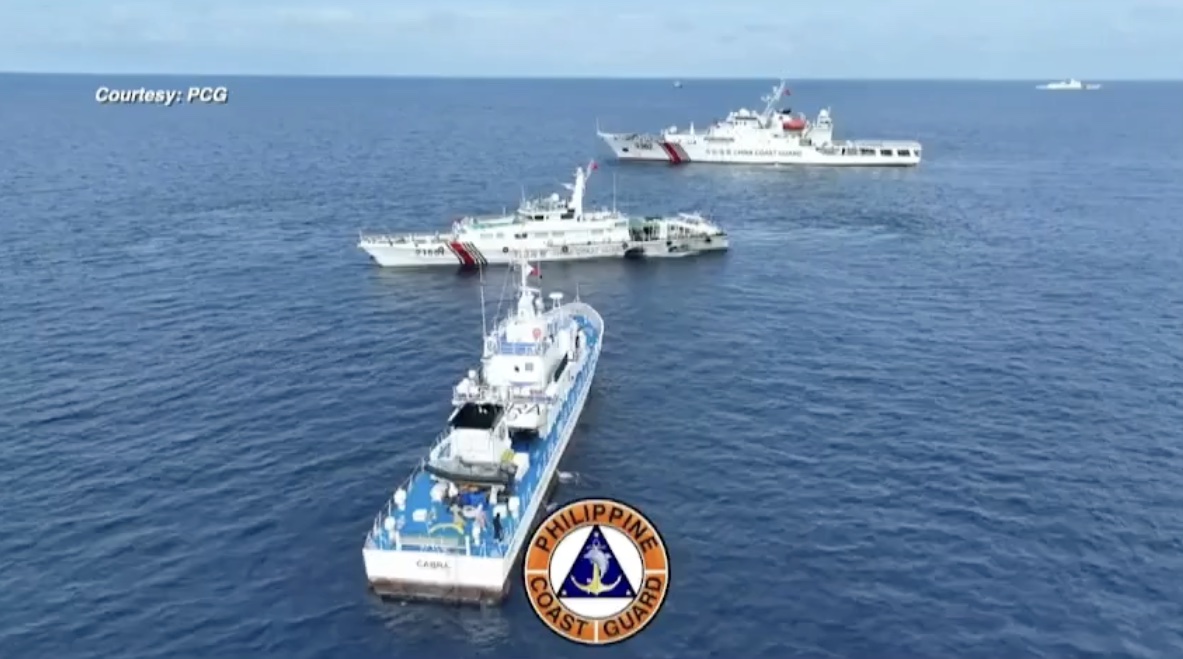
It was optics or the way how the military and coast guard made public the dangerous maneuvers, blockade, and firing of water cannon conducted by the China Coast Guard (CCG), People’s Liberation Army (PLA) Navy, and Chinese maritime militia (CMM) vessels on the civilian supply boats and PCG ships during the previous August 5 resupply operation.
“Because of our approach of being transparent and publicizing the aggressive behavior of China during the previous resupply, this perhaps is the main reason why the Chinese government is no longer allowing the Chinese Coast Guard to use water cannon,” PCG spokesperson for WPS Commodore Jay Tarriela said in a public briefing on Wednesday, August 23.
Tarriela pointed out that the condemnation from the international community received by China due to their aggressive behavior led to the deployment of fewer vessels to stop the follow up resupply mission.
“You can also notice that [during] the last resupply, they deployed six big China Coast Guard vessels but this time they were only deploying four China Coast Guard vessels, two of which are much smaller compared to our ships. I think this has something to do with optics,” he said.
The CCG also did not use water cannon this time, Tarriela confirmed.
AFP Chief General Romeo Brawner Jr. also “shocked” military leaders from the Indo-Pacific region and other allied countries when he presented a video of the water cannon incident during the 25th annual Indo-Pacific Chiefs of Defense (CHODs) in Fiji last week. The presentation was witnessed by General Xu Qiling, deputy chief of staff in the Joint Staff Department of China's Central Military Commission, triggering an exchange of words between the two officials.
AFP spokesperson Col. Medel Aguilar said the sudden change in the behavior of China was a sign that "they probably have learned their lesson.”
“They learned the lesson that violence has no place in this world especially if that violence is founded on something that is not acceptable to international community, and that violence is doing to encroach or to subvert or to shall we say suppress the rightful expression of rights of other countries,” Aguilar said.
What happened during the RORE mission?
During the follow up RORE mission, the PCG deployed 44-meter vessels BRP Cabra and BRP Sindangan to escort the two civilian boats chartered by the AFP to bring food, water, and other supplies to troops onboard the BRP Sierra Madre in Ayungin Shoal.
The BRP Sierra Madre, an active commissioned Philippine Navy vessel, was deliberately ran aground the shoal in 1999 to serve as an AFP outpost in the area and protect the interests of the Philippines over the disputed water.
The CCG deployed 11 CMM vessels and four CCG ships which sailed closely to the supply boats and the PCG ships at approximately 2.5 nautical miles from Ayungin Shoal to block them from entering.
On the other hand, two Philippine Navy vessels were also deployed near the area to monitor the mission.
Wordplay
In a statement, the CCG said they “allowed” the Philippine vessels to enter Ayungin and bring food to the soldiers for humanitarian reasons.
Chinese Ambassador to the Philippines Huang Xilian said that the August 5 mission was interrupted by the CCG since the boats were carrying building materials, hinting that the Philippines was militarizing the shoal.
Both the CCG’s and the Chinese envoy’s claims were disputed by Tarriela.
“First of all, we don’t need permission from the People’s Republic of China. Ayungin Shoal is within our exclusive economic zone. We have the sovereign rights over these waters,” he said, referencing the 2016 arbitral ruling which ruled in favor of the Philippines claims in the WPS and invalidated China’s claims in the South China Sea.
“Second, it’s not also true that they are makatao [humane] or they extended humanitarian assistance to our supply boats. As what I mentioned, our supply boats and Philippine Coast Guard vessels were blocked by China Coast Guard vessels and Chinese maritime militia. It’s not true that they ‘allowed’ us,” he continued.
He also stressed that the CCG and CMMs violated the International Regulations for Preventing Collisions at Sea (COLREGS), a set of rules published by the International Maritime Organization (IMO) in 1972 which prohibits actions that may endanger lives at sea, when they sailed dangerously close to the Philippine vessels.
“Dangerous maneuver is a violence of the COLREGS. The China Coast Guard blocked the Philippine Coast Guard vessels and supply boats from entering Ayungin Shoal,” Tarriela said.
But despite the success of the mission, Tarriela said that the Philippines should still prepare for future resupply operations in Ayungin Shoal as China’s behavior might change.
The only constant thing that the AFP and PCG will have to do for now is to keep being transparent on China's behavior in the WPS while the military and coast guard build its capabilities to defend the country's interests, he said.
“We can always expect for the worst as to what they are going to do. But for the national government, we are not going to be afraid to carry out the resupply operations together with the Armed Forces of the Philippines. The national government will still sustain our efforts in maintaining our presence in the West Philippine Sea,” Tarriela noted.