







PAF holds airdrop exercise with US, Malaysia, Indonesia, Japan


At A Glance
- The Philippine Air Force (PAF) trained with its counterparts from the United States (US), Malaysia, Indonesia, and Japan on low-cost, low-altitude (LCLA) airdrop.
- An LCLA airdrop is a method of delivering supplies from an aircraft.
- The training was one of the flying training exercises (FTX) of the Pacific Airlift Rally 2023 which aims to expand the participants' capability in delivering bundle cargoes for humanitarian assistance and disaster relief (HADR) operations, increase participating air forces' interoperability, and improve logistics capabilities.
The Philippine Air Force (PAF) trained with its counterparts from the United States (US), Malaysia, Indonesia, and Japan on low-cost, low-altitude (LCLA) airdrop as part of the ongoing Pacific Airlift Rally 2023.
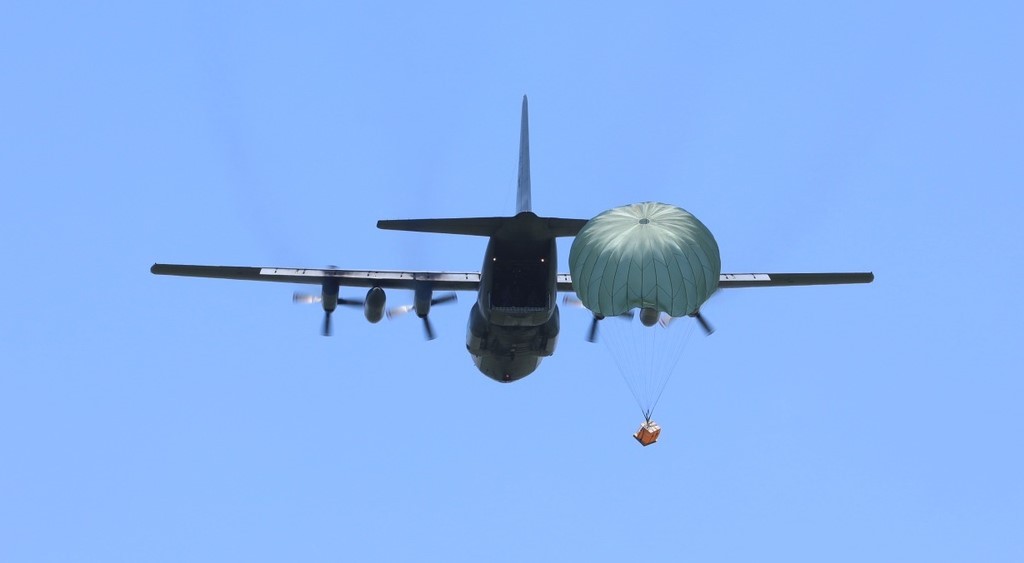
Participants from PAF, United States Air Force (USAF), Royal Malaysian Air Force (RMAF), Tentara Nasional Indonesia Angkatan Udara (TNI-AU), Japan Air Self-Defense Force (JASDF) exchanged best practices during the training held in Sta. Rosa, Laguna on Tuesday, August 15.
PAF spokesperson Col. Ma. Consuelo Castillo said an LCLA airdrop is a method of delivering supplies from an aircraft.
It was one of the flying training exercises (FTX) of the Pacific Airlift Rally 2023 which aims to expand the participants' capability in delivering bundle cargoes for humanitarian assistance and disaster relief (HADR) operations, increase participating air forces' interoperability, and improve logistics capabilities.
Castillo explained that the term “low cost” is used since the pre-packed expendable parachutes being utilized for the airdrop is relatively cheaper while the term “low altitude” refers to the height of the aircraft during the actual drop.
Castillo said dropping from a lower altitude has been proven to be more accurate which is why it is commonly practiced during aerial operations such as HADR and search and rescue (SAR).
“The LCLA serves as an opportunity for the PAF and other international counterparts to share knowledge and expertise on critical airdrop techniques. The exchange of best practices will help contingent air forces to improve their capabilities and be better prepared to respond to natural disasters and other humanitarian emergencies,” Castillo noted.
“For the PAF, this LCLA capability will enable our airlifters to quickly deliver resupply to ground operating troops and provide relief goods to areas inaccessible by land after the onslaught of calamities and disasters,” she added.
The Pacific Airlift Rally is a biennial aerial exercise which embodies cooperation, unity, and shared expertise of the different nations to help keep the Indo-Pacific “a safer and more secure region.”
The 2023 iteration of the exercise kicked off last August 14 with the PAF as its host, and gathering 779 participants from the PAF, Philippine Army (PA), and counterparts from United States, Japan, Indonesia, Malaysia, Bangladesh, Brunei, Canada, Maldives, Mongolia, Nepal, Singapore, Sri Lanka, and Timor Leste.
It will culminate on 18.
Mass casualty, band SMEE
Meanwhile, subject matter expert exchanges (SMEEs) on austere / expeditionary medical casualty and band operations were also conducted by PAF with counterparts from the US Air Force, Indonesian Air Force, and Royal Malaysian Air Force.
The austere / expeditionary medical casualty SMEE brought together medical experts from the four countries as they trained on identifying optimal approaches for establishing a collaborative operational framework to address medical challenges in contested environments with limited resources. The exercise was held at Clark Air Base in Mabalacat City, Pampanga from Aug. 15 to 16.
“A mass casualty simulation exercise was carried out to assess the participants' ability to triage and stabilize patients in a simulated mass casualty scenario, using the skills and knowledge they learned during the academic sessions,” Castillo said.
At Villamor Air Base in Pasay City, the PAF and US Air Force commenced the band SMEE where they trained on band personnel management and band exchanges, band leader conducting techniques, and band operations and management.
Heading the PAF participants were Lt. Col. Emerson Rivera, group commander of the 970th Honor Escort and Ceremonial Group; and First Lt. John Paul Bibon, squadron commander of the 973rd PAF Band Squadron.
The US Air Force band, on the other hand, was led by Lt. Col. Jason Plosch.
“The use of military music on the battlefield has a long and storied history. It has been used by the military around the world for centuries, and it continues to play an important role in modern warfare. Military music is a powerful tool that can be used to motivate, inspire, and coordinate troops,” Castillo explained.
The participating bands will hold rehearsals for a joint performance which will be one of the highlights of the closing ceremony of Pacific Airlift Rally 2023.