

ADVERTISEMENT

No verified AFP info if China has 'tipster' during Ayungin resupply mission but…

Published Aug 15, 2023 09:13 am

At A Glance

  • The Armed Forces of the Philippines (AFP) has no verified information whether or not China received an advance report about the resupply mission to Ayungin (Second Thomas) Shoal last August 5.
  • However, Western Command acting spokesperson Col. Isagani Nato confirmed that the Chinese government has the ability to monitor all the vessels passing through Ayungin Shoal and other parts of the West Philippine Sea using its AIS or automatic identification system, a capability that the Philippines also possesses.
  • The mission was deemed unsuccessful after Chinese coast guard, navy, and maritime militia vessels blocked, performed dangerous maneuvers, and fired water cannon at the Philippine vessels.

The Armed Forces of the Philippines (AFP) has no verified information whether or not China received an advance report about the resupply mission to Ayungin (Second Thomas) Shoal last August 5 which ended up with a cannon attack by the China Coast Guard (CCG) on Philippine vessels.
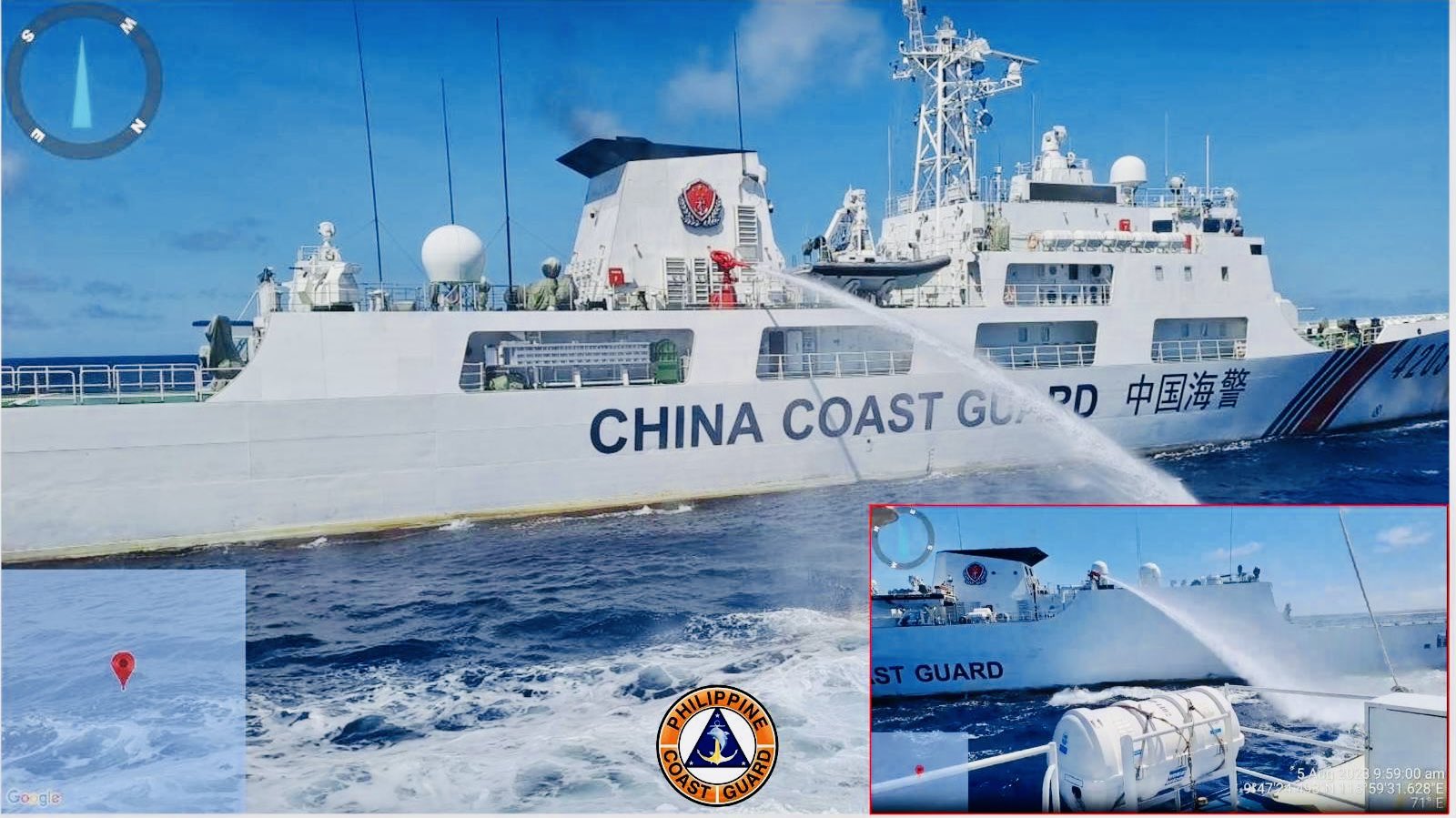
CGS_Ayungin.jpg
A China Coast Guard ship fires a water cannon at a Philippine Coast Guard vessel which is escorting civilian boats while on a resupply mission to Ayungin Shoal on Aug. 5, 2023. (Photo courtesy of PCG)

Col. Isagani Nato, acting spokesperson of the Western Command (WesCom), made the remark on Tuesday, August 15, in reaction to the reported claims of Philippine Coast Guard (PCG) spokesperson for West Philippine Sea (WPS) Commodore Jay Tarriela that China may have been given an advanced intelligence information about the botched mission.

“Lahat naman kasi may effort pagdating sa mga information gathering, ‘yang intelligence so probably may tao rin sila na nagmo-monitor. Pero as of now ay wala pa tayong identified na ganoon eh. Wala pa tayong nakuha na information as of now kung may informant ‘yung Chinese sa ano ha, sa armed forces (Everybody has an effort when it comes to information gathering and intelligence so probably they have personnel who monitors. But as of now, we have not identified anyone. We have not obtained information as of now if the Chinese [government] has an informant, as far as our armed forces is concerned),” Nato said.

However, Nato confirmed that the Chinese government has the ability to monitor all the vessels passing through Ayungin Shoal and other parts of WPS using its AIS or automatic identification system, a capability that the Philippines also possesses.

“May AIS po ‘yung government natin, mayroon din siyempre ‘yung mga Chinese ‘di ba? Capable sila i-monitor ang mga naglalayag papunta doon sa area (Our government has an AIS and the Chinese also has this capability. They are capable to monitor everyone sailing to that area),” Nato said.

Further, the military official said that individuals who are manning the indigenous boat “Uniza Mae 1” and “Uniza Mae 2” to bring supplies to the troops onboard BRP Sierra Madre in Ayungin Shoal are briefed before they proceed with the mission to avoid leakage of any information.

The Palawan-based WesCom is the AFP command responsible for the resupply mission.

“Before every operation o kaya lakad o kung ano man na activities, operations man 'yan o activity, may mga briefings po and ‘yung mga taong ‘yan ay well briefed and informed of the security (Before every operation or activity, there are scheduled briefings for the people involved and they are well briefed and informed of the security),” Nato noted.

Tarriela, in a radio interview on Monday, August 14, reportedly raised the possibility that China may have a tipster or informant about the resupply mission that’s why it managed to station at least six CCG vessels in different parts of the South China Sea a day before the operation.

Two indigenous boats chartered by the AFP and escorted by the PCG were blocked and fired upon by water cannons by Chinese coast guard, navy, and maritime militia vessels while on a resupply mission to Ayungin Shoal last August 5.

The Philippine vessels were supposed to bring food, water, and other supplies to troops onboard BRP Sierra Madre. The incident forced one of the supply boats to return to Palawan while the other boat managed to reach the troops and unload the resources.

Related Tags

Western Command AFP PCG PH-China West Philippine Sea Ayungin Shoal
ADVERTISEMENT
.most-popular .layout-ratio{ padding-bottom: 79.13%; } @media (min-width: 768px) and (max-width: 1024px) { .widget-title { font-size: 15px !important; } }

{{ articles_filter_1561_widget.title }}

.most-popular .layout-ratio{ padding-bottom: 79.13%; } @media (min-width: 768px) and (max-width: 1024px) { .widget-title { font-size: 15px !important; } }

{{ articles_filter_1562_widget.title }}

.most-popular .layout-ratio{ padding-bottom: 79.13%; } @media (min-width: 768px) and (max-width: 1024px) { .widget-title { font-size: 15px !important; } }

{{ articles_filter_1563_widget.title }}

{{ articles_filter_1564_widget.title }}

.mb-article-details { position: relative; } .mb-article-details .article-body-preview, .mb-article-details .article-body-summary{ font-size: 17px; line-height: 30px; font-family: "Libre Caslon Text", serif; color: #000; } .mb-article-details .article-body-preview iframe , .mb-article-details .article-body-summary iframe{ width: 100%; margin: auto; } .read-more-background { background: linear-gradient(180deg, color(display-p3 1.000 1.000 1.000 / 0) 13.75%, color(display-p3 1.000 1.000 1.000 / 0.8) 30.79%, color(display-p3 1.000 1.000 1.000) 72.5%); position: absolute; height: 200px; width: 100%; bottom: 0; display: flex; justify-content: center; align-items: center; padding: 0; } .read-more-background a{ color: #000; } .read-more-btn { padding: 17px 45px; font-family: Inter; font-weight: 700; font-size: 18px; line-height: 16px; text-align: center; vertical-align: middle; border: 1px solid black; background-color: white; } .hidden { display: none; }
function initializeAllSwipers() { // Get all hidden inputs with cms_article_id document.querySelectorAll('[id^="cms_article_id_"]').forEach(function (input) { const cmsArticleId = input.value; const articleSelector = '#article-' + cmsArticleId + ' .body_images'; const swiperElement = document.querySelector(articleSelector); if (swiperElement && !swiperElement.classList.contains('swiper-initialized')) { new Swiper(articleSelector, { loop: true, pagination: false, navigation: { nextEl: '#article-' + cmsArticleId + ' .swiper-button-next', prevEl: '#article-' + cmsArticleId + ' .swiper-button-prev', }, }); } }); } setTimeout(initializeAllSwipers, 3000); const intersectionObserver = new IntersectionObserver( (entries) => { entries.forEach((entry) => { if (entry.isIntersecting) { const newUrl = entry.target.getAttribute("data-url"); if (newUrl) { history.pushState(null, null, newUrl); let article = entry.target; // Extract metadata const author = article.querySelector('.author-section').textContent.replace('By', '').trim(); const section = article.querySelector('.section-info ').textContent.replace(' ', ' '); const title = article.querySelector('.article-title h1').textContent; // Parse URL for Chartbeat path format const parsedUrl = new URL(newUrl, window.location.origin); const cleanUrl = parsedUrl.host + parsedUrl.pathname; // Update Chartbeat configuration if (typeof window._sf_async_config !== 'undefined') { window._sf_async_config.path = cleanUrl; window._sf_async_config.sections = section; window._sf_async_config.authors = author; } // Track virtual page view with Chartbeat if (typeof pSUPERFLY !== 'undefined' && typeof pSUPERFLY.virtualPage === 'function') { try { pSUPERFLY.virtualPage({ path: cleanUrl, title: title, sections: section, authors: author }); } catch (error) { console.error('ping error', error); } } // Optional: Update document title if (title && title !== document.title) { document.title = title; } } } }); }, { threshold: 0.1 } ); function showArticleBody(button) { const article = button.closest("article"); const summary = article.querySelector(".article-body-summary"); const body = article.querySelector(".article-body-preview"); const readMoreSection = article.querySelector(".read-more-background"); // Hide summary and read-more section summary.style.display = "none"; readMoreSection.style.display = "none"; // Show the full article body body.classList.remove("hidden"); } document.addEventListener("DOMContentLoaded", () => { let loadCount = 0; // Track how many times articles are loaded const offset = [1, 2, 3, 4, 5, 6, 7, 8, 9, 10]; // Offset values const currentUrl = window.location.pathname.substring(1); let isLoading = false; // Prevent multiple calls if (!currentUrl) { console.log("Current URL is invalid."); return; } const sentinel = document.getElementById("load-more-sentinel"); if (!sentinel) { console.log("Sentinel element not found."); return; } function isSentinelVisible() { const rect = sentinel.getBoundingClientRect(); return ( rect.top < window.innerHeight && rect.bottom >= 0 ); } function onScroll() { if (isLoading) return; if (isSentinelVisible()) { if (loadCount >= offset.length) { console.log("Maximum load attempts reached."); window.removeEventListener("scroll", onScroll); return; } isLoading = true; const currentOffset = offset[loadCount]; window.loadMoreItems().then(() => { let article = document.querySelector('#widget_1690 > div:nth-last-of-type(2) article'); intersectionObserver.observe(article) loadCount++; }).catch(error => { console.error("Error loading more items:", error); }).finally(() => { isLoading = false; }); } } window.addEventListener("scroll", onScroll); });

Sign up by email to receive news.