






 Philippines
National
Mayon volcanic tremors accompanied by rumbling sounds recorded in past 24 hours — Phivolcs
Philippines
National
Mayon volcanic tremors accompanied by rumbling sounds recorded in past 24 hours — Phivolcs
Mayon volcanic tremors accompanied by rumbling sounds recorded in past 24 hours — Phivolcs


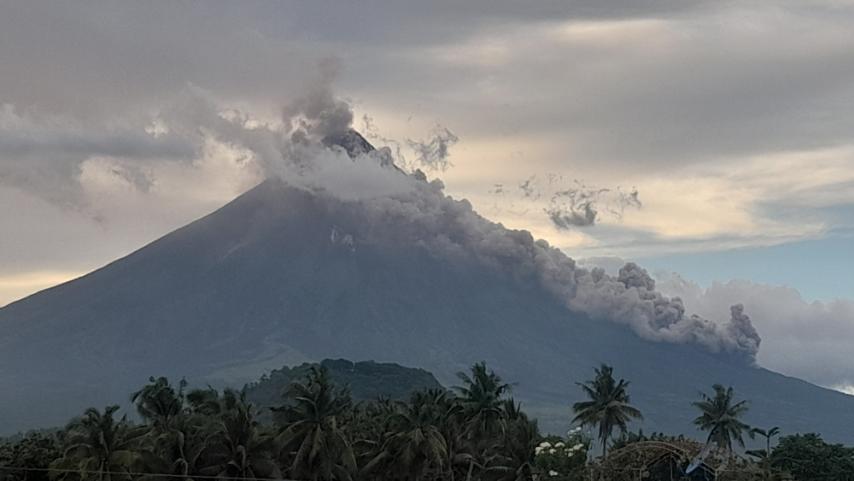
The detection of tremor events accompanied by rumbling sounds during the previous 24-hour monitoring of the Mayon Volcano indicates that it is still in a state of heightened unrest.
Between Thursday, Aug. 10 and Friday, Aug. 11, the Philippine Institute of Volcanology and Seismology (Phivolcs) recorded 106 tremor events that lasted five to 15 minutes.
“Some of these tremors were accompanied by rumbling sounds audible within the seven-kilometer radius from the crater of Mayon,” Phivolcs said.
Sixty-two low-frequency volcanic earthquakes, including four ashing events, were also detected.
Lava effusion continues
Phivolcs said the slow effusion of lava from the summit crater of Mayon has continued to feed the established lava flows on the Bonga, Mi-isi, and Basud gullies on the southeastern, southern, and eastern flanks of the volcano.
The distances between the lava flows and the crater have remained at about 3.4 kilometers (km), 2.8 km, and 1 km from the crater, respectively.
Moreover, Phivolcs said that rockfall and pyroclastic density currents (PDCs) caused by the summit dome and lava flow margin collapses left debris four kilometers from the crater.
Phivolcs noted that 180 rockfall events and three PDCs were recorded in the past 24 hours.
Alert Level 3
Phivolcs said the Mayon Volcano is still on Alert Level 3, which means that a hazardous eruption is still possible within weeks or even days.
Communities near the restive volcano are recommended to maintain increased vigilance against lahars and sediment-laden stream flows along channels draining the volcano edifice, as heavy rainfall could cause channel-confined lahars and sediment-laden stream flows.
Since Mayon Volcano’s status was upgraded in June, Phivolcs strongly advised that entry into the six-kilometer permanent danger zone be strictly prohibited.
Furthermore, it warned that ash fall may occur in areas south of Mayon Volcano due to current wind patterns.
Phivolcs advised pilots to avoid flying near the volcano’s summit because ash from a sudden eruption can be dangerous to aircraft.