

ADVERTISEMENT

China tensions rising, US revives WWII-era Pacific airfield

Published Dec 30, 2023 02:57 pm

WASHINGTON, United States - In the middle of the Pacific ocean, an abandoned US airfield once key to dropping the nuclear bomb on Japan -- and nearly lost to history amid encroaching forest -- is being revived.
349223R-Preview.jpg
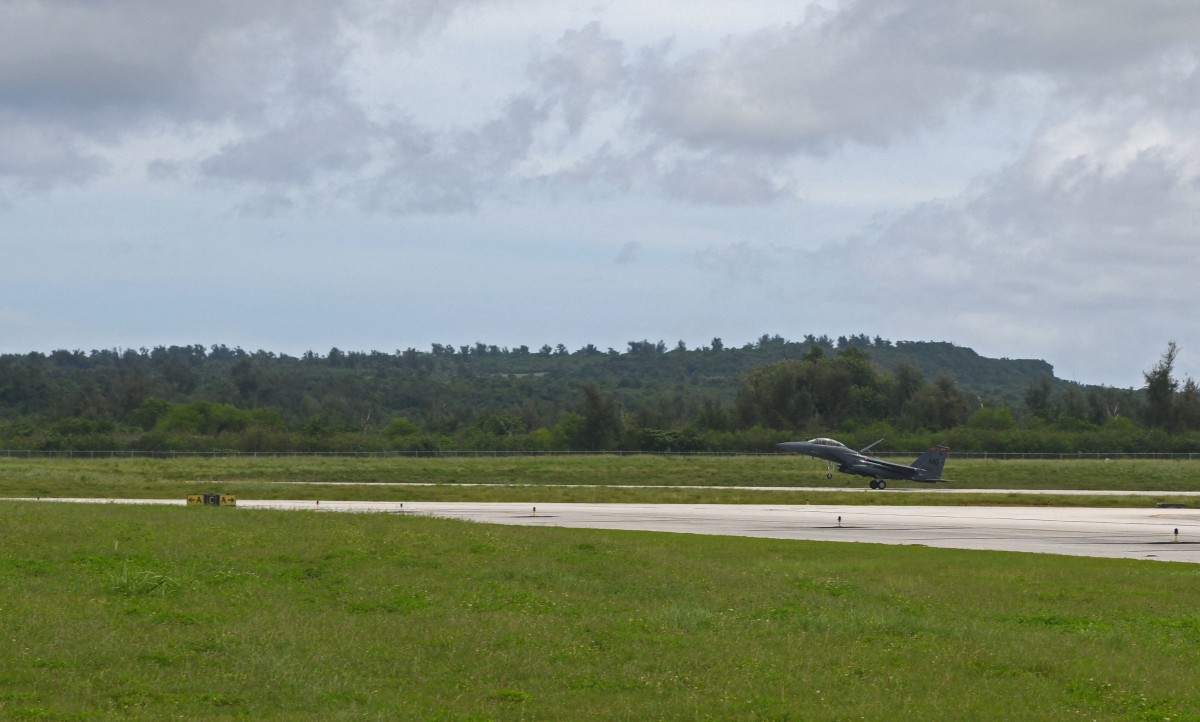
This US Air Force handout image shows an F-15E Strike Eagle from Mountain Home Air Force Base, Idaho, landing on the runway at the Tinian International Airport, Tinian, July 27, 2021. In the middle of the Pacific ocean, an abandoned US airfield once key to dropping the nuclear bomb on Japan -- and nearly lost to history amid encroaching forest -- is being revived. But as the Americans hack away at the jungle overgrowth at Tinian island airfield and other old, World War II-era bases across the region, it won't be with Japan on their mind. Rather, it's Beijing's growing influence in the Pacific that is spurring the recovery of a slew of abandoned runways on the 40 square-mile speck of land that makes up Tinian, part of the US overseas territory of the Northern Mariana Islands. "Rehabilitation of World War II-era airfields has provided Pacific Air Forces (PACAF) a rapidly executable avenue to enhance infrastructure in the region," a spokesperson told AFP.
(Photo by Benjamin SUTTON / US AIR FORCE / AFP)

But as the Americans hack away at the jungle overgrowth at Tinian island airfield and other old, World War II-era bases across the region, it won't be with Japan on their mind.

Rather, it's Beijing's growing influence in the Pacific that is spurring the recovery of a slew of abandoned runways on the 40 square-mile (100 square-kilometer) speck of land that makes up Tinian, part of the US territory of the Northern Mariana Islands.

"Rehabilitation of World War II-era airfields has provided Pacific Air Forces (PACAF) a rapidly executable avenue to enhance infrastructure in the region," a spokesperson told AFP.

Though the statement mentioned a "sense of urgency" enabling PACAF to "enhance... warfighting capability and improve deterrent posture alongside Allies and partners," it did not mention China directly.

But Washington's plans for what officials have described as "an extensive" facility on Tinian comes amid a serious military pivot to the Pacific in recent years -- and as China builds its own new bases in the region, including in disputed waters.

"The most comprehensive and serious challenge to US national security is the (People's Republic of China's) coercive and increasingly aggressive endeavor to refashion the Indo-Pacific region and the international system to suit its interests and authoritarian preferences," the Department of Defense's 2022 planning document, called the National Defense Strategy, reads.

Tinian's old military airfield "has extensive pavement underneath the overgrown jungle. We'll be clearing that jungle out between now and summertime," Air Force General Kenneth Wilsbach recently told Japanese outlet Nikkei Asia.

Meanwhile, military projects for "fuel and airfield development" at the island's nearby civilian airport are already underway, according to the PACAF spokesman.

- Back to the future -

If little known now, the airfield at Tinian was perhaps the most important -- and the busiest -- in the world in 1945, as its six hastily built runways played host to US B-29 bombers carrying out missions against Japan, some 1,500 miles (2,300 kilometers) away.

Including, on August 6 and August 9 of that year, the planes that dropped nuclear bombs on Hiroshima and Nagasaki.

"Little Boy" and "Fat Man," as the weapons were known, killed some 200,000 people.

In the last three years, money annually allocated to Indo-Pacific military construction costs has doubled, from $1.8 billion in 2020 to just shy of $3.6 billion in 2023, according to a recent report from the Congressional Research Service (CRS).

It's part of a Pentagon strategy to open a range of flexible military bases, able to operate outside of the larger, longstanding installations in Japan, South Korea and the American island territory of Guam.

On Tinian, initial work started near the civilian airport in February 2022, before extending toward the World War II airfield on the north of the island.

Within two years, tarmac rehabilitation and the construction of fuel tanks are set to be completed, at a budget of at least $162 million, part of contingency plans in the event "access to Andersen Air Force Base or other western Pacific locations is limited or denied," according to Air Force financial documents reviewed by AFP.

Across multiple projects at Tinian, the total cost is unclear, "due to differing timelines and requirements, and the fact that not all work is being executed by the US Air Force," the PACAF spokesperson said.

- No 'super bases' -
Tinian isn't the only World War II-era base being revamped: new defense appropriations also include money for construction at Basa Air Base in the Philippines, "along with ongoing projects" at the Royal Australian Air Force's Darwin and Tindal bases, according to the PACAF spokesperson.

"A lot of our strategy there is taking many of the World War II airfields that frankly are overgrown by the jungle, and there's still concrete or asphalt underneath," Wilsbach said in a September speech.

"We're not making super bases anywhere. We're looking for a place to get some fuel and some weapons, maybe get a bite to eat and take a nap and then get airborne again."

Satellite images already show the extent of the work underway, including a new tarmac built just north of the civilian airport.

Not far off, satellite images show other military developments -- from China, which has created artificial islets among the diplomatically contested Spratly Islands, used to host its own air bases.

Related Tags

WORLDNEWS
ADVERTISEMENT
.most-popular .layout-ratio{ padding-bottom: 79.13%; } @media (min-width: 768px) and (max-width: 1024px) { .widget-title { font-size: 15px !important; } }

{{ articles_filter_1561_widget.title }}

.most-popular .layout-ratio{ padding-bottom: 79.13%; } @media (min-width: 768px) and (max-width: 1024px) { .widget-title { font-size: 15px !important; } }

{{ articles_filter_1562_widget.title }}

.most-popular .layout-ratio{ padding-bottom: 79.13%; } @media (min-width: 768px) and (max-width: 1024px) { .widget-title { font-size: 15px !important; } }

{{ articles_filter_1563_widget.title }}

{{ articles_filter_1564_widget.title }}

.mb-article-details { position: relative; } .mb-article-details .article-body-preview, .mb-article-details .article-body-summary{ font-size: 17px; line-height: 30px; font-family: "Libre Caslon Text", serif; color: #000; } .mb-article-details .article-body-preview iframe , .mb-article-details .article-body-summary iframe{ width: 100%; margin: auto; } .read-more-background { background: linear-gradient(180deg, color(display-p3 1.000 1.000 1.000 / 0) 13.75%, color(display-p3 1.000 1.000 1.000 / 0.8) 30.79%, color(display-p3 1.000 1.000 1.000) 72.5%); position: absolute; height: 200px; width: 100%; bottom: 0; display: flex; justify-content: center; align-items: center; padding: 0; } .read-more-background a{ color: #000; } .read-more-btn { padding: 17px 45px; font-family: Inter; font-weight: 700; font-size: 18px; line-height: 16px; text-align: center; vertical-align: middle; border: 1px solid black; background-color: white; } .hidden { display: none; }
function initializeAllSwipers() { // Get all hidden inputs with cms_article_id document.querySelectorAll('[id^="cms_article_id_"]').forEach(function (input) { const cmsArticleId = input.value; const articleSelector = '#article-' + cmsArticleId + ' .body_images'; const swiperElement = document.querySelector(articleSelector); if (swiperElement && !swiperElement.classList.contains('swiper-initialized')) { new Swiper(articleSelector, { loop: true, pagination: false, navigation: { nextEl: '#article-' + cmsArticleId + ' .swiper-button-next', prevEl: '#article-' + cmsArticleId + ' .swiper-button-prev', }, }); } }); } setTimeout(initializeAllSwipers, 3000); const intersectionObserver = new IntersectionObserver( (entries) => { entries.forEach((entry) => { if (entry.isIntersecting) { const newUrl = entry.target.getAttribute("data-url"); if (newUrl) { history.pushState(null, null, newUrl); let article = entry.target; // Extract metadata const author = article.querySelector('.author-section').textContent.replace('By', '').trim(); const section = article.querySelector('.section-info ').textContent.replace(' ', ' '); const title = article.querySelector('.article-title h1').textContent; // Parse URL for Chartbeat path format const parsedUrl = new URL(newUrl, window.location.origin); const cleanUrl = parsedUrl.host + parsedUrl.pathname; // Update Chartbeat configuration if (typeof window._sf_async_config !== 'undefined') { window._sf_async_config.path = cleanUrl; window._sf_async_config.sections = section; window._sf_async_config.authors = author; } // Track virtual page view with Chartbeat if (typeof pSUPERFLY !== 'undefined' && typeof pSUPERFLY.virtualPage === 'function') { try { pSUPERFLY.virtualPage({ path: cleanUrl, title: title, sections: section, authors: author }); } catch (error) { console.error('ping error', error); } } // Optional: Update document title if (title && title !== document.title) { document.title = title; } } } }); }, { threshold: 0.1 } ); function showArticleBody(button) { const article = button.closest("article"); const summary = article.querySelector(".article-body-summary"); const body = article.querySelector(".article-body-preview"); const readMoreSection = article.querySelector(".read-more-background"); // Hide summary and read-more section summary.style.display = "none"; readMoreSection.style.display = "none"; // Show the full article body body.classList.remove("hidden"); } document.addEventListener("DOMContentLoaded", () => { let loadCount = 0; // Track how many times articles are loaded const offset = [1, 2, 3, 4, 5, 6, 7, 8, 9, 10]; // Offset values const currentUrl = window.location.pathname.substring(1); let isLoading = false; // Prevent multiple calls if (!currentUrl) { console.log("Current URL is invalid."); return; } const sentinel = document.getElementById("load-more-sentinel"); if (!sentinel) { console.log("Sentinel element not found."); return; } function isSentinelVisible() { const rect = sentinel.getBoundingClientRect(); return ( rect.top < window.innerHeight && rect.bottom >= 0 ); } function onScroll() { if (isLoading) return; if (isSentinelVisible()) { if (loadCount >= offset.length) { console.log("Maximum load attempts reached."); window.removeEventListener("scroll", onScroll); return; } isLoading = true; const currentOffset = offset[loadCount]; window.loadMoreItems().then(() => { let article = document.querySelector('#widget_1690 > div:nth-last-of-type(2) article'); intersectionObserver.observe(article) loadCount++; }).catch(error => { console.error("Error loading more items:", error); }).finally(() => { isLoading = false; }); } } window.addEventListener("scroll", onScroll); });

Sign up by email to receive news.