






 Philippines
National
58% of Filipinos support Marcos admin's territorial policies in West PH Sea
Philippines
National
58% of Filipinos support Marcos admin's territorial policies in West PH Sea
58% of Filipinos support Marcos admin's territorial policies in West PH Sea


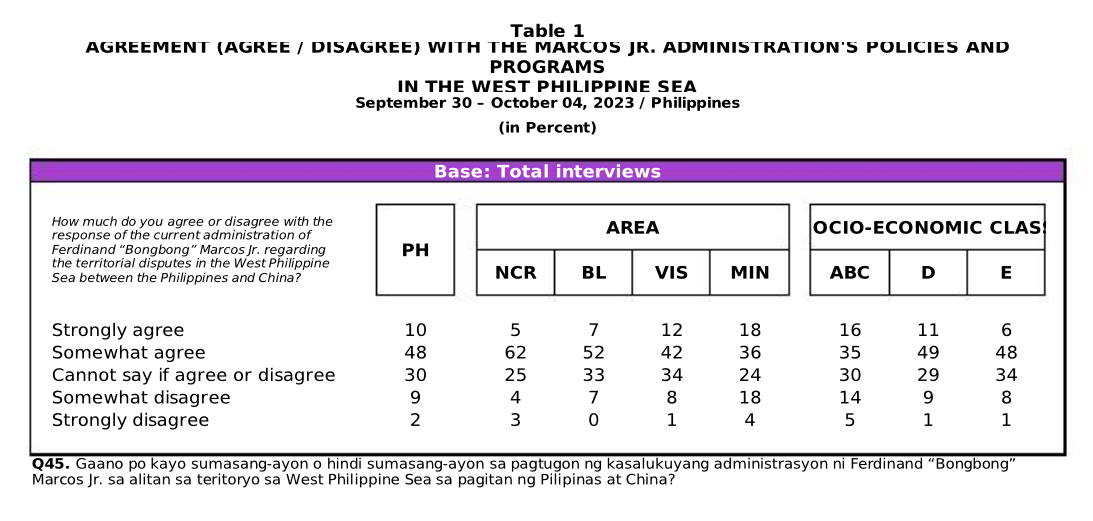
An OCTA Research survey revealed that majority of adult Filipinos are in support of the Marcos administration’s policies and programs to address territorial disputes between the Philippines and China in the West Philippine Sea.
The Third Quarter 2023 “Tugon ng Masa” (TNM) survey conducted from Sept. 30 to Oct. 4 with 1,200 respondents found that 58 percent of adult Filipinos support Marcos Jr.'s policies and programs in the West Philippine Sea in the third quarter of 2023.
“This represents a significant 15-point increase from the 43 percent recorded in the second quarter TNM survey conducted in July 2023,” OCTA said in its report released on Thursday, Dec. 28.
It noted that the agreement rating ranged from 54 percent to 67 percent across various major areas, and from 51 percent to 60 percent across socio-economic classes.
Metro Manila had the highest level of agreement (67 percent), while Visayas and Mindanao had the lowest (54 percent).
Meanwhile, it received the highest agreement ratings (60 percent) from Filipinos in Class D and the lowest agreement ratings (51 percent) from Filipinos in Class ABC.
OCTA also pointed out that agreement with the Marcos administration's policies and programs in the West Philippine Sea ranged from 2 percent to 89 percent across regions.
Bicol region received the highest agreement rating of 89 percent, while Cagayan Valley had the lowest agreement rating of 2 percent.
OCTA said Northern Mindanao had the highest level of “dissatisfaction” with the Marcos Jr. administration's policies and programs in the West Philippine Sea (41 percent), while Cagayan Valley had the highest percentage of “ambivalent” views on the current government’s policies and programs (98 percent).
Filipinos aged 75 and above most supportive of Marcos admin’s WPS policies
In terms of age group, agreement with the Marcos administration's West Philippine Sea policies and programs ranged from 51 percent to 65 percent.
Adult Filipinos aged 75 and up had the highest agreement rating (65 percent), while adult Filipinos aged 18 to 24 had the lowest agreement rating (51 percent).
In terms of age groups, those aged 18 to 24 (15 percent) and 75 and older (15 percent) are most dissatisfied with the administration's policies and programs in the West Philippine Sea, while those aged 45 to 54 had the highest percentage of ambivalent views on the government’s policies and programs (35 percent), followed closely by those aged 65 to 74 (34 percent), 25 to 34 (25 percent), and 25 to 34 (25 percent).
Most Filipinos favor diplomacy, military action to assert territorial rights
OCTA also found a “significant majority” of Filipinos favoring a dual approach of “diplomacy and military action” in asserting territorial rights in the West Philippine Sea.
Seventy percent of Filipinos prefer asserting the country's territorial rights through diplomacy and other peaceful means, while 65 percent prefer asserting territorial rights through military action, defined as “expanded naval patrols and troop presence in the West Philippine Sea.”
Other measures mentioned in the survey were modernizing and strengthening the country’s military capability to protect the territories (62 percent); conducting joint maritime patrol and exercises with ally countries (42 percent); expanding diplomatic efforts with the countries within and outside of the region to reduce tension in the area (42 percent), and shelving disputes for joint economic development of the area (17 percent).
“It must be noted that the top three priority measures, as ranked by respondents, remained the same when compared to the data from the TNM survey in the second quarter 2023 conducted last July 2023,” OCTA said.
Across socio-economic classes, adult Filipinos in Classes ABC (72 percent) and D (71 percent), prefer further asserting the Philippines' territorial rights through diplomacy and other peaceful means for the West Philippine Sea conflict.
Filipinos in Class E (70 percent) also prefer the Philippines' territorial rights to be further asserted through military action.