







PAGASA expects either zero or one tropical cyclone in January


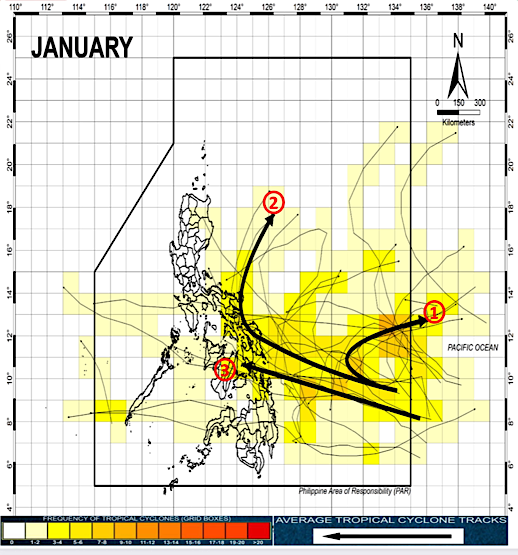
The likelihood of a tropical cyclone forming inside or entering the Philippine area of responsibility (PAR) in January is slim, based on the climate outlook of the Philippine Atmospheric, Geophysical and Astronomical Services Administration (PAGASA).
PAGASA said that, with either zero or one tropical cyclone that may enter or form within the PAR in January, “there is a fewer/lesser chance of tropical cyclone formation during this month.”
Climatological tracks for the month suggest three most common tracks: a tropical cyclone will form within the PAR but recurve but will not make landfall; a tropical cyclone will form within PAR and make landfall in Eastern Visayas, then will recurve toward the northern part of PAR before dissipating; and a tropical cyclone in that formed in the Western Pacific will enter the PAR and make landfall in central Philippines before dissipating.
The month’s climatological tracks indicate three likely scenarios: a tropical cyclone that forms in the Western Pacific will enter the PAR, making landfall in the central Philippines before dissipating; a tropical cyclone that forms in the PAR will “recurve” but not make landfall; or a tropical cyclone that forms in the PAR will make landfall in Eastern Visayas before recurving toward the northern part of the PAR before dissipating.
According to the PAGASA’s rainfall forecast for the period of January through April 2024, most of the country could experience “generally way below to below-normal rainfall conditions,” with a “higher probability for below-normal” rainfall in most areas.
Meanwhile, PAGASA said the current “strong” El Niño event is expected to continue through December 2023-January 2024 period.
PAGASA projected that El Niño will likely persist until the March–May 2024 season before transitioning to an El Niño Southern Oscillation (ENSO)-neutral state, indicating that there will be neither an El Niño nor a La Niña in the April–June 2024 season, based on the global climate models.
El Niño increases the likelihood of below-normal rainfall conditions, which could have negative consequences, such as dry spells and droughts, in some areas of the country in the fourth quarter of 2023 and into the first quarter of 2024.
This may have a negative impact on climate-sensitive sectors, such as water resources, agriculture, energy, health, public safety, and other critical sectors in the country.
However, PAGASA pointed out that while stronger El Niño events increase the likelihood of El Niño-related climate anomalies, they do not always result in strong impacts or manifest in all places.