ADVERTISEMENT

Ukrainians move Christmas to Dec 25 to be 'far from Moscow'

Published Dec 25, 2023 12:35 pm
348Y846-Preview.jpg
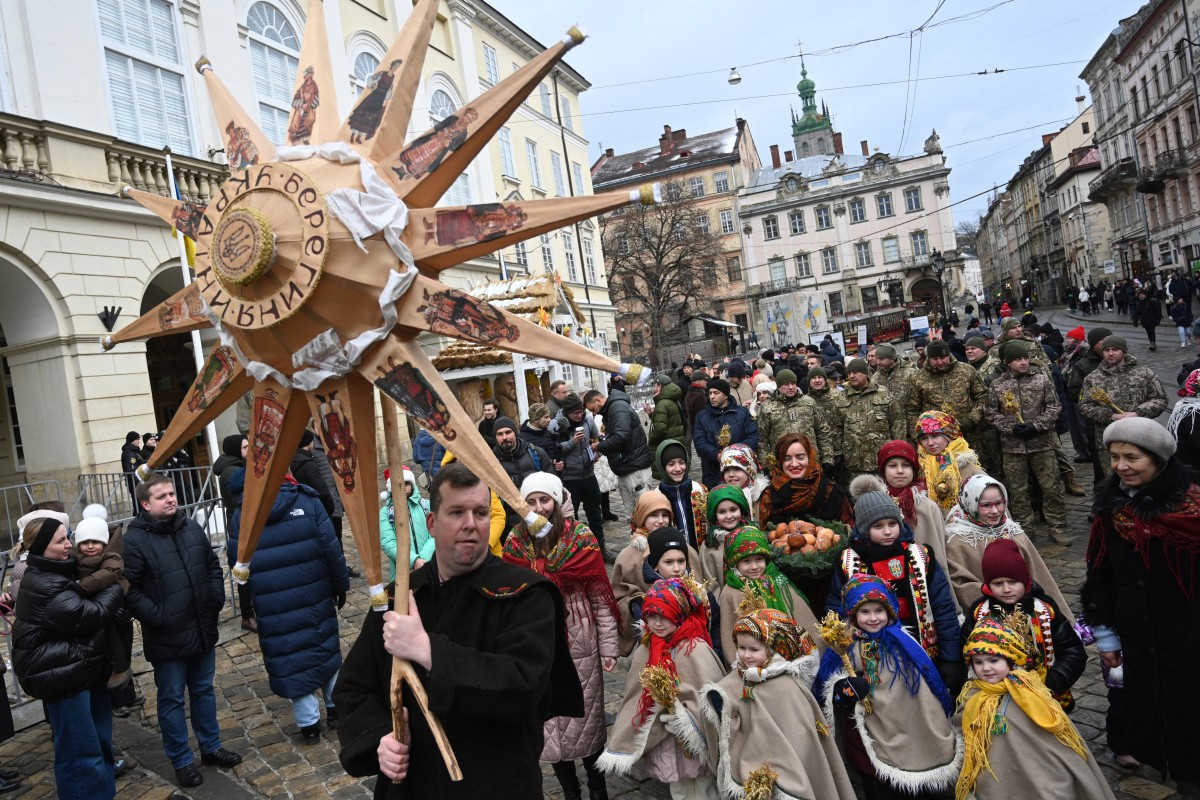
People walk through the streets as they take part in Christmas Eve celebration in Lviv, on December 24, 2023, amid the Russian invasion of Ukraine. Ukrainians attend Christmas Eve services as they prepare to celebrate Christmas Day on December 25 for the first time, after the government changed the date from the Orthodox Church observance of January 7 in a snub to Russia, on December 24, 2023. (Photo by YURIY DYACHYSHYN / AFP)

ODESA, Ukraine– Ukrainian Orthodox Christians attended services on Sunday as the country for the first time celebrated Christmas on December 25, after the government changed the date from January 7, when most Orthodox believers celebrate, as a snub to Russia.

"All Ukrainians are together," said Ukrainian President Volodymyr Zelensky in a Christmas message released Sunday evening.

"We all celebrate Christmas together. On the same date, as one big family, as one nation, as one united country."

In the southern Black Sea port of Odesa, churchgoers prayed and lit candles as priests in gold vestments held Christmas Eve service in the Cathedral of the Nativity, decorated with fir trees and a nativity scene.

"We believe that we really should celebrate Christmas with the whole world, far away, far away from Moscow. For me that's the new message now," said one smiling parishioner, Olena, whose son is a medic on the front line.

"We really want to celebrate in a new way. This is a holiday with the whole of Ukraine, with our independent Ukraine. This is very important for us," she told AFP.


- 'Abandon Russian heritage' -


Most eastern Christian churches use the Julian calendar, where Christmas falls on January 7, rather than the Gregorian calendar used in everyday life and by Western churches.

Zelensky signed a law in July moving the celebration to December 25, saying it allowed Ukrainians to "abandon the Russian heritage of imposing Christmas celebrations on January 7".

The date change is part of hastened moves since the invasion to remove traces of the Russian and Soviet empires. Other measures include renaming streets and removing monuments.

The Orthodox Church of Ukraine formally broke away from the Russian Orthodox Church over Moscow's annexation of Crimea in 2014 and its support for separatists in eastern Ukraine.


- 'Join civilised world' -


The political rift has seen priests and even entire parishes swap from one church to another, with the new Orthodox Church of Ukraine growing fast and taking over several Russia-linked church buildings, moves supported by the government.

On Sunday evening, worshippers packed St Michael's Golden-Domed Monastery in Kyiv -- the headquarters of the new independent church -- for a Christmas service led by the primate of the Orthodox Church of Ukraine, Metropolitan Yepifaniy.

Ukrainians around the country voiced support for the Christmas date change.

"We wanted to support what is happening in Ukraine now. Because changes are always difficult, and when these changes occur, more people are needed to support it in order for something new to happen," said Denis, a young man attending church in Odesa.

At Kyiv's Golden-Domed Monastery, Oksana Krykunova said that for her, after the invasion, it was "natural to switch to the 25th".

She added: "I just visited my parents -- my 81-year-old mother and 86-year-old father -- and they accepted it absolutely (normally)."

In the western city of Lviv, which has been little damaged by the war, Taras Kobza, an army medic, said "we have to join the civilised world."

Tetiana, a singer in a traditional music group called Yagody (berries), agreed: "I'm very happy that we are finally celebrating Christmas Eve and Christmas together with the rest of the world. It's really cool."

The Ukrainian Greek Catholic Church has also opted to hold Christmas services on December 25.

But the historically Russia-linked Ukrainian Orthodox Church is keeping the January 7 Christmas date. This church claims to have cut ties with Russia because of the war but many Ukrainians are sceptical.

Under the Soviet Union, atheism was encouraged and Christmas traditions such as trees and gifts were shifted to New Year's Eve, which became the main holiday.

Ukrainian Christmas traditions include a dinner on Christmas Eve with 12 meatless dishes including a sweet grain pudding called kutya.

People decorate homes with elaborate sheaves of wheat called didukh. Celebrations also include singing carols called kolyadky, carrying decorations in the shape of stars and performing nativity scenes.


Related Tags

WORLDNEWS
ADVERTISEMENT
.most-popular .layout-ratio{ padding-bottom: 79.13%; } @media (min-width: 768px) and (max-width: 1024px) { .widget-title { font-size: 15px !important; } }

{{ articles_filter_1561_widget.title }}

.most-popular .layout-ratio{ padding-bottom: 79.13%; } @media (min-width: 768px) and (max-width: 1024px) { .widget-title { font-size: 15px !important; } }

{{ articles_filter_1562_widget.title }}

.most-popular .layout-ratio{ padding-bottom: 79.13%; } @media (min-width: 768px) and (max-width: 1024px) { .widget-title { font-size: 15px !important; } }

{{ articles_filter_1563_widget.title }}

{{ articles_filter_1564_widget.title }}

.mb-article-details { position: relative; } .mb-article-details .article-body-preview, .mb-article-details .article-body-summary{ font-size: 17px; line-height: 30px; font-family: "Libre Caslon Text", serif; color: #000; } .mb-article-details .article-body-preview iframe , .mb-article-details .article-body-summary iframe{ width: 100%; margin: auto; } .read-more-background { background: linear-gradient(180deg, color(display-p3 1.000 1.000 1.000 / 0) 13.75%, color(display-p3 1.000 1.000 1.000 / 0.8) 30.79%, color(display-p3 1.000 1.000 1.000) 72.5%); position: absolute; height: 200px; width: 100%; bottom: 0; display: flex; justify-content: center; align-items: center; padding: 0; } .read-more-background a{ color: #000; } .read-more-btn { padding: 17px 45px; font-family: Inter; font-weight: 700; font-size: 18px; line-height: 16px; text-align: center; vertical-align: middle; border: 1px solid black; background-color: white; } .hidden { display: none; }
function initializeAllSwipers() { // Get all hidden inputs with cms_article_id document.querySelectorAll('[id^="cms_article_id_"]').forEach(function (input) { const cmsArticleId = input.value; const articleSelector = '#article-' + cmsArticleId + ' .body_images'; const swiperElement = document.querySelector(articleSelector); if (swiperElement && !swiperElement.classList.contains('swiper-initialized')) { new Swiper(articleSelector, { loop: true, pagination: false, navigation: { nextEl: '#article-' + cmsArticleId + ' .swiper-button-next', prevEl: '#article-' + cmsArticleId + ' .swiper-button-prev', }, }); } }); } setTimeout(initializeAllSwipers, 3000); const intersectionObserver = new IntersectionObserver( (entries) => { entries.forEach((entry) => { if (entry.isIntersecting) { const newUrl = entry.target.getAttribute("data-url"); if (newUrl) { history.pushState(null, null, newUrl); let article = entry.target; // Extract metadata const author = article.querySelector('.author-section').textContent.replace('By', '').trim(); const section = article.querySelector('.section-info ').textContent.replace(' ', ' '); const title = article.querySelector('.article-title h1').textContent; // Parse URL for Chartbeat path format const parsedUrl = new URL(newUrl, window.location.origin); const cleanUrl = parsedUrl.host + parsedUrl.pathname; // Update Chartbeat configuration if (typeof window._sf_async_config !== 'undefined') { window._sf_async_config.path = cleanUrl; window._sf_async_config.sections = section; window._sf_async_config.authors = author; } // Track virtual page view with Chartbeat if (typeof pSUPERFLY !== 'undefined' && typeof pSUPERFLY.virtualPage === 'function') { try { pSUPERFLY.virtualPage({ path: cleanUrl, title: title, sections: section, authors: author }); } catch (error) { console.error('ping error', error); } } // Optional: Update document title if (title && title !== document.title) { document.title = title; } } } }); }, { threshold: 0.1 } ); function showArticleBody(button) { const article = button.closest("article"); const summary = article.querySelector(".article-body-summary"); const body = article.querySelector(".article-body-preview"); const readMoreSection = article.querySelector(".read-more-background"); // Hide summary and read-more section summary.style.display = "none"; readMoreSection.style.display = "none"; // Show the full article body body.classList.remove("hidden"); } document.addEventListener("DOMContentLoaded", () => { let loadCount = 0; // Track how many times articles are loaded const offset = [1, 2, 3, 4, 5, 6, 7, 8, 9, 10]; // Offset values const currentUrl = window.location.pathname.substring(1); let isLoading = false; // Prevent multiple calls if (!currentUrl) { console.log("Current URL is invalid."); return; } const sentinel = document.getElementById("load-more-sentinel"); if (!sentinel) { console.log("Sentinel element not found."); return; } function isSentinelVisible() { const rect = sentinel.getBoundingClientRect(); return ( rect.top < window.innerHeight && rect.bottom >= 0 ); } function onScroll() { if (isLoading) return; if (isSentinelVisible()) { if (loadCount >= offset.length) { console.log("Maximum load attempts reached."); window.removeEventListener("scroll", onScroll); return; } isLoading = true; const currentOffset = offset[loadCount]; window.loadMoreItems().then(() => { let article = document.querySelector('#widget_1690 > div:nth-last-of-type(2) article'); intersectionObserver.observe(article) loadCount++; }).catch(error => { console.error("Error loading more items:", error); }).finally(() => { isLoading = false; }); } } window.addEventListener("scroll", onScroll); });

Sign up by email to receive news.