ADVERTISEMENT

Volcano erupts in southwest Iceland after weeks of earthquakes

Published Dec 19, 2023 10:17 am
34878KD-Preview.jpg
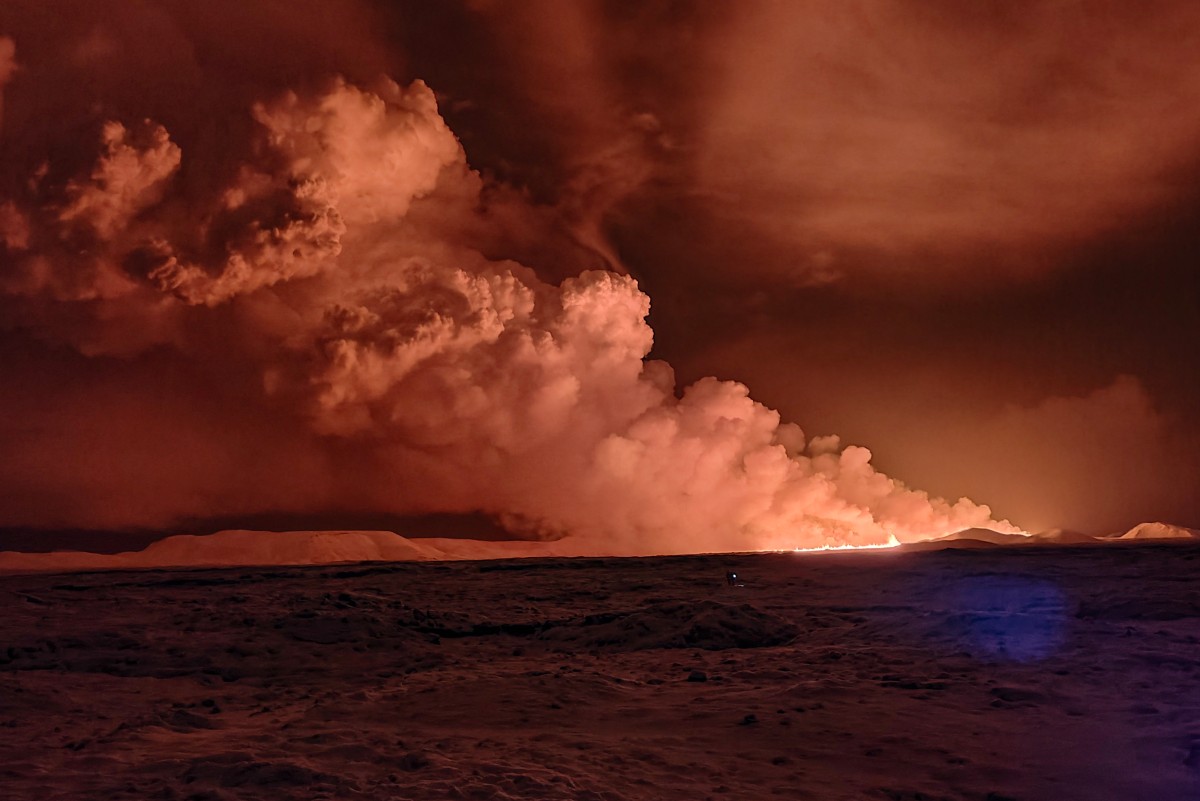
Smoke is billowing as the lava colour the night sky orange from an volcanic eruption on the Reykjanes peninsula 3 km north of Grindavik, western Iceland on December 18, 2023. A volcanic eruption began on Monday night in Iceland, south of the capital Reykjavik, following an earthquake swarm, Iceland's Meteorological Office reported. (Photo by Kristin Elisabet Gunnarsdottir / AFP)


REYKJAVIK, Iceland– A volcano in Iceland was still erupting Tuesday hours after geysers of molten lava shot into the night sky after weeks of intense seismic activity southwest of Reykjavik.

The eruption on the Reykjanes peninsula began Monday at around 10:17 pm (2217 GMT) after an earthquake swarm, the Icelandic Meteorological Office said, referring to a series of small shakes.

Live-streamed footage of the eruption showed glowing orange jets of lava spewing from a gash in the ground, surrounded by billowing clouds of red smoke.

"We hope for the best but it is clear this is a considerable eruption," Prime Minister Katrin Jakobsdottir wrote on Facebook.

For weeks, the Nordic country had been anticipating an eruption on the peninsula southwest of the capital after intense earthquake activity, which prompted authorities to evacuate thousands of people and close the Blue Lagoon geothermal spa famed for its turquoise waters.

The meteorological office estimated that the volcano had opened a fissure about four kilometres (2.5 miles) long, with the southern end just three kilometres away from the fishing town of Grindavik.

By 3:00 am, the meteorological office said the intensity of the eruption had stabilised and "the activity is decreasing", although was unable to estimate how long it would last.

"We now wait to see what the forces of nature have in store," President Gudni Thorlacius Johannesson wrote on X, formerly Twitter. He added that protecting lives and infrastructure was the priority.

Vidir Reynisson, head of the Department of Civil Protection, urged people to stay away from the area, telling a local television station: "This is no tourist eruption."

Fears that it could cause havoc to air travel after another Icelandic eruption in 2010 grounded thousands of flights across Europe and North America has so far failed to materialise.

Reykjavik's international airport remained open. Operator ISAVIA said: "For the time being, no disruptions to arrivals or departures at Keflavik airport."


- New era -


Since October, thousands of earthquakes had been detected on the Reykjanes peninsula, a possible precursor to an impending volcanic eruption.

Roughly 4,000 people were evacuated from Grindavik, a fishing port around 40 kilometres (25 miles) from Reykjavik, on November 11 after scientists determined that a tunnel of magma was shifting beneath them.

Residents told AFP the series of small earthquakes -- sometimes hundreds per day -- had damaged roads and buildings.

Since then, they have only been allowed to visit their homes during certain daylight hours.

Authorities have organised occasional trips into the village, escorting those with homes in the most perilous parts as they rescued everything from cherished pets to photo albums, furniture and clothing.

Volcanic eruptions are not uncommon in Iceland, which is home to 33 active volcano systems, the highest number in Europe. But the Reykjanes peninsula had not experienced an eruption for eight centuries until 2021.

Since then, three have struck, in 2021, 2022 and earlier this year -- all in remote, uninhabited areas.

Volcanologists say this could be the start of a new era of activity in the region.

In 2010, the eruption of Iceland's long-dormant Eyjafjallajokull volcano -- an ice-capped volcano more than 1,660 metres tall -- shot huge amounts of ash into the atmosphere. That explosive eruption was not fatal, but forced the cancellation of around 100,000 flights and left more than 10 million travellers stranded.

Situated in the North Atlantic, Iceland straddles the Mid-Atlantic Ridge, a crack in the ocean floor separating the Eurasian and North American tectonic plates.

Related Tags

Manila City metronews
ADVERTISEMENT
.most-popular .layout-ratio{ padding-bottom: 79.13%; } @media (min-width: 768px) and (max-width: 1024px) { .widget-title { font-size: 15px !important; } }

{{ articles_filter_1561_widget.title }}

.most-popular .layout-ratio{ padding-bottom: 79.13%; } @media (min-width: 768px) and (max-width: 1024px) { .widget-title { font-size: 15px !important; } }

{{ articles_filter_1562_widget.title }}

.most-popular .layout-ratio{ padding-bottom: 79.13%; } @media (min-width: 768px) and (max-width: 1024px) { .widget-title { font-size: 15px !important; } }

{{ articles_filter_1563_widget.title }}

{{ articles_filter_1564_widget.title }}

.mb-article-details { position: relative; } .mb-article-details .article-body-preview, .mb-article-details .article-body-summary{ font-size: 17px; line-height: 30px; font-family: "Libre Caslon Text", serif; color: #000; } .mb-article-details .article-body-preview iframe , .mb-article-details .article-body-summary iframe{ width: 100%; margin: auto; } .read-more-background { background: linear-gradient(180deg, color(display-p3 1.000 1.000 1.000 / 0) 13.75%, color(display-p3 1.000 1.000 1.000 / 0.8) 30.79%, color(display-p3 1.000 1.000 1.000) 72.5%); position: absolute; height: 200px; width: 100%; bottom: 0; display: flex; justify-content: center; align-items: center; padding: 0; } .read-more-background a{ color: #000; } .read-more-btn { padding: 17px 45px; font-family: Inter; font-weight: 700; font-size: 18px; line-height: 16px; text-align: center; vertical-align: middle; border: 1px solid black; background-color: white; } .hidden { display: none; }
function initializeAllSwipers() { // Get all hidden inputs with cms_article_id document.querySelectorAll('[id^="cms_article_id_"]').forEach(function (input) { const cmsArticleId = input.value; const articleSelector = '#article-' + cmsArticleId + ' .body_images'; const swiperElement = document.querySelector(articleSelector); if (swiperElement && !swiperElement.classList.contains('swiper-initialized')) { new Swiper(articleSelector, { loop: true, pagination: false, navigation: { nextEl: '#article-' + cmsArticleId + ' .swiper-button-next', prevEl: '#article-' + cmsArticleId + ' .swiper-button-prev', }, }); } }); } setTimeout(initializeAllSwipers, 3000); const intersectionObserver = new IntersectionObserver( (entries) => { entries.forEach((entry) => { if (entry.isIntersecting) { const newUrl = entry.target.getAttribute("data-url"); if (newUrl) { history.pushState(null, null, newUrl); let article = entry.target; // Extract metadata const author = article.querySelector('.author-section').textContent.replace('By', '').trim(); const section = article.querySelector('.section-info ').textContent.replace(' ', ' '); const title = article.querySelector('.article-title h1').textContent; // Parse URL for Chartbeat path format const parsedUrl = new URL(newUrl, window.location.origin); const cleanUrl = parsedUrl.host + parsedUrl.pathname; // Update Chartbeat configuration if (typeof window._sf_async_config !== 'undefined') { window._sf_async_config.path = cleanUrl; window._sf_async_config.sections = section; window._sf_async_config.authors = author; } // Track virtual page view with Chartbeat if (typeof pSUPERFLY !== 'undefined' && typeof pSUPERFLY.virtualPage === 'function') { try { pSUPERFLY.virtualPage({ path: cleanUrl, title: title, sections: section, authors: author }); } catch (error) { console.error('ping error', error); } } // Optional: Update document title if (title && title !== document.title) { document.title = title; } } } }); }, { threshold: 0.1 } ); function showArticleBody(button) { const article = button.closest("article"); const summary = article.querySelector(".article-body-summary"); const body = article.querySelector(".article-body-preview"); const readMoreSection = article.querySelector(".read-more-background"); // Hide summary and read-more section summary.style.display = "none"; readMoreSection.style.display = "none"; // Show the full article body body.classList.remove("hidden"); } document.addEventListener("DOMContentLoaded", () => { let loadCount = 0; // Track how many times articles are loaded const offset = [1, 2, 3, 4, 5, 6, 7, 8, 9, 10]; // Offset values const currentUrl = window.location.pathname.substring(1); let isLoading = false; // Prevent multiple calls if (!currentUrl) { console.log("Current URL is invalid."); return; } const sentinel = document.getElementById("load-more-sentinel"); if (!sentinel) { console.log("Sentinel element not found."); return; } function isSentinelVisible() { const rect = sentinel.getBoundingClientRect(); return ( rect.top < window.innerHeight && rect.bottom >= 0 ); } function onScroll() { if (isLoading) return; if (isSentinelVisible()) { if (loadCount >= offset.length) { console.log("Maximum load attempts reached."); window.removeEventListener("scroll", onScroll); return; } isLoading = true; const currentOffset = offset[loadCount]; window.loadMoreItems().then(() => { let article = document.querySelector('#widget_1690 > div:nth-last-of-type(2) article'); intersectionObserver.observe(article) loadCount++; }).catch(error => { console.error("Error loading more items:", error); }).finally(() => { isLoading = false; }); } } window.addEventListener("scroll", onScroll); });

Sign up by email to receive news.