







Marcos proposes paradigm shift to de-escalate tensions in WPS
By Raymund Antonio and Raymund Antonio


President Marcos wants a “paradigm shift” or a “new way” of dealing with China’s aggressive actions in the West Philippine Sea, revealing that he also plans to release a joint position with the Philippines’ regional and international partners on ways to de-escalate the tensions.
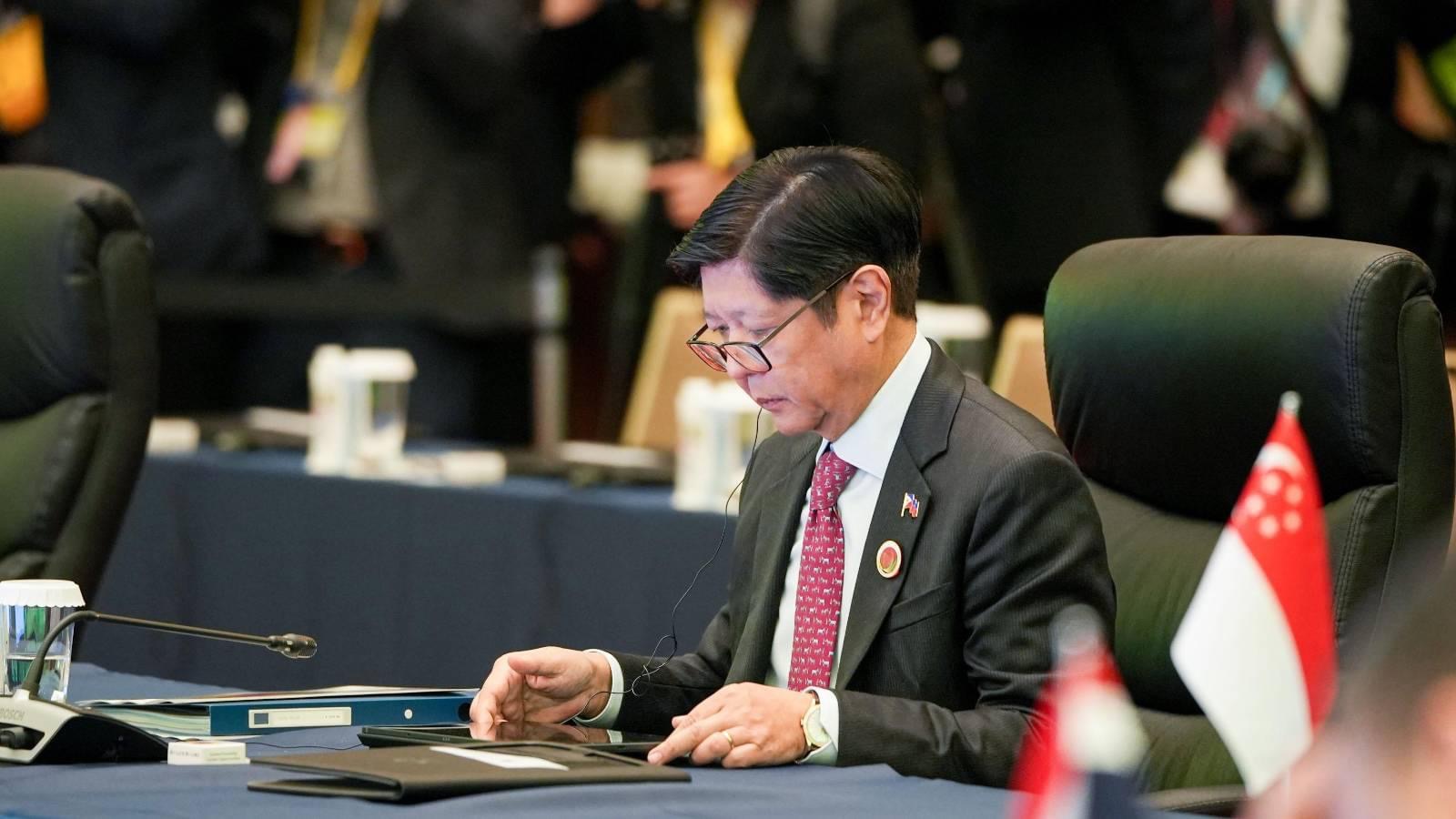 President Ferdinand 'Bongbong' Marcos Jr. at the ASEAN-Japan Commemoration Summit in Tokyo. (Photo from the Presidential Communications Office)
In a statement released by Malacañang on Tuesday, Dec. 19, the Chief Executive maintained that this new way should bring the Philippines and China “down the road to peace” but emphasized the need to act swiftly as the issue affects the livelihood of Filipino fisherfolk.
The President said this after lamenting that the “traditional methods of diplomacy” being conducted by the Philippines—such as filing diplomatic protests and summoning the Chinese envoy to Manila—are being disregarded by China as it continues to harass Philippine sea vessels.
“Well, to this point, we have resorted to the traditional methods of diplomacy where, should there be an incident, we send note verbal. Our embassy will send a démarche to the Foreign Affairs (Ministry) office in Beijing, but we have been doing this for many years now, with very little progress,” Marcos told the Japanese media.
“We have to do something what we have not done before. We have to come up with a new concept, a new principle, a new idea so that we move, as I say, we move the needle the other way. It’s going up, let’s move the needle back, so that paradigm shift is something that we have to formulate,” he added.
The President believes that the situation in the West Philippine Sea will not improve if Manila will continue to deal with China in the current way.
Last week, before Marcos left for the Japan-Association of Southeast Asian Nations (ASEAN) commemorative summit in Tokyo, China Coast Guard (CCG) water cannoned Philippine vessels near the Scarborough and Ayungin Shoals, both of which are within Manila’s exclusive economic zone (EEZ).
The Philippines has taken three legal steps in these latest intrusions. It filed a diplomatic protest with the Chinese Ministry of Foreign Affairs, summoned Chinese Ambassador to the Philippines Huang Xilian, and made a “demarche to the Chinese Ministry of Foreign Affairs officials” to call out the CCG.
While he did not specify what actions his administration would take next, the President affirmed that he will continue discussing with regional partners in the Indo-Pacific and “the rest of the world,” if necessary, on ways to de-escalate the tensions with China.
“We do not want to go the point where there are incidents that might cause an actual violent conflict. Maybe from a mistake or a misunderstanding and these things happen all the time,” the Chief Executive, whose administration has taken a stronger stance against China as opposed to the Duterte administration, said.
“And so, we have, in my review, it’s time that the countries that feel that they have an involvement in this situation, we have to come up with a paradigm shift,” he added.
Marcos plans to encourage Philippine partners to come up with a joint position, stating their responsibilities as far as the disputed waters is concerned.
“We have to bring all of those ideas together and to change the direction that these incidents have taken us. We have to stop going that way. We’ve gone down the wrong road. We have to disengage and find ourselves a more peaceful road to go down,” he said.
“We have, as I have said, the consensus that we must continue to promote peace, but we have to decide amongst ourselves what part each of us plays and what we can play, what we are willing to play,” Marcos added.
The President, however, stressed that a “good plan” will bring both sides of the conflict “down, not the road to conflict, but down the road to peace.”