






 Philippines
National
Prioritize funding vs malnutrition not CIF funds—Drilon urges gov't
Philippines
National
Prioritize funding vs malnutrition not CIF funds—Drilon urges gov't
Prioritize funding vs malnutrition not CIF funds—Drilon urges gov't


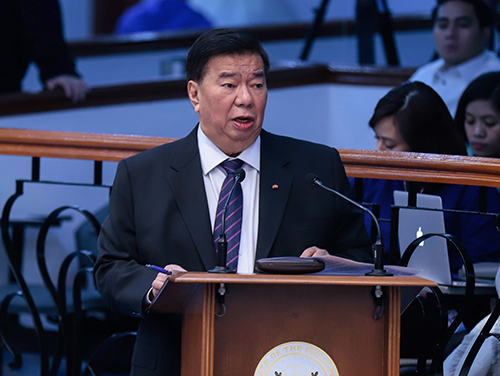 Former Senator Franklin Drilon
Instead of spending for confidential and intelligence funds (CIF), the government should direct public funds towards feeding malnourished children, former Senate president Franklin Drilon said.
Drilon made the call during a feeding and nutrition program called the “Mingo Meals for Nutrition Program” in Iloilo City on Tuesday, December 12, which he facilitated. The former lawmaker was able to raise P3.6-million funds from the private sector for this endeavor.
According to the former justice secretary, the Philippines is currently grappling with a pressing health and socio-economic problem.
"The malnutrition crisis in our country is an urgent matter that demands our immediate attention. It is disheartening to know that 3.245 million Filipino children are malnourished,” Drilon said.
“This issue must be prioritized, especially when we consider the allocation of funds in the 2024 national budget, where over P10-billion is allocated to CIFs. We need to ask ourselves how much is devoted to malnutrition,” Drilon said.
Recent data from the Department of Health (DOH) shows that about 29.5 percent of the 11 million Filipino children under five years and below are malnourished and stunted.
That is why he said, he is supporting such initiative to highlight the problem of malnutrition in the Philippines and in order to draw in public attention and the government to this issue.
“This is really a problem for the country. Can you imagine 3.245 million Filipino kids are malnourished. To me, this should be prioritized, not the confidential and intelligence funds,” Drilon stressed.
He said various studies can attest to this, such as the United Nations Children’s Fund (UNICEF) which found out that 95 children succumb to the effects of malnutrition daily.
“This deeply worrying statistic not only poses immediate threats to the health of our children but also jeopardizes their educational prospects and overall future potential,” he said.
Drilon also pointed out that the Philippines’ dismal performance in the Programme for International Student Assessment (PISA) is linked to the issue of hunger and inadequate nutrition among Filipino children.
Based on the 2022 PISA study, the Philippines' performance in the three subjects remained relatively unchanged compared to 2018 when it first participated in the assessment.
In the 2018 PISA study, the Philippines scored the lowest in reading and second lowest in math and science among the 79 participating nations.
“The PISA survey underscores the correlation between malnutrition and education, showing that stunting adversely impacts the capacity of our children to learn,” he said.