

ADVERTISEMENT

Supreme Court asked to decide if Trump has immunity from prosecution

Published Dec 12, 2023 01:01 am

WASHINGTON, United States - Federal prosecutors asked the US Supreme Court on Monday to rule quickly on whether former president Donald Trump has immunity from prosecution so his trial on charges of conspiring to overturn the 2020 election can go ahead as scheduled.
IMG_4016.jpeg

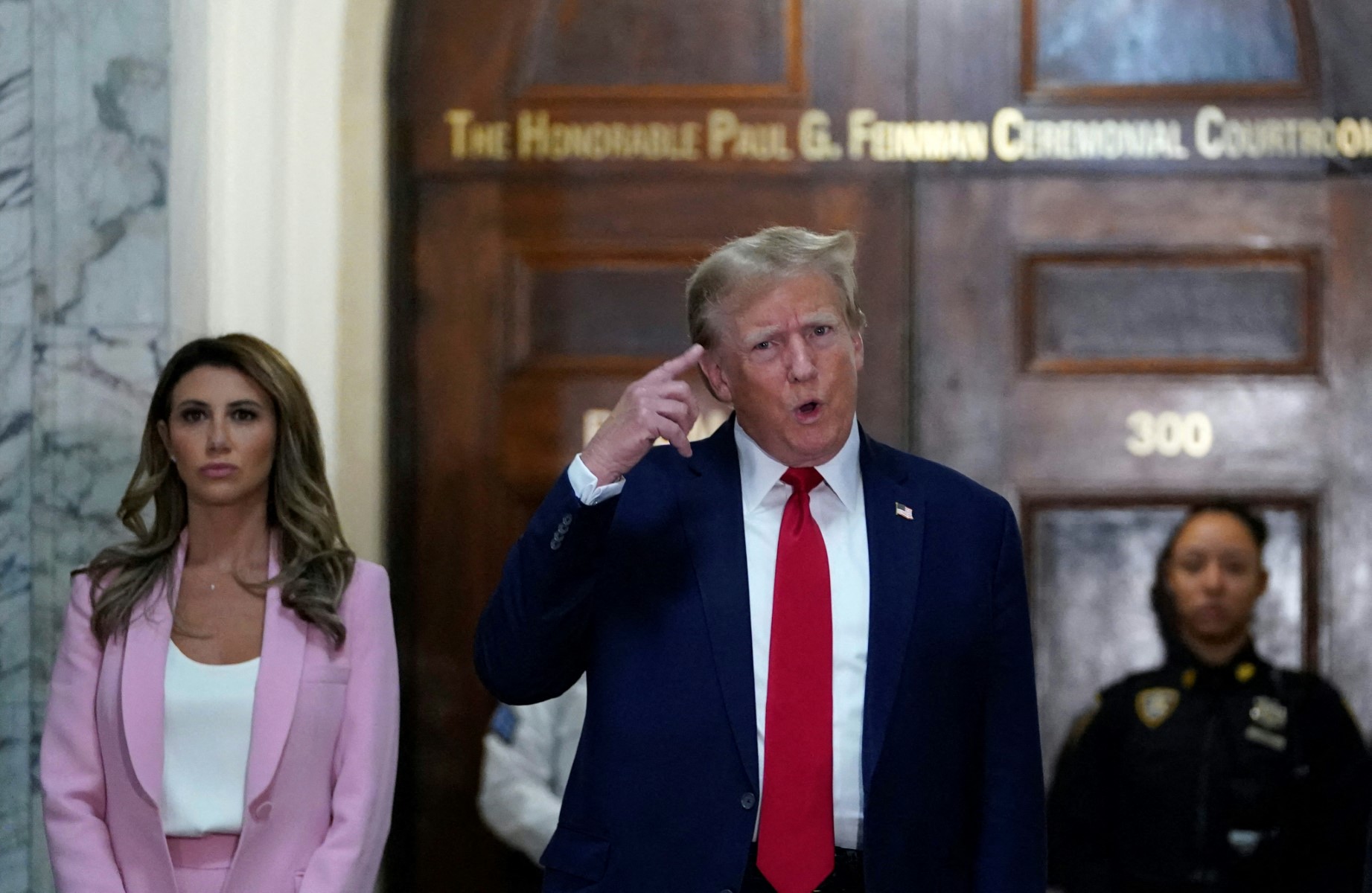
Former US President Donald Trump (C) speaks to members of the media as he arrives at the New York State Supreme Court during the civil fraud trial against the Trump Organization, in New York City on December 7, 2023.

"This case presents a fundamental question at the heart of our democracy: whether a former President is absolutely immune from federal prosecution for crimes committed while in office," Special Counsel Jack Smith said in a filing to the nation's highest court.

Smith asked the Supreme Court, which has a 6-3 conservative majority, including three justices nominated by Trump, for an expedited ruling.

"The United States recognizes that this is an extraordinary request," the special counsel said. "This is an extraordinary case."

"It is of paramount public importance that respondent's claims of immunity be resolved as expeditiously as possible -- and, if respondent is not immune, that he receive a fair and speedy trial on these charges," Smith said.

The Supreme Court said it would expedite consideration of Smith's petition that it take up the case, and asked Trump's attorneys to state by December 20 their position on the special counsel's request.

The former Republican president's historic trial is scheduled to begin in Washington on March 4, 2024.

Trump's lawyers have repeatedly sought to delay the trial until after the November 2024 election including with a claim that a former president enjoys "absolute immunity" and cannot be prosecuted for actions he took while in the White House.

US District Judge Tanya Chutkan, who is to preside over the first ever criminal trial of a former president, rejected the immunity claim on December 1.

"Whatever immunities a sitting President may enjoy, the United States has only one Chief Executive at a time, and that position does not confer a lifelong 'get-out-of-jail-free' pass," Chutkan said.

"Defendant's four-year service as Commander in Chief did not bestow on him the divine right of kings to evade the criminal accountability that governs his fellow citizens," she added.

Lawyers for Trump, the frontrunner for the 2024 Republican presidential nomination, have appealed Chutkan's ruling to a federal appeals court.

Smith is asking the Supreme Court to bypass the appeals court and take up the case itself on an emergency basis.


- 'No person is above the law' -


In his filing, Smith said "a cornerstone of our constitutional order is that no person is above the law.

"The force of that principle is at its zenith where, as here, a grand jury has accused a former President of committing federal crimes to subvert the peaceful transfer of power to his lawfully elected successor," the special counsel said.

"Nothing could be more vital to our democracy than that a President who abuses the electoral system to remain in office is held accountable for criminal conduct."

A Trump spokesperson denounced Smith's move, saying in a statement there is "no reason to rush this sham to trial except to injure President Trump."

Carl Tobias, a University of Richmond law professor, told AFP Smith's request is a rare procedure but he makes "compelling arguments."

"Smith essentially contends that the future of the US as a functioning democracy is at stake," Tobias said.

Trump was indicted in August for seeking to upend the results of the November 2020 election won by Democrat Joe Biden in a concerted effort that led to the violent January 6, 2021 attack by his supporters on the US Capitol.

The former president is accused of seeking to disenfranchise American voters with his false claims he won the election.

Smith also asked the Supreme Court to decide whether Trump's prosecution violates constitutional protections against double jeopardy -- being tried twice for the same crime.

Trump was impeached by the Democratic-majority House of Representatives for "incitement of insurrection" following the attack on the Capitol but was acquitted by the Senate.

The nine Supreme Court justices are to hold their next conference on whether to accept new cases on January 5. The current court term is scheduled to end in June.


Related Tags

world news
ADVERTISEMENT
.most-popular .layout-ratio{ padding-bottom: 79.13%; } @media (min-width: 768px) and (max-width: 1024px) { .widget-title { font-size: 15px !important; } }

{{ articles_filter_1561_widget.title }}

.most-popular .layout-ratio{ padding-bottom: 79.13%; } @media (min-width: 768px) and (max-width: 1024px) { .widget-title { font-size: 15px !important; } }

{{ articles_filter_1562_widget.title }}

.most-popular .layout-ratio{ padding-bottom: 79.13%; } @media (min-width: 768px) and (max-width: 1024px) { .widget-title { font-size: 15px !important; } }

{{ articles_filter_1563_widget.title }}

{{ articles_filter_1564_widget.title }}

.mb-article-details { position: relative; } .mb-article-details .article-body-preview, .mb-article-details .article-body-summary{ font-size: 17px; line-height: 30px; font-family: "Libre Caslon Text", serif; color: #000; } .mb-article-details .article-body-preview iframe , .mb-article-details .article-body-summary iframe{ width: 100%; margin: auto; } .read-more-background { background: linear-gradient(180deg, color(display-p3 1.000 1.000 1.000 / 0) 13.75%, color(display-p3 1.000 1.000 1.000 / 0.8) 30.79%, color(display-p3 1.000 1.000 1.000) 72.5%); position: absolute; height: 200px; width: 100%; bottom: 0; display: flex; justify-content: center; align-items: center; padding: 0; } .read-more-background a{ color: #000; } .read-more-btn { padding: 17px 45px; font-family: Inter; font-weight: 700; font-size: 18px; line-height: 16px; text-align: center; vertical-align: middle; border: 1px solid black; background-color: white; } .hidden { display: none; }
function initializeAllSwipers() { // Get all hidden inputs with cms_article_id document.querySelectorAll('[id^="cms_article_id_"]').forEach(function (input) { const cmsArticleId = input.value; const articleSelector = '#article-' + cmsArticleId + ' .body_images'; const swiperElement = document.querySelector(articleSelector); if (swiperElement && !swiperElement.classList.contains('swiper-initialized')) { new Swiper(articleSelector, { loop: true, pagination: false, navigation: { nextEl: '#article-' + cmsArticleId + ' .swiper-button-next', prevEl: '#article-' + cmsArticleId + ' .swiper-button-prev', }, }); } }); } setTimeout(initializeAllSwipers, 3000); const intersectionObserver = new IntersectionObserver( (entries) => { entries.forEach((entry) => { if (entry.isIntersecting) { const newUrl = entry.target.getAttribute("data-url"); if (newUrl) { history.pushState(null, null, newUrl); let article = entry.target; // Extract metadata const author = article.querySelector('.author-section').textContent.replace('By', '').trim(); const section = article.querySelector('.section-info ').textContent.replace(' ', ' '); const title = article.querySelector('.article-title h1').textContent; // Parse URL for Chartbeat path format const parsedUrl = new URL(newUrl, window.location.origin); const cleanUrl = parsedUrl.host + parsedUrl.pathname; // Update Chartbeat configuration if (typeof window._sf_async_config !== 'undefined') { window._sf_async_config.path = cleanUrl; window._sf_async_config.sections = section; window._sf_async_config.authors = author; } // Track virtual page view with Chartbeat if (typeof pSUPERFLY !== 'undefined' && typeof pSUPERFLY.virtualPage === 'function') { try { pSUPERFLY.virtualPage({ path: cleanUrl, title: title, sections: section, authors: author }); } catch (error) { console.error('ping error', error); } } // Optional: Update document title if (title && title !== document.title) { document.title = title; } } } }); }, { threshold: 0.1 } ); function showArticleBody(button) { const article = button.closest("article"); const summary = article.querySelector(".article-body-summary"); const body = article.querySelector(".article-body-preview"); const readMoreSection = article.querySelector(".read-more-background"); // Hide summary and read-more section summary.style.display = "none"; readMoreSection.style.display = "none"; // Show the full article body body.classList.remove("hidden"); } document.addEventListener("DOMContentLoaded", () => { let loadCount = 0; // Track how many times articles are loaded const offset = [1, 2, 3, 4, 5, 6, 7, 8, 9, 10]; // Offset values const currentUrl = window.location.pathname.substring(1); let isLoading = false; // Prevent multiple calls if (!currentUrl) { console.log("Current URL is invalid."); return; } const sentinel = document.getElementById("load-more-sentinel"); if (!sentinel) { console.log("Sentinel element not found."); return; } function isSentinelVisible() { const rect = sentinel.getBoundingClientRect(); return ( rect.top < window.innerHeight && rect.bottom >= 0 ); } function onScroll() { if (isLoading) return; if (isSentinelVisible()) { if (loadCount >= offset.length) { console.log("Maximum load attempts reached."); window.removeEventListener("scroll", onScroll); return; } isLoading = true; const currentOffset = offset[loadCount]; window.loadMoreItems().then(() => { let article = document.querySelector('#widget_1690 > div:nth-last-of-type(2) article'); intersectionObserver.observe(article) loadCount++; }).catch(error => { console.error("Error loading more items:", error); }).finally(() => { isLoading = false; }); } } window.addEventListener("scroll", onScroll); });

Sign up by email to receive news.