






 Philippines
National
China's water cannon attack in West PH Sea endangers lives—UK, Australia
Philippines
National
China's water cannon attack in West PH Sea endangers lives—UK, Australia
China's water cannon attack in West PH Sea endangers lives—UK, Australia
By Raymund Antonio and Raymund Antonio


The ambassadors of the United Kingdom, Australia, France, and Germany on Sunday, Dec. 10, joined voices to rebuke the latest water cannon attack by China in the West Philippine Sea, with two of them saying that the incident “endangers lives and livelihoods.”
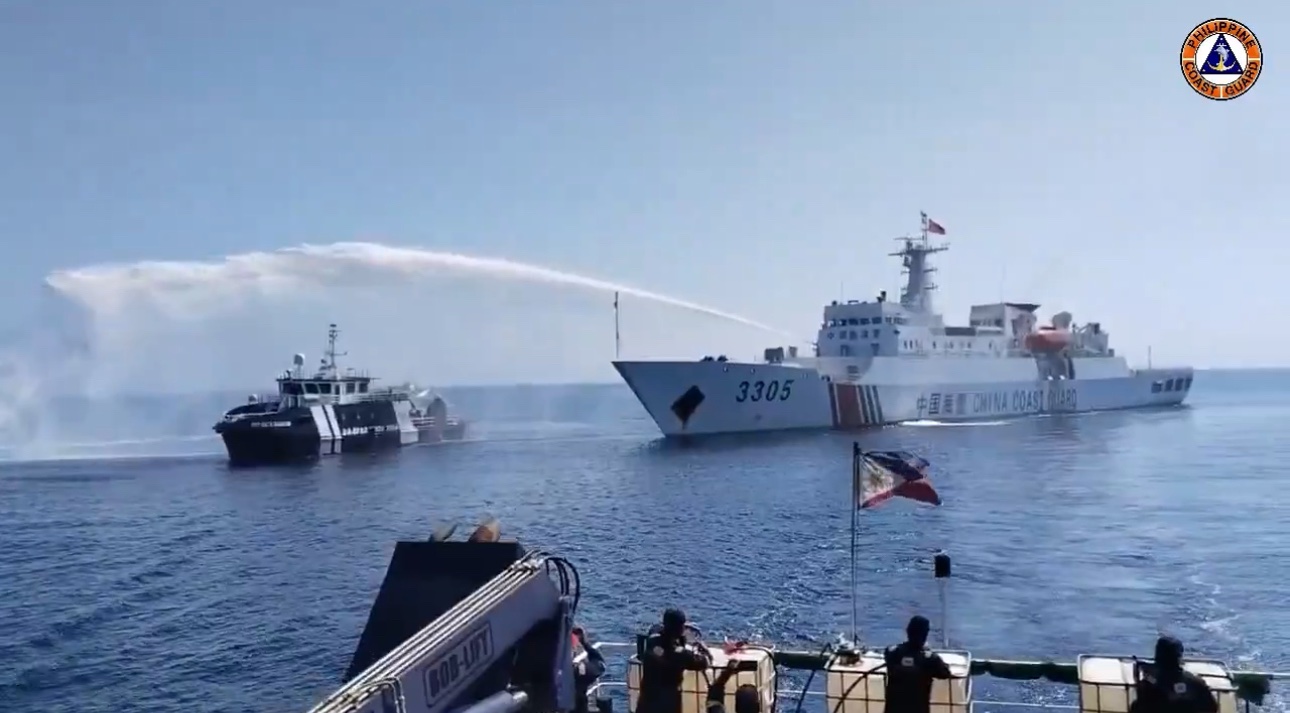 China Coast Guard fires water cannon at a Bureau of Fisheries and Aquatic Resources (BFAR) vessel in Bajo de Masinloc on Saturday, Dec. 9, 2023. (PCG screenshot)
In separate statements, the envoys called on China to respect the 1982 United Nations Convention on the Law of the Sea (UNCLOS) and the 2016 arbitral award.
“Seriously concerned by reports of dangerous actions by Chinese vessels against Philippine vessels today,” Australian Ambassador to the Philippines Hae Kyong Yu wrote.
“This endangers lives and livelihoods. (Australia) again reiterates the call for peace, stability and respect for UNCLOS in the South China Sea, a vital international waterway for us all,” she added.
British Ambassador to Manila Laure Beaufils echoed Yu’s statement.
“The (United Kingdom) is aware of the unsafe actions by CCG vessels against Philippines BFAR vessels near Scarborough Shoal today. This endangers lives and livelihoods and undermines regional peace and stability. The UK reiterates its full support for UNCLOS,” she said.
French Ambassador to the Philippines Marie Fontanel stated that France is also “seriously concerned once again by the very dangerous actions” against the resupply mission by the Philippines in the West Philippine Sea.
“(France) reiterates the importance of UNCLOS to ensure freedom of navigation and recalls the 2016 Arbitral Award. #FreeAndOpenIndoPacific,” she wrote.
German Ambassador Andreas Pfaffernoschke expressed support for the Delegation of the European Union in the Philippines’ statement that the 2016 arbitral ruling, which invalidated the basis of China’s nine-dash line claim in the contested waters, is a useful and legally binding mechanism to peacefully resolve the dispute.
“(Germany) fully supports the statement made by the ambassador of the (European Union) and calls for the respect of the rule of law, including the 2016 UNCLOS award,” he said.
The South Korean Embassy in Manila also voiced their concern against China’s recent actions.
“The ROK Embassy in the Philippines is concerned about the recent use of water cannons against Philippine vessels in the South China Sea,” it said.
“We reaffirm our strong support for peace, stability and rules-based order in the South China Sea and for the freedom of navigation and overflight based on the principles of international law, including UNCLOS,” the embassy added.
On Saturday, Dec. 9, three Bureau of Fisheries and Aquatic Resources (BFAR) vessels were attack with a water cannon by China Coast Guard (CCG) and Chinese militia vessels during a humanitarian and supply mission to 30 fishing vessels off Bajo de Masinloc.
This is not the first time that CCG vessels used water cannon in the disputed waters; the first one was an Aug. 5 incident when Philippine vessels were en route to BRP Sierra Madre to bring supplies to military troops there.
Beijing’s claim of the entire South China Sea, including features inside the EEZs of the Philippines, Vietnam, Brunei, Indonesia, Malaysia, and Taiwan, raised regional and international tensions, with several countries urging it to abide by international laws and rulings, including the 2016 Arbitral Tribunal ruling awarded to Manila.