






 Philippines
National
PH, Colombia share best practices in sustaining peace process gains
Philippines
National
PH, Colombia share best practices in sustaining peace process gains
PH, Colombia share best practices in sustaining peace process gains


A delegation of peace and security experts from Colombia met with their Filipino counterparts and shared their own experiences in implementing the peace process with the Revolutionary Armed Forces of Colombia, also known as Fuerza Armadas Revolucionarias de Colombia (FARC).
Secretary Carlito G. Galvez, Jr., presidential adviser on Peace, Reconciliation and Unity (OPAPRU) said the meeting between Colombian and Philippine peace process experts on Nov. 6 was essential in facilitating the proper design of reintegration and normalization pathways, as well as monitoring and evaluation of programs for former combatants.
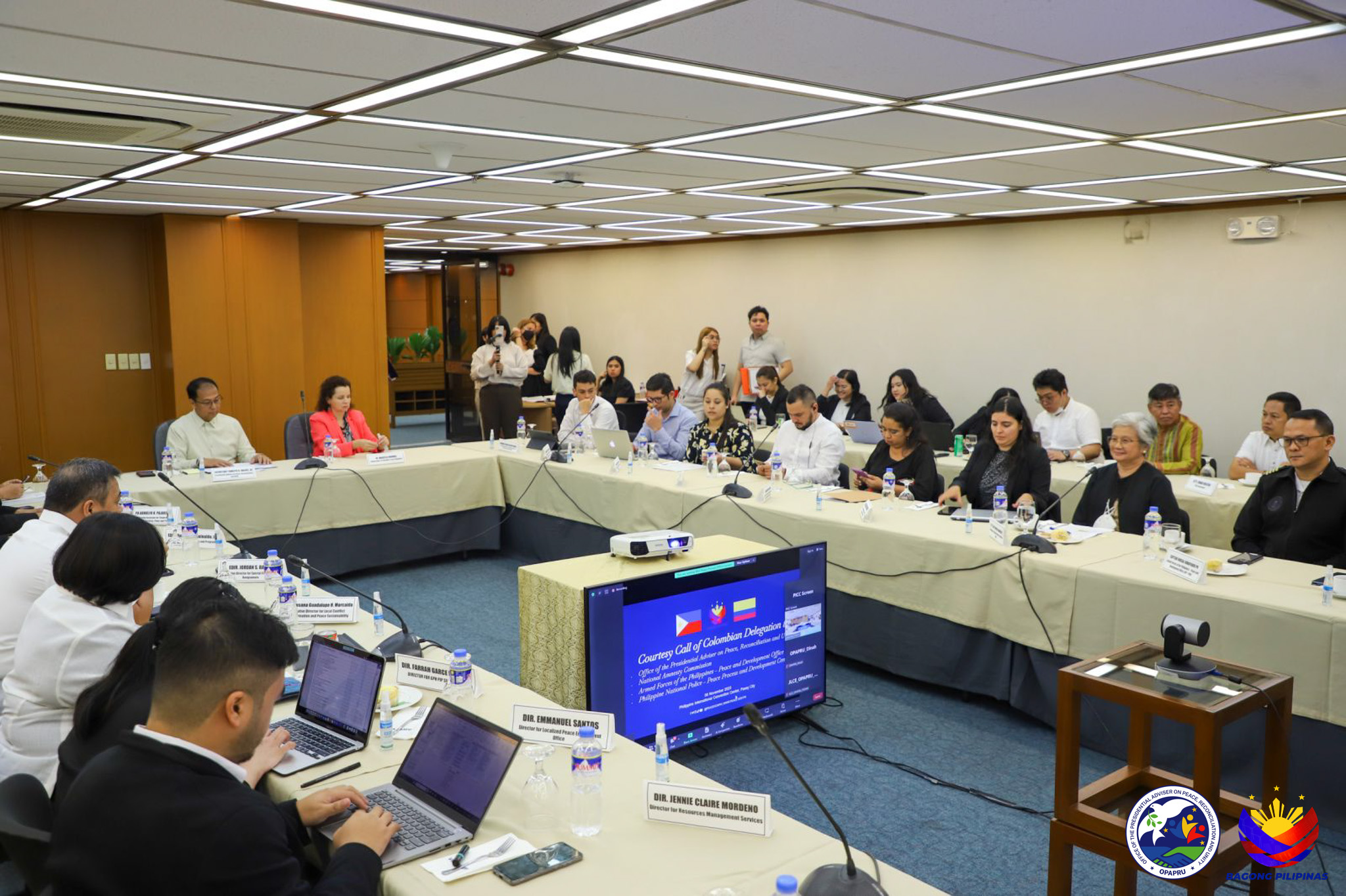
A Colombian delegation led by Ambassador Marcela Ordoñez met with officials of the Office of the Presidential Adviser on Peace, Reconciliation, and Unity (OPAPRU) led by Sec. Carlito G. Galvez, Jr. to share best practices in peacebuilding. (photo: OPAPRU)
“Our main objective is to ensure the sustainability of our interventions and that they address in the best way possible the needs of these ex-fighters,” said Galvez who was instrumental in the peace agreement with the Moro Islamic Liberation Front (MILF).
The Colombian delegation was headed by Ambassador of Colombia to the Philippines Marcela Ordóñez who shared his country’s best practice and successes with FARC.
During discussions OPAPRU officials headed by Galvez, Ordoñez highlighted the significance of the meeting, saying it’s not a one-sided presentation of information but rather a two-way exchange of insights.
“This is a very important meeting for us in the exchange of best practices between Colombia and the Philippines. It’s not a type of cooperation where a country comes and teaches the other one what to do,” Ordóñez noted.
“What happens in the South-South Cooperation, you get two countries that are on the same level. The Philippines and Colombia are middle income countries and countries that do many fantastic things, and are improving best practices in other fields. So, what we do is one country shares what they are doing, [while] the other country shares what they are doing, and the two countries learn and improve the type of work they do,” she explained.
The sharing of experience is part of the Technical Cooperation Agreement (TCA) signed by the Government of the Philippines (GPH) with the Colombian Agency for Reintegration and Normalization (ARN) in April 2014.
The TCA outlines various activities to facilitate the sharing of lessons learned in the respective countries’ peace processes which include the conduct of virtual exchanges; a visit of the Philippine delegation to Colombia, a visit of the Colombian delegation to the Philippines; and a series of webinars.
The Colombian delegation discussed the brief history of the peace agreement inked by the Colombian government and the FARC, as well as the five key points contained in the said agreement.
The FARC and the Colombian Government signed a final peace agreement on November 24, 2016, ending more than five decades of war. More than 14,000 members of the revolutionary group signed the peace deal.
The agreement is focused on uplifting the lives of the victims, as well as helping the former rebels in their transformation as peaceful and productive civilians as a means to finally put an end to the armed conflict.
The prigtam, which is called the Agency for Reincorporation and Normalization (ARN), plays a crucial role in ensuring the implementation of the peace agreement through its key program called the “Integral Reincorporation Programme.”
ARN Territorial Deputy Director Leonardo Salcedo Garcia stressed that although the ARN exists, “the reincorporation process is a responsibility of all the entities [in the] country.”
The reincorporation is a process whereby former combatants who signed the peace agreement shall collectively pursue the realization of their struggles and aspirations through active political and community participation.
“They keep [their] struggle, [as they] try to transform the conflict in[to] the legal struggle like a political party, being part of the congress of the republic,” Garcia said.
He underscored the importance of bringing the ex-combatants closer to the different communities in Colombia.
“The community-based reincorporation process is a very important component because [it] tries to bring benefits for all the communities and the process is in the different parts of the countries,” Garcia emphasized.
“And the ex-combatants are living with other communities – peasant communities, Afro-Colombian communities, indigenous peoples, urban communities. So, this is very important. So, they can see that the community is working together with the ex-combatants,” he added.
The ARN is composed of 19 territorial groups with a presence in almost all the national territories. The reincorporation process is composed of four components which include political reincorporation, economical reincorporation, social reincorporation, and community-based reincorporation.
Galvez said TCA between the Philippine and Colombian governments is “both timely and relevant given recent developments in the global peace and security front.”
“The Colombian and the Philippine experiences in its peace processes have shown major gains in this regard, whose dividends are now being felt and which have enabled our respective governments to focus on the crucial task of nation-building,”