







DPWH, DSWD top Q3 gov't spending
By Raymund Antonio and Raymund Antonio


In response to the call of the Marcos administration to accelerate government spending in the second quarter of the year, the Department of Public Works and Highways (DPWH) and the Department of Social Welfare and Development (DSWD) topped the spending of government agencies this third quarter.
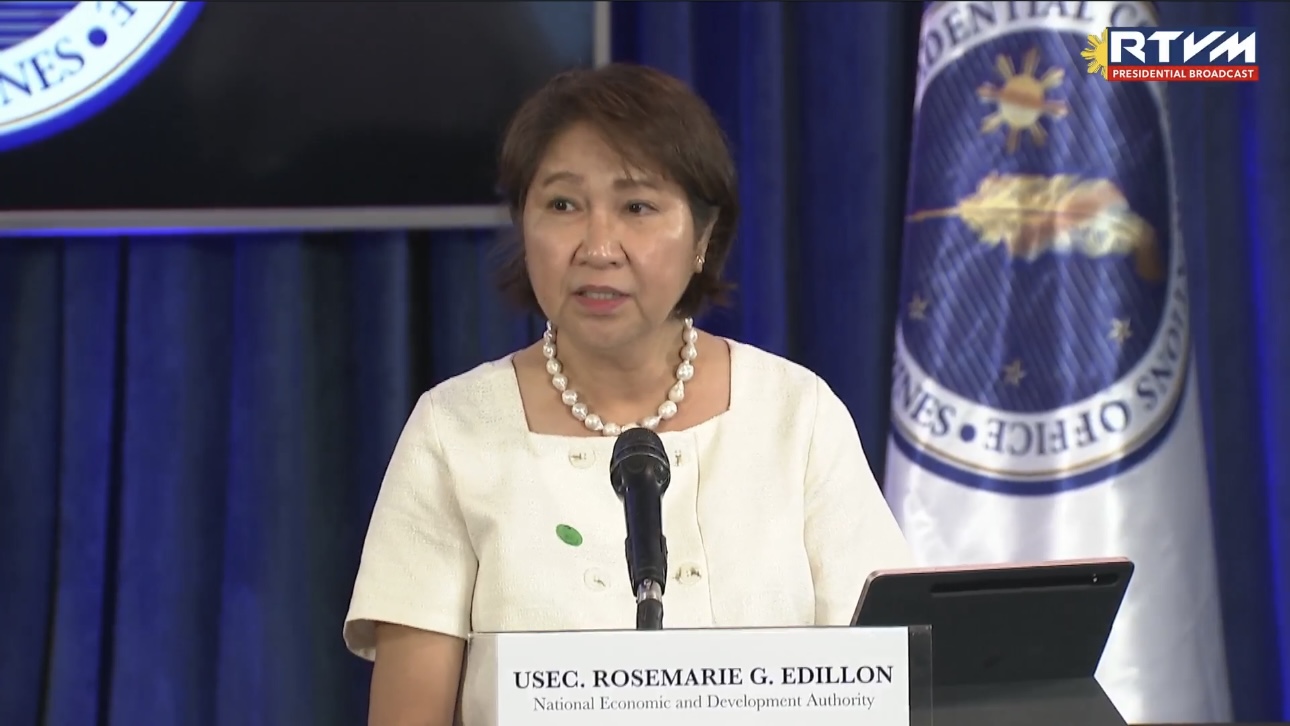 NEDA Undersecretary Rosemarie Edillon (RTVM screenshot)
This was revealed by National Economic and Development Authority (NEDA) Undersecretary Rosemarie Edillon on Tuesday, Nov. 7, in a Palace press briefing after a sectoral meeting with President Marcos.
Though she initially deferred to the Department of Budget and Management (DBM) a question about which among the government agencies improved their spending, she eventually said it was DPWH in terms of capital spending and then followed by DSWD.
Government spending, which was pegged by the country’s economic managers to improve the country’s growth rate by the year’s end, was one of the three agendas that Marcos discussed.
The two others were food inflation and non-food inflation, the NEDA official shared.
“Iyong sa spending, ni-report ng DBM iyong naging progress natin na actually for this third quarter, mataas ang naging spending ng mga ahensya (In terms of spending, the DBM reported on our progress that actually for this third quarter, the agencies had improved spending),” Edillon said.
She expounded that the agencies were able to submit their catch-up plans, while “many of them” improved their spending for the third quarter.
“So, we’re expecting yeah actually that’s until end of September na pala iyong datos nila (their data would be until good until the end of September). So, talagang (really) we’re able to plug naman those holes,” the NEDA official added.
In August this year, NEDA Secretary Arsenio Balisacan said that speeding up the implementation of projects and programs would benefit the economy for the second half of 2023.
He also revealed that the agency has presented its catch-up plans and action plans for government agencies to follow.
Meanwhile, Edillon also discussed a report from the Sub-committee on Inflation and Market Outlook, which was created by Marcos “to provide advice anticipating the developments either in the country and especially outside.”
The directive from the subcommittee was to prepare for the El Niño phenomenon, especially in the agricultural sector since there are ways to ramp up the production in provinces that will be less likely to be affected by the extreme climate, the official said.
She also stressed the need to monitor closely the fuel prices in terms of the impact of non-food items on the country’s overall inflation.
“With respect to non-food inflation, ang nakita namin na medyo kailangan nating bantayan (we can see that we really need to monitor) is still the fuel prices which hindi naman natin masyadong magagawaan ng paraan (we cannot do anything about) except really to manage the demand in which case it’s really energy conservation,” she explained.
The official, however, expressed confidence that even the impact of the Israel-Hamas conflict on fuel and energy prices in case of an escalation could be contained by the completion of several energy power plants and transmission projects by this year or early next year.