







Mayor Jeannie tops NCR mayors' performance survey


Malabon City Mayor Jeannie Sandoval topped an international institution-led survey that assessed the performance of National Capital Region (NCR) mayors in the different aspects of local governance such as creation of public service-centered programs and coordination with their respective constituents.
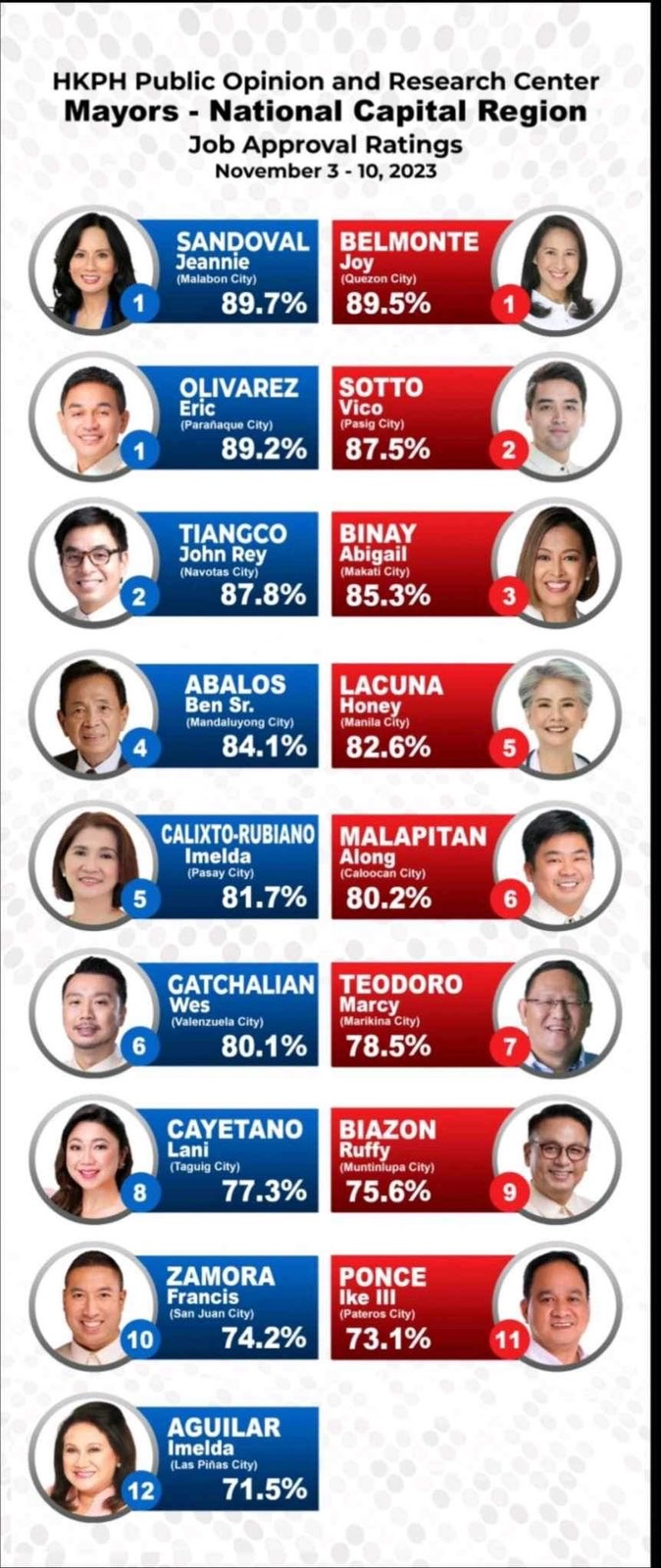
(Photo from HKPH Public Opinion and Research Center)
Sandoval led the survey spearheaded by the HKPH Public Opinion and Research Center in conjunction with the Asia Research Center based in Hong Kong with a whopping 89.7 percent performance score. She was followed by Mayor Joy Belmonte of Quezon City with 89.5 percent, and Mayor Eric Olivarez of Parañaque City with 89.2 percent.
Pasig City Mayor Vico Sotto followed with 87.5 percent, Mayor John Rey Tiangco of Navotas City with 86.8 percent, Mayor Abigail Binay of Makati City with 85.3 percent, Mayor Benjamin Abalos Sr. of Mandaluyong City with 84.1 percent, and Mayor Honey Lacuna of Manila City and Mayor Emi Calixto-Rubiano of Pasay City both with 81.7 percent.
Both Mayor Along Malapitan of Caloocan City and Mayor Wes Gatchalian of Valenzuela City, scored above 80 percent, while Mayor Marcy Teodoro of Marikina City received 78.5 percent, followed by Mayor Lani Cayetano of Taguig City with 77.3 percent, Mayor Ruffy Biazon of Muntinlupa City with 75.6 percent, Mayor Francis Zamora of San Juan City with 74.2 percent, and Mayors Ike Ponce III of Pateros and Imelda Aguilar of Las Piñas City with 73.1 percent and 71.5 percent respectively.
According to Survey Director Steven Su, the survey, which was carried out from Nov. 3 to 10, and involved 1,200 participants, primarily focused on leadership and governance, and scrutinized the mayors' effectiveness in decision making, transparency, and accountability. The evaluation also extensively covered policy implementation in key urban areas, such as housing, transportation, and environmental management.
The report also evaluated the efficiency of public services such as waste management, healthcare, and public safety, as well as the mayors' involvement in economic development, including urban planning, infrastructure projects, and support for local businesses. Their capabilities in managing crises, particularly during natural disasters and public health emergencies, are also assessed.
"The second aspect of the HKPH-ARC assessment delves into community engagement and inclusivity. This part of the evaluation focuses on how mayors interact with residents and address their concerns. The preservation of local culture and heritage is another significant area of assessment, alongside initiatives in education and youth programs. The report pays special attention to the efforts and policies related to environmental sustainability, with a particular emphasis on addressing climate change and ecological protection," Su said.
He added that the survey methodology used in this assessment ensured a representative sample across diverse demographics and socio-economic backgrounds. By combining both qualitative and quantitative questions, the survey was designed to provide depth and accuracy in its findings.
"The objective analysis and reporting of the data are emphasized as crucial elements, aiming to provide a clear understanding of the mayors' impact on the quality of life and overall development within their respective cities and municipality," the director explained.