







Self-rated poverty slightly down in Q3 2023 — OCTA


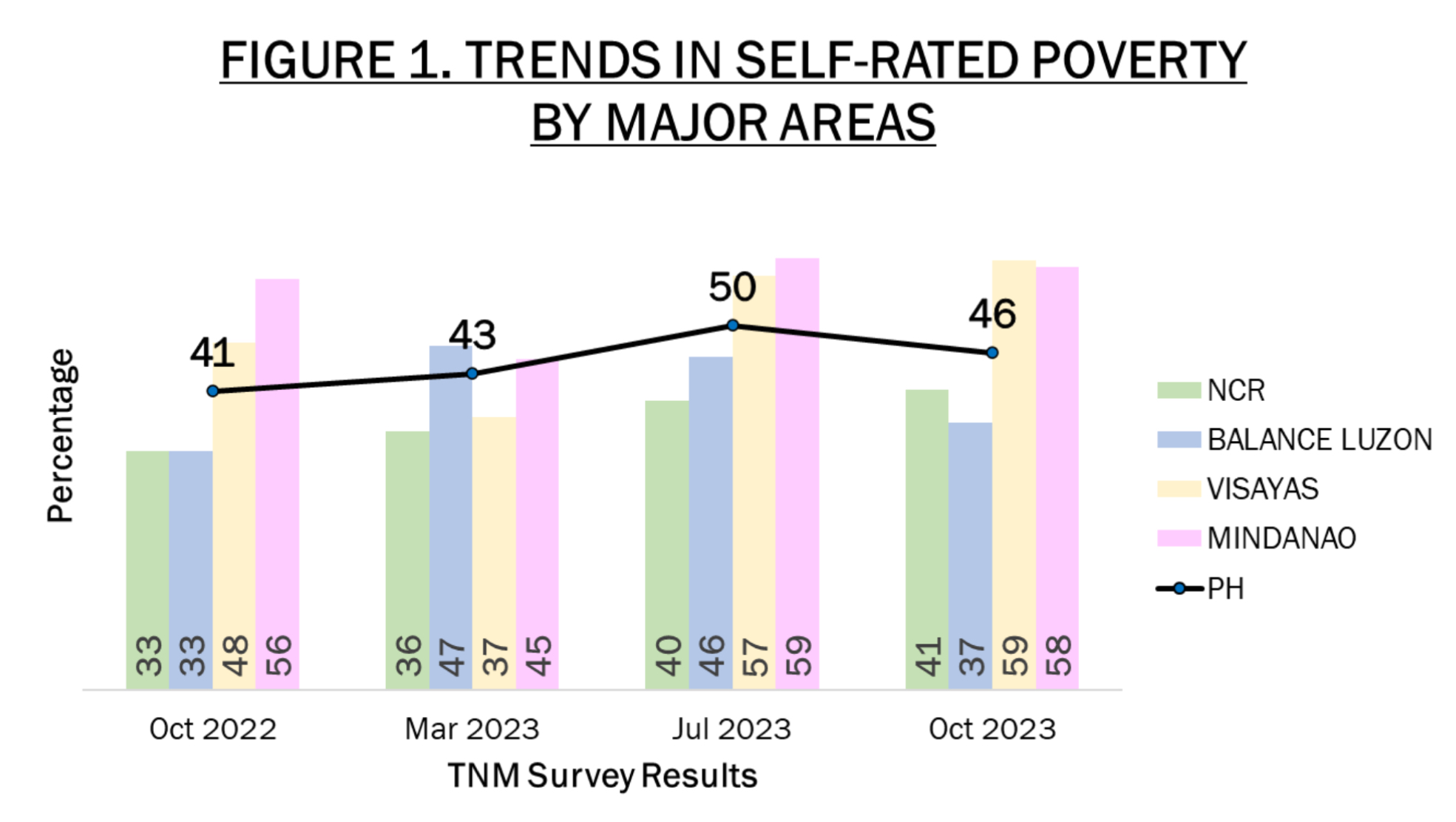
The number of Filipino families who consider themselves “poor” has dropped in the third quarter of 2023, OCTA’s “Tugon ng Masa” survey showed on Tuesday, Nov. 21.
OCTA released the results for its self-rated poverty survey conducted from Sept. 30 to Oct. 4, showing that 46 percent, or an estimated 12.1 million Filipino families consider themselves poor.
“This data represents a slight decrease than the estimated 13.2 million families—at 50 percent—recorded in the second quarter TNM survey conducted last July 2023,” OCTA said in a statement.
“The 4 percent decrease represents approximately 1 million families and is the first time in three quarters that a dip in self-rated poverty was observed,” it added.
OCTA also pointed out that the significant decline in self-rated poverty in Balance Luzon—from 46 to 37 percent—was the primary driver of the overall decrease in self-rated low-income families.
In comparison to other major areas, Visayas has the highest percentage of adult Filipinos who consider their families poor, accounting for 59 percent, closely followed by Mindanao at 58 percent.
OCTA also found that 56 percent of Filipinos continue to believe that their state of poverty in the country has remained the same.
Furthermore, Metro Manila and Balance Luzon have the highest percentages of adult Filipinos who believe the country’s poverty level has remained constant, at 63 percent and 62 percent, respectively.
Meanwhile, 29 percent of adult Filipinos in Visayas believe poverty has improved under the current administration.
OCTA also noted that there has been an increase in the proportion of adult Filipinos who believe that the country’s state of poverty is worse than before, rising from 17 percent in July 2023 to 29 percent in October 2023.
Conversely, the proportion of adult Filipinos who believe the country’s poverty situation is “better than before” has decreased from 21 percent to 12 percent.
A similar trend was observed among adult Filipinos who believe that the state of poverty in the country remains the same, decreasing from 60 percent to 56 percent.
Self-rated hunger improves
During the same survey period, OCTA found that 10 percent, or an estimated 2.6 million families, indicated that they experienced involuntary hunger or “not having anything to eat at least once in the last three months before the survey period.”
“This is lower than the recorded 15 percent or close to 3.9 million families during the Second Quarter TNM survey conducted last July 2023. The 5 percent decrease represents approximately 1.3 million families and is the is the first time in three quarters that a dip in self-rated hunger was observed,” it pointed out.
Across major areas, Visayas had the highest self-rated hunger (13 percent), followed by Balance Luzon (11 percent), Mindanao (9 percent), and Metro Manila (3 percent).
OCTA said that among the major areas, the proportion of Filipino families who experienced involuntary hunger in the previous three months fell by 11 percentage points in Metro Manila, from 14 percent in July 2023 to 3 percent in October 2023.
It added that 91 percent of those whose families experienced hunger in the previous three months said it happened “once or a few times,” while only 9 percent said it happened “frequently or always.”
OCTA’s Third Quarter of 2023 Tugon ng Masa survey is an independent poll that was conducted with 1,200 adult respondents nationwide from Sept. 30 to Oct. 4.