






 Philippines
National
Marcos urges foreign leaders: Broaden Asia Pacific's private sector ties
Philippines
National
Marcos urges foreign leaders: Broaden Asia Pacific's private sector ties
Marcos urges foreign leaders: Broaden Asia Pacific's private sector ties


President Marcos has urged Asia-Pacific leaders to expand the regional bloc's cooperation with the business sector in advancing their agendas.
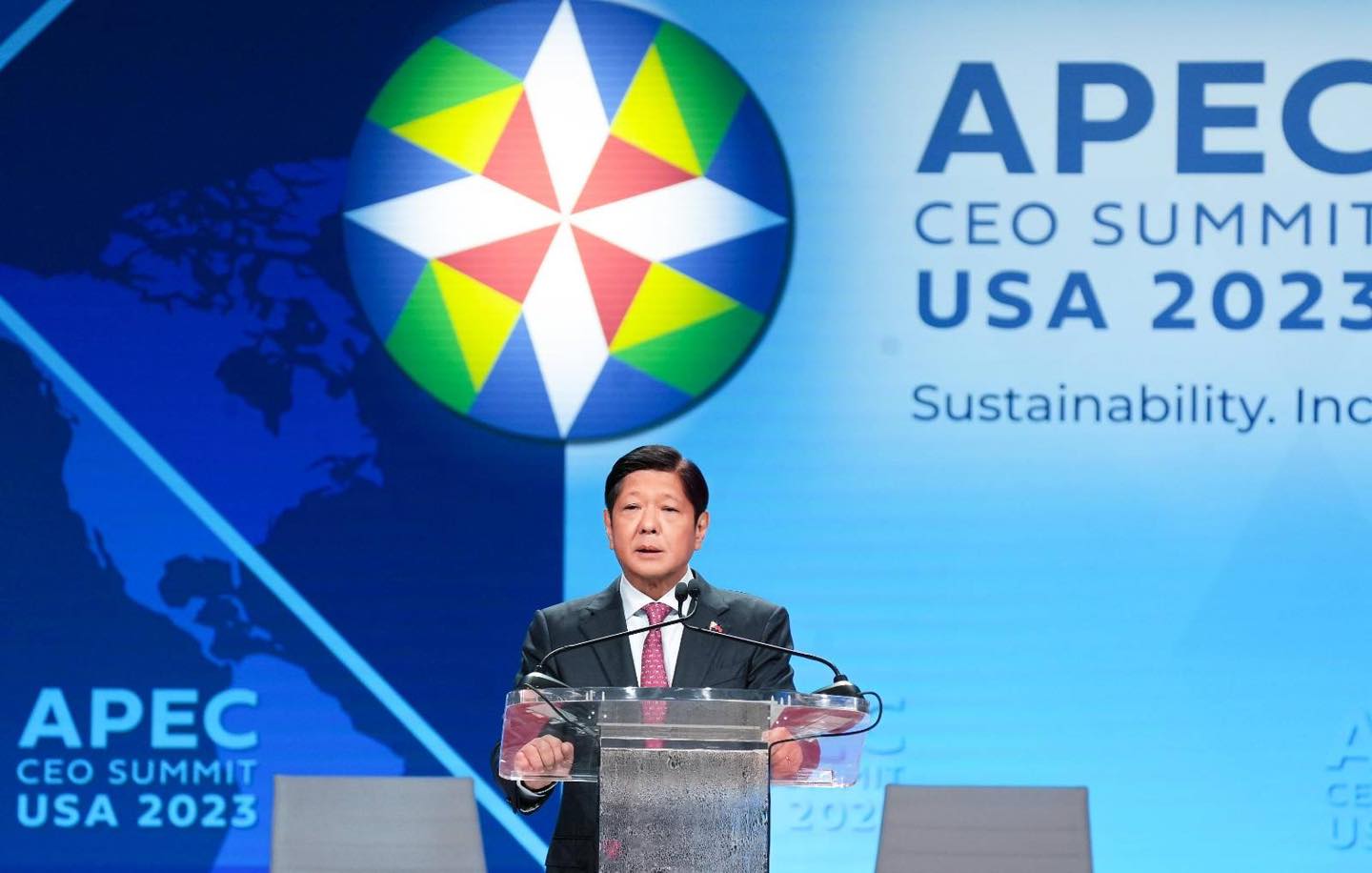
In his opening remarks at the Asia-Pacific Economic Cooperation (APEC) CEO Summit on Thursday, Nov. 16 (Manila time) in San Francisco, Marcos enumerated elements crucial to strengthen the bloc in terms of executing its priorities and strategies.
Marcos stressed that like the Philippines, the regional bloc must bolster its partnership with stakeholders, especially the private sector.
"[T]he partnership of our governments with stakeholders, especially the business sector, must both broaden in scope and deepen in commitments. [Intentional] equity calls for moving away from traditional mere shared financing to formulating frameworks and adopting models that will enable the mainstreaming of sustainable practices in an inclusive manner," he said.
He cited that cooperation with private sector could include sharing of aggregated consumer data from industries to enable evidence-based and scalable public programs and projects; recalibration and standardization of reporting structures and assessment templates to take stock of our progress in an equitable and sustainable growth; and collaboration on the development of environmental, social, and governance (ESG), responsible business conduct (RBC), and good regulatory practices (GRP) and other partners and frameworks that will balance profit and prosperity with the region's accountability to the environment and its people and help ensure that not one group is adversely affected.
"This administration’s partnership with the Philippines’ Private Sector Advisory Council (PSAC) forges a collaborative environment that more easily generates jobs and pursues future-ready, inclusive, and sustainable industrialization," Marcos cited.
The President further said that the APEC's "table must continue to expand to accommodate seats to represent all our people," noting that the US hosting of this year's APEC "has expertly demonstrated how this should be done through stakeholder engagements, policy dialogues, and expert consultations."
He, however, stressed that "as decision-makers, ours is the role to take heed and constructively discuss how to stitch our differing contexts together and multi-directional approaches."
Enlarge the scope of cooperation
Marcos pointed out that the biggest challenge for the region is to "increase the level of our ambition and enlarge the scope of our cooperation."
"The issues that we face - supply chain shocks, food and energy insecurity, natural disasters, health emergencies, and the climate crisis - demand that we augment our efforts to address, mitigate, and pre-empt the negative economic impacts of the Ukraine," he stated.
"Guiding us is the APEC Putrajaya Vision 2040 which, itself, recognizes that progress must be delivered not only in trade and investment liberalization and facilitation, but also in digitalization and innovation, and a strong, balanced, secure, inclusive, and sustainable growth," he added.
Marcos enjoined his fellow leaders to "not waver" in implementing actions from various partnerships and identifying areas for further collaboration "in pursuit of equitable development, including by ensuring that each one is provided with opportunities to participate in the regional and global economy and made resilient from burgeoning shocks."
He said the regional bloc must continue to build on APEC’s partnership with the private sector and be more in sync with the APEC Business Advisory Council (ABAC), and other stakeholders.
"We must act regionally; we must also shrink our intentions globally by finding coherence in our workstreams with those of other economies of the world and other regional and international organizations," he said.
This as he emphasized that APEC is geared towards averting conflict, stressing that "sustained prosperity and progress are only possible in a world that is at peace, which in turn must be a peace that is built on a solid economic foundation."
Do not alienate our people
While he encouraged better relationships with the private sector, Marcos told fellow leaders to not alienate people, particularly the small-scale producers and suppliers within the global value chains.
He said that as economies embrace new technologies, temptations abound to push for one’s own profit from the development of these technologies or to discriminate imports from those deemed non-compliant to environmental standards.
"Those have deleterious effects to not only our supply chains, but will also further exclude our people, especially our small-scale producers, suppliers, and exporters, from participating in global value chains, and thereby, limiting their participation in the production and distribution of products and services that facilitate our sustainable transition," he said.
"Developing economies and our people are most at risk of such alienation," he added.
The President stressed that instead, countries must intensify capacity building, economic cooperation and technical assistance, knowledge and data sharing among economies so that each is empowered and provided with the tools toward sustainable development, while creating complementarities in our economies and further opportunities for trade and investment.