







USAID, DENR launch climate resiliency project in six PH cities


The United States Agency for International Development (USAID) has launched a five-year program with the Department of Environment and Natural Resources (DENR) to help at least six cities to adapt to the adverse effects of climate change.
In a Memorandum of Agreement signed by USAID Mission Director Ryan Washburn DENR Secretary Maria Antonia Yulo Loyzaga, the Philippines’ environment department is tasked to ensure that the outcomes of the Climate Resilient Cities project are always in line with the use of climate data in local climate change planning, in accessing climate finance, and in implementing nature-based solutions are aligned with the Philippine climate change agenda.
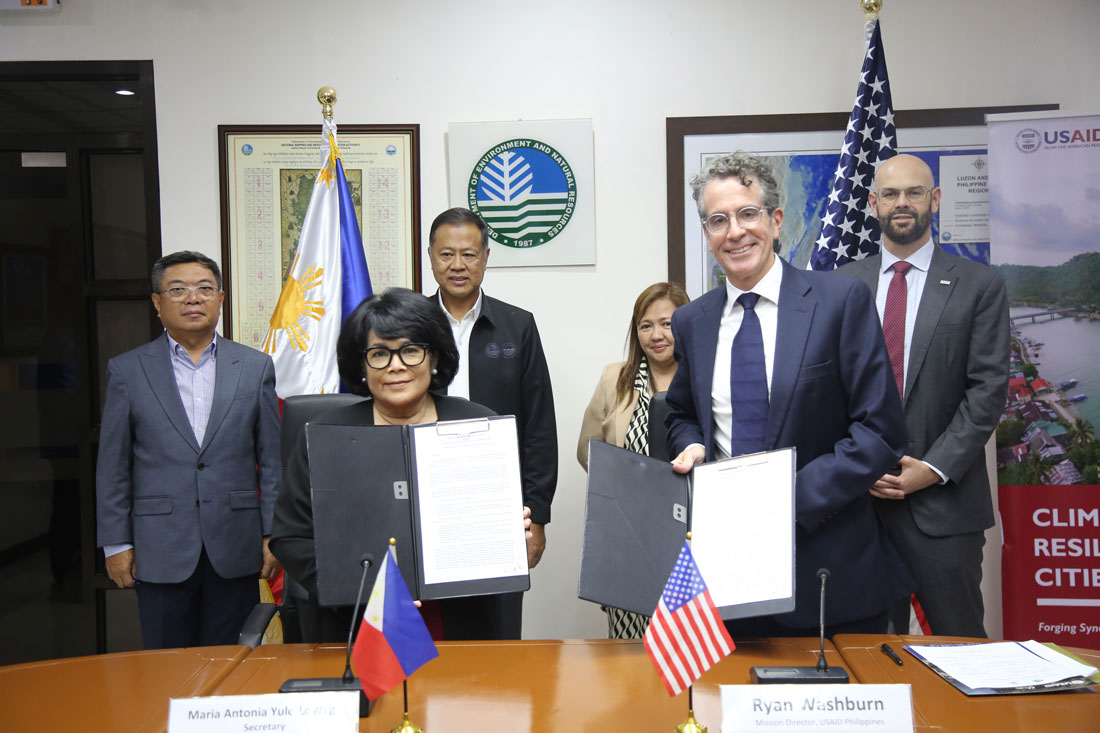
USAID Mission Director Ryan Washburn and Department of Environment and Natural Resources (DENR) Secretary Maria Antonia Yulo Loyzaga sign a Memorandum of Understanding for the five-year, $15 million Climate Resilient Cities (CRC) project to help the cities of Batangas, Borongan, Cotabato, Iloilo, Legazpi and Zamboanga adapt to, mitigate, and endure the impacts of climate change. (photo: DENR)
Among the key targets of the projects are the reduction of the greenhouse gas emissions and help partners build resilience; conservation of 100 million hectares of critical landscapes; and support 500 million people worldwide to prepare and adapt to climate change.
The Climate Resilient Cities project is also supported by the Korea International Cooperation Agency.
“Through the project, DENR and USAID will work towards capacity-building and development programs in partner cities and facilitate workshops and conferences, reform national or local level policies related to climate change and nature-based solutions, organize events, and promote information materials and knowledge products,” Yulo said in a statement.
The Climate Resilient Cities project, which is based on the Philippine climate change agenda through the National Climate Adaptation Plan, will be implemented in the cities of Batangas and Legazpi in Luzon; Borongan and Iloilo in the Visayas; and, Zamboanga and Cotabato in Mindanao.
Yulo said the goal of the project is for the six cities to mitigate and endure the impacts of climate change through knowledge-enhancement and improving access to climate change financing.
“As cities increase in number and size, it underscores the need to enhance resilience capacities to withstand climate-related shocks and stresses,” said Yulo.
“The specific interest of DENR is to enhance anticipatory action, which can be aided by the purpose of this project which is to allow technical capacity to be built in local government units to understand climate data and analysis at a granularity that they can actually use to take focused and direct action,” she added.
For his part, Washburn said the Climate Resilient Cities project is a good preparatory work as the Philippines prepare to launch its National Climate Adaptation Plan at COP 28 (2023 Climate Change Conference).
“USAID is working alongside climate-vulnerable cities in the country to become more resilient to these challenges. Through this project, the US government is helping local governments and other stakeholders better understand, use and disseminate climate information to communities,” said Washburn.
Aside from the DENR, Washburn said the USAID is working with the Catholic Relief Services, as well as its other implementing partners that include the Philippine Disaster Resilience Foundation and Conservation International.
The US government has been a key development partner of the Philippines for the past 60 years, the cooperation expands to working with individuals, communities, and the government to improve lives.