







Makati receives NCR Resilience Champion Award


The Makati City local government received the National Capital Region (NCR) Resilience Champion Award given by the Department of the Interior and Local Government (DILG), Metro Manila Development Authority (MMDA), and the United Nations Development Programme Philippines (UNDP PH).
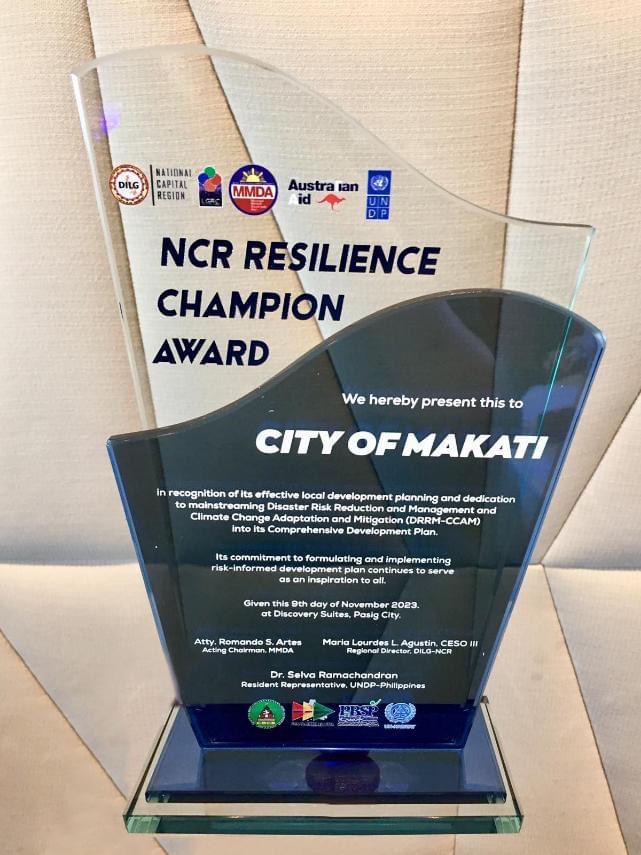
According to Makati City Mayor Abby Binay, the award symbolizes the agencies' recognition of Makati's effective planning and dedication in main streaming its Disaster Risk Reduction and Management and Climate Change Adaptation and Mitigation (DRRM-CCAM) of the Comprehensive Development Plan of Makati.
"Ang UNDP ay may apat na dekada na sa Pilipinas. Isa sa kaniÂlang papel ay ang tulungan ang bansa sa capacity building at palaÂwigin ang democratic governance, sustainable management of natural resources, climate change adaptaÂtion and disaster risk management, at resilience and peacebuilding (UNDP has been in the Philippines for four decades already. One of their roles is to help the country improve its democratic governance, sustainable management of natural resources, climate change adaptaÂtion and disaster risk management, resilience, and peacebuilding)," she added.
The mayor lauded Makati's outstanding Disaster Risk Reduction and ManageÂment and Climate Change Adaptation and Mitigation plan which also serves as a role model of other cities in the creation of their own programs.
In September of 2022, Makati City was proclaimed as the first-ever Resilience Hub in the Philippines and in Southeast Asia by the United Nations Disaster Risk Reduction (UNDRR).
The UNDRR defines resilience hubs as cities, municipalities, or local authorities that have political and technical commitment to take actions to address disaster and climate risks.
It said that in order to qualify as a resilience hub, a city must have reached a high level of resilience building commitments, showed sustained mechanism for DRR/resilience investments, and with an expertise and interest in disseminating best practices to other cities joining the Making Cities Resilient 2030 (MCR2030) initiative. The position is renewable every three years.
MCR2030 resilience hubs may also host international events related to the MCR2030; coordinate study tours to showcase practical examples and share experience; team up with other cities to provide support in the expertise area; provide technical assistance and support training to enhance resilience awareness and in the development and implementation of the DRR/Resilience strategies; publish and disseminate knowledge products, lessons learned and good practices; provide access to partners who can support the journey of twinned cities along the Resilience Roadmap; inject seed financing; and provide assistance with credit ratings and development of municipal bond markets.
Makati's best practices in Disaster Risk Reduction (DRR) have also been shared in a number of international platforms joined by cities all over the region.
In 2017, Makati City enhanced its resilience roadmap – the Makati Disaster Risk Reduction and Management Plan – using the Disaster Resilience Scorecard, an MCR tool.
In 2020, the city used the Disaster Resilience Scorecard Public Health Addendum in coming up with its DRRM-Health Plan that integrates public health emergencies to mitigate their impact on all sectors.
On Sept. 26, the city was chosen as the Disaster Cluster leader of CityNet, the largest association of urban stakeholders aiming to promote sustainable development in the Asia-Pacific region.