

ADVERTISEMENT

1962 Ferrari auctioned for $51.7 M in New York: Sotheby's

Published Nov 14, 2023 01:27 am

At A Glance

  • A 1962 Ferrari 250 GTO sports car sold for $51.7 million in New York on Monday, Nov. 13, making it the second most expensive car ever sold at auction, Sotheby's said.
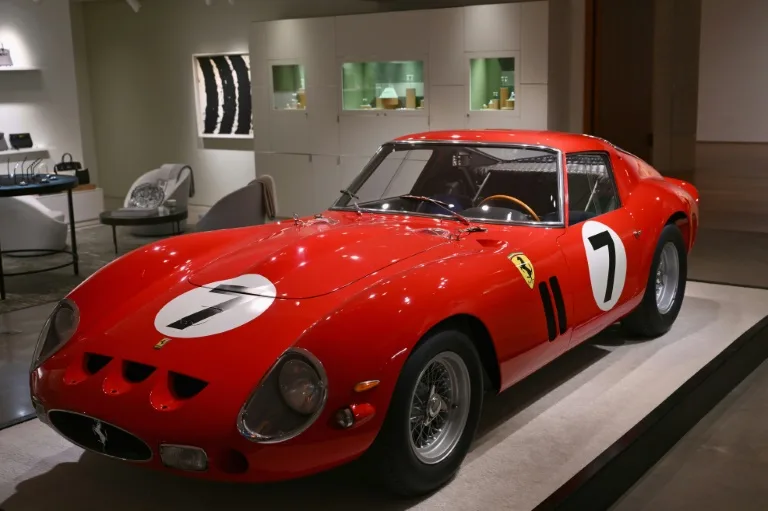
NEW YORK (AFP) -- A 1962 Ferrari 250 GTO sports car sold for $51.7 million in New York on Monday, Nov. 13, making it the second most expensive car ever sold at auction, Sotheby's said.

ferrari 250 gto.webp
The 1962 Ferrari 250 GTO (AFP)

The bright red roadster had been the property of an American collector for the past 38 years, and its auction price was surpassed only by that of a Mercedes 300 SLR Uhlenhaut Coupe that went for 135 million euros in 2022, the auction house said. That would be $144 million at today's exchange rate.

The 250 GTO went on sale Monday evening after a few minutes of bidding in the auction room, but at a price lower than the more than $60 million expected by RM Sotheby's, the luxury car subsidiary of the auction house.

Sotheby's did not identify the winning bidder.

Dating from 1962, this legendary Scuderia sports car -- chassis 3765, four-liter engine developing 390 horsepower -- had finished second in a 1,000 km endurance race on the German Nurburgring circuit, as well as in the legendary 24 Hours of Le Mans, where the team had to withdraw due to engine failure, according to RM Sotheby's.

After several years of competition on the Italian mainland and in Sicily, the car was sold and exported to the US in the late 1960s.

Restored and modified, the 250 GTO changed American owners several times before ending up in the hands of an Ohio "dedicated collector" in 1985, who sold it on Monday.

"This stunning GTO offers its next caretaker further touring and vintage racing enjoyment, or display at major concours d’elegance and marque gatherings worldwide," Sotheby's said.

The Mercedes 300 SLR Uhlenhaut Coupe that fetched 135 million euros in 2022 was one of only two examples of the sport car. It sold at a confidential auction at the German manufacturer's museum in Stuttgart and was the most expensive car ever sold worldwide, whether at auction or privately, a RM Sotheby's spokesman told AFP.

This week, New York auction houses Sotheby's and Christie's conclude their autumn season of art sales, which have not been affected by hard times and are raking in hundreds of millions of dollars.

The market is driven by China and Asia and shows no signs of slowing down, according to Sotheby's, despite a tense international context.

"Whatever happens in the financial markets, a car of this caliber is a collector's item, a once-in-a-lifetime opportunity," Michael Caimano of RM Sotheby's told AFP before the sale, comparing the Ferrari to a work of art that "can be touched, felt and heard."

Related Tags

Ferrari
ADVERTISEMENT
.most-popular .layout-ratio{ padding-bottom: 79.13%; } @media (min-width: 768px) and (max-width: 1024px) { .widget-title { font-size: 15px !important; } }

{{ articles_filter_1561_widget.title }}

.most-popular .layout-ratio{ padding-bottom: 79.13%; } @media (min-width: 768px) and (max-width: 1024px) { .widget-title { font-size: 15px !important; } }

{{ articles_filter_1562_widget.title }}

.most-popular .layout-ratio{ padding-bottom: 79.13%; } @media (min-width: 768px) and (max-width: 1024px) { .widget-title { font-size: 15px !important; } }

{{ articles_filter_1563_widget.title }}

{{ articles_filter_1564_widget.title }}

.mb-article-details { position: relative; } .mb-article-details .article-body-preview, .mb-article-details .article-body-summary{ font-size: 17px; line-height: 30px; font-family: "Libre Caslon Text", serif; color: #000; } .mb-article-details .article-body-preview iframe , .mb-article-details .article-body-summary iframe{ width: 100%; margin: auto; } .read-more-background { background: linear-gradient(180deg, color(display-p3 1.000 1.000 1.000 / 0) 13.75%, color(display-p3 1.000 1.000 1.000 / 0.8) 30.79%, color(display-p3 1.000 1.000 1.000) 72.5%); position: absolute; height: 200px; width: 100%; bottom: 0; display: flex; justify-content: center; align-items: center; padding: 0; } .read-more-background a{ color: #000; } .read-more-btn { padding: 17px 45px; font-family: Inter; font-weight: 700; font-size: 18px; line-height: 16px; text-align: center; vertical-align: middle; border: 1px solid black; background-color: white; } .hidden { display: none; }
function initializeAllSwipers() { // Get all hidden inputs with cms_article_id document.querySelectorAll('[id^="cms_article_id_"]').forEach(function (input) { const cmsArticleId = input.value; const articleSelector = '#article-' + cmsArticleId + ' .body_images'; const swiperElement = document.querySelector(articleSelector); if (swiperElement && !swiperElement.classList.contains('swiper-initialized')) { new Swiper(articleSelector, { loop: true, pagination: false, navigation: { nextEl: '#article-' + cmsArticleId + ' .swiper-button-next', prevEl: '#article-' + cmsArticleId + ' .swiper-button-prev', }, }); } }); } setTimeout(initializeAllSwipers, 3000); const intersectionObserver = new IntersectionObserver( (entries) => { entries.forEach((entry) => { if (entry.isIntersecting) { const newUrl = entry.target.getAttribute("data-url"); if (newUrl) { history.pushState(null, null, newUrl); let article = entry.target; // Extract metadata const author = article.querySelector('.author-section').textContent.replace('By', '').trim(); const section = article.querySelector('.section-info ').textContent.replace(' ', ' '); const title = article.querySelector('.article-title h1').textContent; // Parse URL for Chartbeat path format const parsedUrl = new URL(newUrl, window.location.origin); const cleanUrl = parsedUrl.host + parsedUrl.pathname; // Update Chartbeat configuration if (typeof window._sf_async_config !== 'undefined') { window._sf_async_config.path = cleanUrl; window._sf_async_config.sections = section; window._sf_async_config.authors = author; } // Track virtual page view with Chartbeat if (typeof pSUPERFLY !== 'undefined' && typeof pSUPERFLY.virtualPage === 'function') { try { pSUPERFLY.virtualPage({ path: cleanUrl, title: title, sections: section, authors: author }); } catch (error) { console.error('ping error', error); } } // Optional: Update document title if (title && title !== document.title) { document.title = title; } } } }); }, { threshold: 0.1 } ); function showArticleBody(button) { const article = button.closest("article"); const summary = article.querySelector(".article-body-summary"); const body = article.querySelector(".article-body-preview"); const readMoreSection = article.querySelector(".read-more-background"); // Hide summary and read-more section summary.style.display = "none"; readMoreSection.style.display = "none"; // Show the full article body body.classList.remove("hidden"); } document.addEventListener("DOMContentLoaded", () => { let loadCount = 0; // Track how many times articles are loaded const offset = [1, 2, 3, 4, 5, 6, 7, 8, 9, 10]; // Offset values const currentUrl = window.location.pathname.substring(1); let isLoading = false; // Prevent multiple calls if (!currentUrl) { console.log("Current URL is invalid."); return; } const sentinel = document.getElementById("load-more-sentinel"); if (!sentinel) { console.log("Sentinel element not found."); return; } function isSentinelVisible() { const rect = sentinel.getBoundingClientRect(); return ( rect.top < window.innerHeight && rect.bottom >= 0 ); } function onScroll() { if (isLoading) return; if (isSentinelVisible()) { if (loadCount >= offset.length) { console.log("Maximum load attempts reached."); window.removeEventListener("scroll", onScroll); return; } isLoading = true; const currentOffset = offset[loadCount]; window.loadMoreItems().then(() => { let article = document.querySelector('#widget_1690 > div:nth-last-of-type(2) article'); intersectionObserver.observe(article) loadCount++; }).catch(error => { console.error("Error loading more items:", error); }).finally(() => { isLoading = false; }); } } window.addEventListener("scroll", onScroll); });

Sign up by email to receive news.