

ADVERTISEMENT

CHEd urged to allocate more dev't funds to private HEIs; prioritize the 'poorest' in college subsidy

Published Oct 8, 2023 01:04 pm

The Commission on Higher Education (CHEd) has been urged to allocate more development funds to private higher education institutions (HEIs) and to prioritize the "poorest" students in its college subsidy program.

250419_CHED SCHOLARSHIP_02_BALMORES.jpg
(MARK BALMORES / MANILA BULLETIN / FILE PHOTO)

The Second Congressional Commission on Education (EDCOM 2) highlighted the need for a "balanced" allocation of CHEd's Higher Education Development Fund (HEDF) between private and public HEIs.

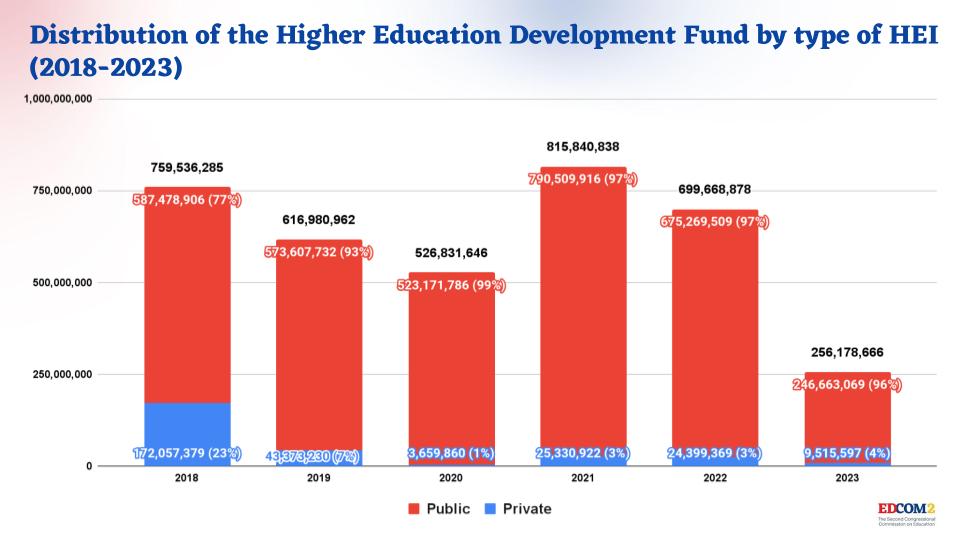
EDCOM 2 data revealed a "disproportionate percentage" of the HEDF allocated to public schools, with 96 percent going to public HEIs and only four percent to private HEIs, even though "86 percent of HEIs in the country are private."

According to EDCOM 2 data from 2018 to 2023, the share of HEDF allocated to public HEIs increased from 77 to 96 percent, while the share allocated to private HEIs decreased from 23 to four percent.
 

edcom1.jpg
EDCOM 2 data points to a disproportionate percentage of the HEDF allotted to public schools (Courtesy of EDCOM 2) 


The HEDF was established through RA 7722, which also created CHEd in 1994, exclusively for the strengthening of higher education nationwide. This establishment of HEDF was in line with the recommendations of the first Education Commission, which defined its purpose as supporting "faculty development, scholarships for deserving but financially challenged students, and improvements to libraries and laboratories."

It was also clarified that the HEDF was intended for both public and private HEIs, taking into account that, at that time, 85 percent of HEIs were private institutions.

Prioritizing the poorest students

Meanwhile, EDCOM 2 also urged CHEd to ensure that the poorest students receive the highest priority in the Tertiary Education Subsidy (TES) program.

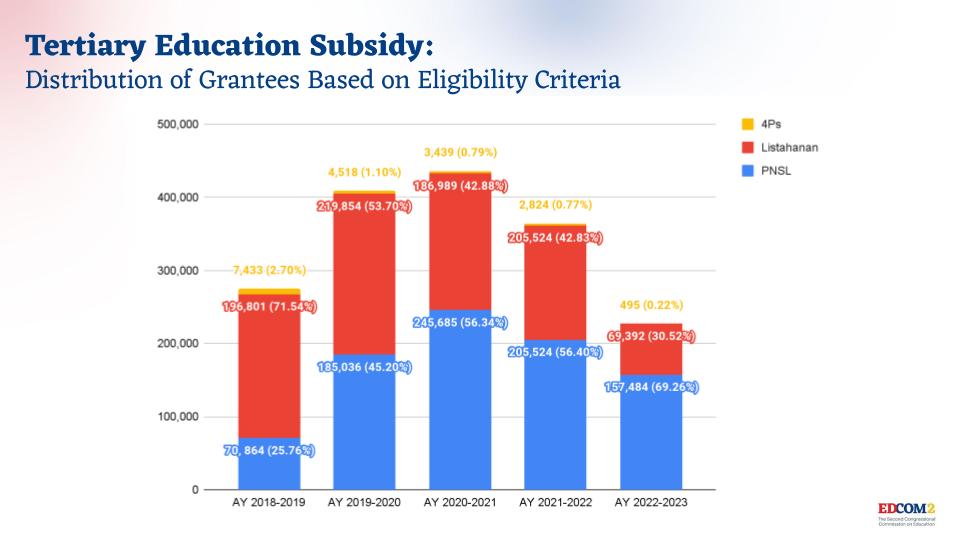
Since 2018, EDCOM 2 pointed out that the share of the poorest scholars under the TES program has continuously declined, leading to a dwindling share of the poorest TES grantees.

The TES is a subsidy established to support all Filipino students enrolling in undergraduate programs at State Universities and Colleges (SUCs), Local Universities and Colleges (LUCs), and private HEIs, as per Republic Act 10931, or the "Universal Access to Quality Tertiary Education."
 

edcom2.jpg
The share of the poorest TES grantees have continuously dwindled since 2018 (Courtesy of EDCOM 2)


TES grantees categorized under "Listahanan" are the neediest students, determined based on the Department of Social Welfare and Development's National Household Targeting System for Poverty Reduction, or Listahanan 2.0, and ranked according to their estimated per capita household income.

Meanwhile, TES grantees under the "PNSL" (Place with No SUC/LUC) category are those enrolled in private higher education institutions in areas without SUCs or LUCs, regardless of their need or household income. The percentage of grantees in this category steadily rose from 25.76 percent in 2018 to 69.26 percent in 2022.

EDCOM 2, established through RA 11899, is a congressional body tasked with conducting a comprehensive national assessment and evaluation of the Philippine education sector.

Over the next three years, EDCOM 2 will also recommend legislative measures to address the education crisis in the country.

Related Tags

Commission on Higher Education
ADVERTISEMENT
.most-popular .layout-ratio{ padding-bottom: 79.13%; } @media (min-width: 768px) and (max-width: 1024px) { .widget-title { font-size: 15px !important; } }

{{ articles_filter_1561_widget.title }}

.most-popular .layout-ratio{ padding-bottom: 79.13%; } @media (min-width: 768px) and (max-width: 1024px) { .widget-title { font-size: 15px !important; } }

{{ articles_filter_1562_widget.title }}

.most-popular .layout-ratio{ padding-bottom: 79.13%; } @media (min-width: 768px) and (max-width: 1024px) { .widget-title { font-size: 15px !important; } }

{{ articles_filter_1563_widget.title }}

{{ articles_filter_1564_widget.title }}

.mb-article-details { position: relative; } .mb-article-details .article-body-preview, .mb-article-details .article-body-summary{ font-size: 17px; line-height: 30px; font-family: "Libre Caslon Text", serif; color: #000; } .mb-article-details .article-body-preview iframe , .mb-article-details .article-body-summary iframe{ width: 100%; margin: auto; } .read-more-background { background: linear-gradient(180deg, color(display-p3 1.000 1.000 1.000 / 0) 13.75%, color(display-p3 1.000 1.000 1.000 / 0.8) 30.79%, color(display-p3 1.000 1.000 1.000) 72.5%); position: absolute; height: 200px; width: 100%; bottom: 0; display: flex; justify-content: center; align-items: center; padding: 0; } .read-more-background a{ color: #000; } .read-more-btn { padding: 17px 45px; font-family: Inter; font-weight: 700; font-size: 18px; line-height: 16px; text-align: center; vertical-align: middle; border: 1px solid black; background-color: white; } .hidden { display: none; }
function initializeAllSwipers() { // Get all hidden inputs with cms_article_id document.querySelectorAll('[id^="cms_article_id_"]').forEach(function (input) { const cmsArticleId = input.value; const articleSelector = '#article-' + cmsArticleId + ' .body_images'; const swiperElement = document.querySelector(articleSelector); if (swiperElement && !swiperElement.classList.contains('swiper-initialized')) { new Swiper(articleSelector, { loop: true, pagination: false, navigation: { nextEl: '#article-' + cmsArticleId + ' .swiper-button-next', prevEl: '#article-' + cmsArticleId + ' .swiper-button-prev', }, }); } }); } setTimeout(initializeAllSwipers, 3000); const intersectionObserver = new IntersectionObserver( (entries) => { entries.forEach((entry) => { if (entry.isIntersecting) { const newUrl = entry.target.getAttribute("data-url"); if (newUrl) { history.pushState(null, null, newUrl); let article = entry.target; // Extract metadata const author = article.querySelector('.author-section').textContent.replace('By', '').trim(); const section = article.querySelector('.section-info ').textContent.replace(' ', ' '); const title = article.querySelector('.article-title h1').textContent; // Parse URL for Chartbeat path format const parsedUrl = new URL(newUrl, window.location.origin); const cleanUrl = parsedUrl.host + parsedUrl.pathname; // Update Chartbeat configuration if (typeof window._sf_async_config !== 'undefined') { window._sf_async_config.path = cleanUrl; window._sf_async_config.sections = section; window._sf_async_config.authors = author; } // Track virtual page view with Chartbeat if (typeof pSUPERFLY !== 'undefined' && typeof pSUPERFLY.virtualPage === 'function') { try { pSUPERFLY.virtualPage({ path: cleanUrl, title: title, sections: section, authors: author }); } catch (error) { console.error('ping error', error); } } // Optional: Update document title if (title && title !== document.title) { document.title = title; } } } }); }, { threshold: 0.1 } ); function showArticleBody(button) { const article = button.closest("article"); const summary = article.querySelector(".article-body-summary"); const body = article.querySelector(".article-body-preview"); const readMoreSection = article.querySelector(".read-more-background"); // Hide summary and read-more section summary.style.display = "none"; readMoreSection.style.display = "none"; // Show the full article body body.classList.remove("hidden"); } document.addEventListener("DOMContentLoaded", () => { let loadCount = 0; // Track how many times articles are loaded const offset = [1, 2, 3, 4, 5, 6, 7, 8, 9, 10]; // Offset values const currentUrl = window.location.pathname.substring(1); let isLoading = false; // Prevent multiple calls if (!currentUrl) { console.log("Current URL is invalid."); return; } const sentinel = document.getElementById("load-more-sentinel"); if (!sentinel) { console.log("Sentinel element not found."); return; } function isSentinelVisible() { const rect = sentinel.getBoundingClientRect(); return ( rect.top < window.innerHeight && rect.bottom >= 0 ); } function onScroll() { if (isLoading) return; if (isSentinelVisible()) { if (loadCount >= offset.length) { console.log("Maximum load attempts reached."); window.removeEventListener("scroll", onScroll); return; } isLoading = true; const currentOffset = offset[loadCount]; window.loadMoreItems().then(() => { let article = document.querySelector('#widget_1690 > div:nth-last-of-type(2) article'); intersectionObserver.observe(article) loadCount++; }).catch(error => { console.error("Error loading more items:", error); }).finally(() => { isLoading = false; }); } } window.addEventListener("scroll", onScroll); });

Sign up by email to receive news.