







PLDT, Smart assure cybersafe 'Makabata Helpline 1383'


As the primary telecommunication partner of the Council for the Welfare of Children (CWC), PLDT Inc. and Smart Communications Corp. assured the public of the cybersecurity and connectivity operations of the expanded “Makabata Helpline 1383.”
The expanded Makabata Helpline 1383, launched on Saturday, Oct. 21, is the flagship program of the CWC that provides a communication tool for children and concerned citizens to safely report any cases of child’s rights violations.
The CWC initially inaugurated the helpline in 2022, but only covered specialized cases of children involved in armed conflict. The program was expanded nationwide to cater to all children’s concerns whether physical, sexual, emotional, and verbal abuse and exploitation, and bullying among others.
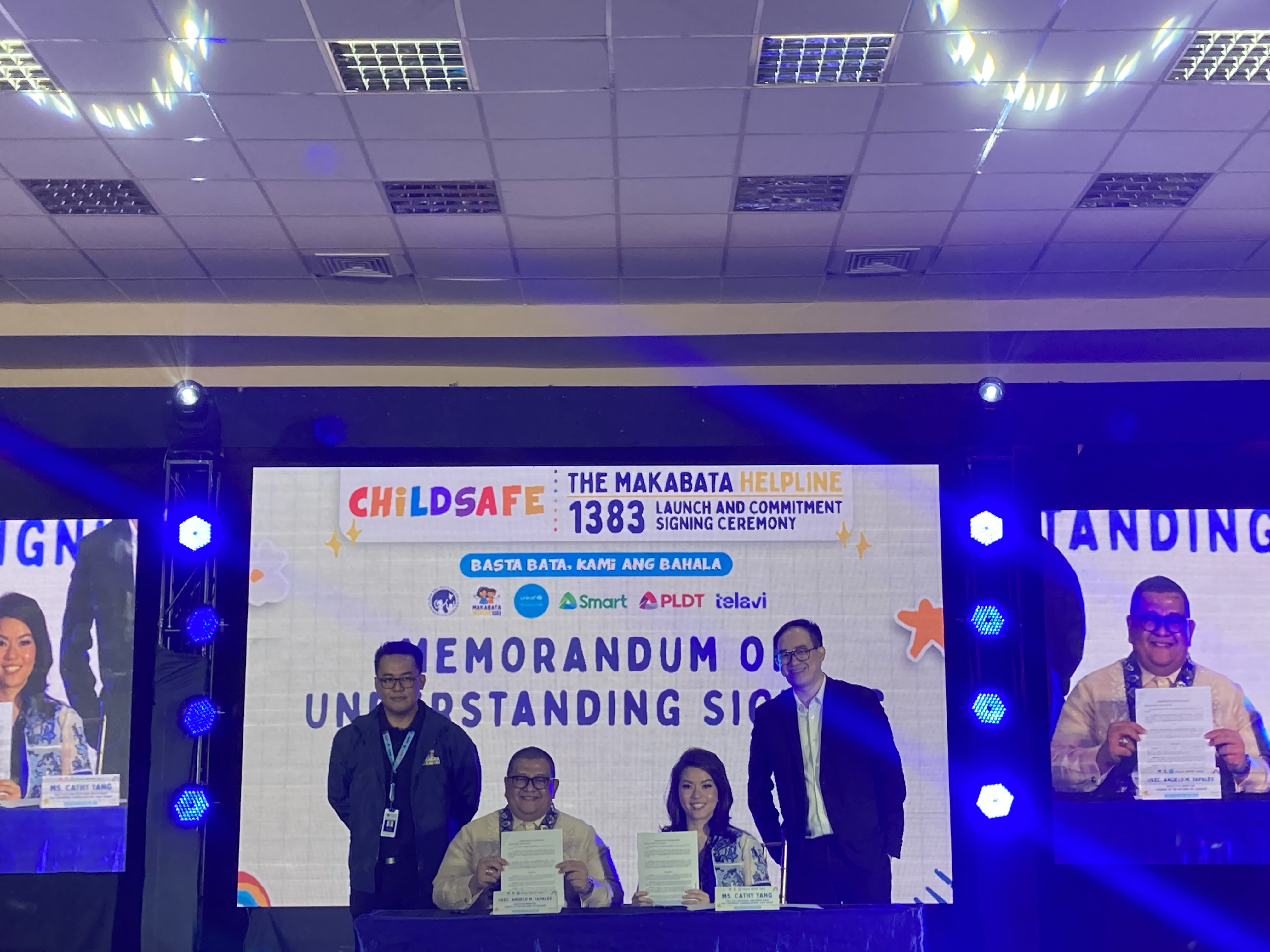
According to William Batac of the PLDT Enterprise Revenue Group, the company provides the platform for the helpline and manages the services that come with the acquired number since it has control of the majority of the country’s telephone lines and has the furthest mobile reach, including callers from the provinces or remote areas.
“When a complainant or concerned citizen dials 1383, we will provide the highway for the CWC to answer and disseminate to the concerned agencies,” he said.
Unlike the initial launch of the helpline last year, Batac shared that the expansion includes a “click-to-call” function wherein the public simply need internet or data access to click the helpline option on the CWC’s website.
To ensure the efficiency of the system, PLDT will train CWC personnel, especially those manning the helpline, to enhance its capabilities, he added.
In terms of cybersecurity, PLDT First Vice President (FVP) and Chief Information Security Officer Angel T. Redoble said the company is continuously coordinating with the CWC to ensure the helpline is safe from third-party callers intercepting the helpline.
“Definitely, we will continue to improve the cybersecurity aspect that we have right now in order to also make sure it’s “future-proof” and we continue to protect this line and not allow anyone who has malicious intent in compromising the helpline,” said Redoble.
Community-based reporting
The Makabata Helpline 1383 functions as an active referral system that can answer childrens’ inquiries, refer cases to the authorities, and help give emergency assistance to children in grave situations.
It has formed partnerships with various organizations and signed 15 memoranda of understanding (MOU) with national and local government agencies like the Philippine National Police (PNP), National Bureau of Protection (NBI), and Women and Children Protection Center, as well as non-government organizations (NGOs) like the United Nations Children’s Fund (UNICEF) Philippines, Child Rights Network, and the private sector such as Miriam College and PLDT and Smart.
“Our partnership with the CWC allows us to be an enabler of a reporting mechanism that is community-based and needed to solve and help children to seek help,” said PLDT FVP and Corporate Communications Head Cathy Yang.
Child Protection Platform
PLDT has developed its own child protection platform that helps them mitigate the proliferation of child sexual abuse and exploitation materials (CSAEM) and help report cases of online sexual abuse and exploitation of children (OSAEC).
PLDT First Vice President (FVP) and Chief Information Security Officer Angel T. Redoble explained that they block the identified and verified links or URLs reported to them by the Internet Watch Foundation (IWF) and the Canadian Centre for Child Protection (C3P) through “Project Arachnid.” It uses a “system-to-system” process of data sharing and communication to prevent their personnel from being exposed to the CSAEM.
“URLs are converted to IP addresses and the IP addresses are broadcast to our environment, so when PLDT or Smart subscribers try to access these URLs, they will be redirected to our child protection platform,” he said.
For CSAEM stored in legitimate websites, Redoble said they are able to “scrutinize the contents of the access, but not all access” since legitimate websites and domains cannot be blocked.
He shared that it took them a year to design their child protection platform to not violate privacy-related laws and address the growing problems of subscribers accessing CSAEM.
“To date, we have 855,000 contents that have been blocked. Since we started the campaign in the fourth quarter of 2021, we have already blocked more than 1.5 billion. Over the years, the access attempts are slowly going down,” said Redoble.
As for CSAEM in social media platforms, PLDT has created a communication channel wherein they communicate directly with the social media companies, inform them of CSAEM on their site and ask them to delete it.
“Luckily enough, they were also fast. So far, no more reports of CSAEM on social media have reached us, but we are very clear also that when we report, they will have to act on it,” he added.
Global Chain of Trust
Redoble and Yang emphasized the company’s goal of establishing the “Global Chain of Trust” which will facilitate partnerships with internet service providers (ISPs) and countries, particularly in the Southeast Asian region, to block and eradicate CSAEM online on a regional level.
“What we really want to do is partner with different telcos. It’s not just us. Other countries will also be involved. We believe that blocking is not sustainable. We block one site, 10 or 100 sites are up in just a few minutes. By creating the Global Chain of Trust, we alienate all these illegitimate, bogus CSAEM websites, and all these countries will share,” said Redoble.