






 Philippines
National
Envoys assert arbitral ruling, UNCLOS after collisions in West PH Sea
Philippines
National
Envoys assert arbitral ruling, UNCLOS after collisions in West PH Sea
Envoys assert arbitral ruling, UNCLOS after collisions in West PH Sea
By Raymund Antonio and Raymund Antonio


More envoys spoke out against the incidents of collision between the China Coast Guard (CCG) and Philippine vessels in the disputed waters of the West Philippine Sea, and called on both countries to follow the 2016 arbitral ruling and a United Nations (UN) convention on maritime laws.
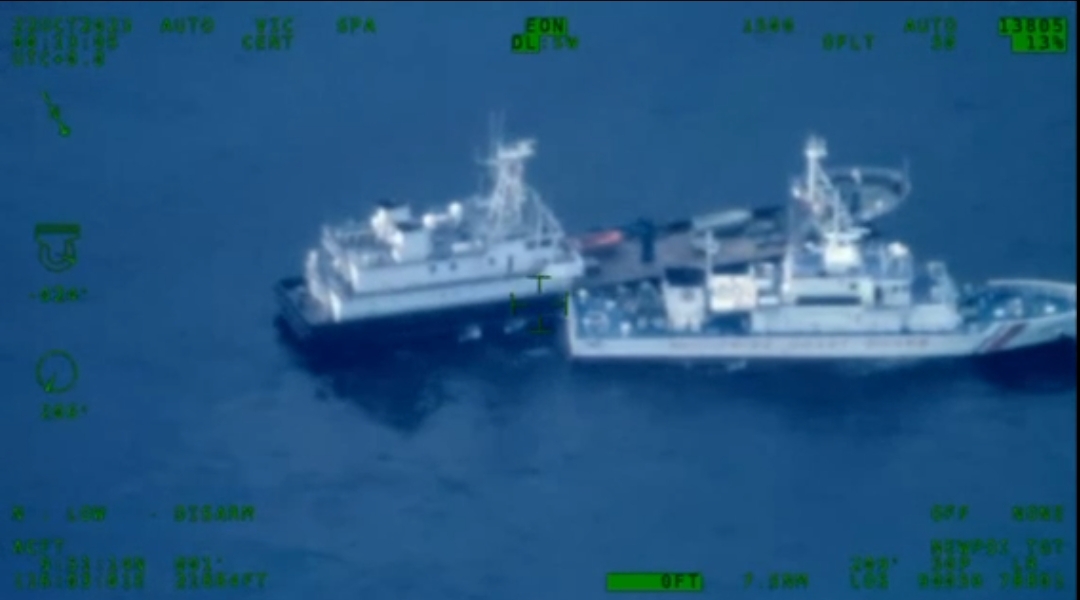 BRP Cabra's (right) port side is bumped by Chinese maritime militia vessel (CMMV) 00003 during a resupply mission at Ayungin Shoal on Oct. 22, 2023. (Photo courtesy of National Task Force for West Philippine Sea)
The ambassadors of France, the United Kingdom, Czech Republic, and New Zealand in the Philippines were the latest envoys to voice out their growing concerns in the incidents in the region.
Their statements published on X (formerly Twitter) follow those of the United States, Canada, Japan, Australia, the European Union, Germany, and The Netherlands.
“Seriously concerned by the collision incidents in the South China Sea today and the dangerous attempts to disrupt a (Philippine) resupply mission in its EEZ,” French Ambassador to Manila Marie Fontanel said.
“(France) calls for respect of the freedom of navigation protected by international law and UNCLOS,” she added, referring to the 1982 United Nations Convention on the Law of the Sea (UNCLOS), the landmark convention that was the basis of the Philippines’ arbitral win over China’s nine-dash line claim.
British Ambassador to the Philippines Laure Beaufils expressed her country’s opposition to raising tensions in the contested waters.
“(United Kingdom) is very concerned by reports of unsafe conduct towards Philippines vessels on their latest resupply mission to the Ayungin Shoal. (UK) joins the (Philippines) in calling for adherence to UNCLOS and the 2016 aribtral award. We oppose actions which raise tensions in the South China Sea,” she wrote.
Czech Republic Ambassador Karel Hejc also took to X to sound the alarm on the “frequency” of the incidents in the region between the Philippines and China.
“We are concerned about both gravity and frequency of the incidents in the South China Sea. We urge all parties to respect their #UNCLOS / international law obligations,” the envoy retweeted a post from the Czech Republic Embassy.
New Zealand Ambassador Peter Kell warned of the “heightening risk to safety and undermining regional stability” that the collision can result to.
“NZ is deeply concerned at Sunday's actions towards the Philippines in its EEZ, with physical contact between vessels heightening risk to safety and undermining regional stability. NZ again calls on all parties to engage in peaceful resolution of disputes in accordance with UNCLOS,” he said as he reposted a statement from the New Zealand Embassy.
The ambassadors’ statements came after the National Task Force for the West Philippine Sea (NTFWPS) reported on Sunday, Oct. 22, that a CCG vessel collided with a Philippine Army-contracted resupply civilian boat and a Philippine Coast Guard (PCG) vessel while on a resupply mission to a grounded Philippine vessel in the Ayungin Shoal.
The collisions followed a series of incidents in the vicinity of the Ayungin Shoal, which is well within the Philippines’ exclusive economic zone (EEZ), where China had been blocking and bullying Philippine vessels in a resupply mission.
Despite winning the 2016 arbitral tribunal, a landmark case that invalidated the basis of China’s nine-dash line claim in the resource-rich waters, Manila was unable to stop Beijing’s aggressive actions in the region.
It has, instead, relied on old and new western allies, particularly the United States, in pushing China to behave in a region geopolitical pundits believe is a potential military flashpoint.
China has spoken adamantly against Western powers’ influence in the world’s most important sea lane for trade and repeatedly pushed for bilateral talks, which Manila shuns because of the imbalance of power.