

ADVERTISEMENT

ASEAN, Gulf states eye peaceful dispute resolution; cooperation vs cybercrime, extremism

Published Oct 21, 2023 07:52 am

At A Glance

  • The leaders reaffirmed the importance of maintaining and promoting peace, stability, maritime safety and security, freedom of navigation and overflight in the region, and other lawful uses of the seas and unimpeded lawful maritime commerce.
  • The leaders wished to enhance trade and investment flows and promote trade and investment relations between the two blocs.
  • The leaders want strong cooperation to protect children's rights and welfare through networking and exchange of policies, knowledge, and best practices.

Southeast Asian countries and Gulf states have agreed to uphold peace and security, address climate change and other mobility issues, and promote free trade while supporting small businesses.
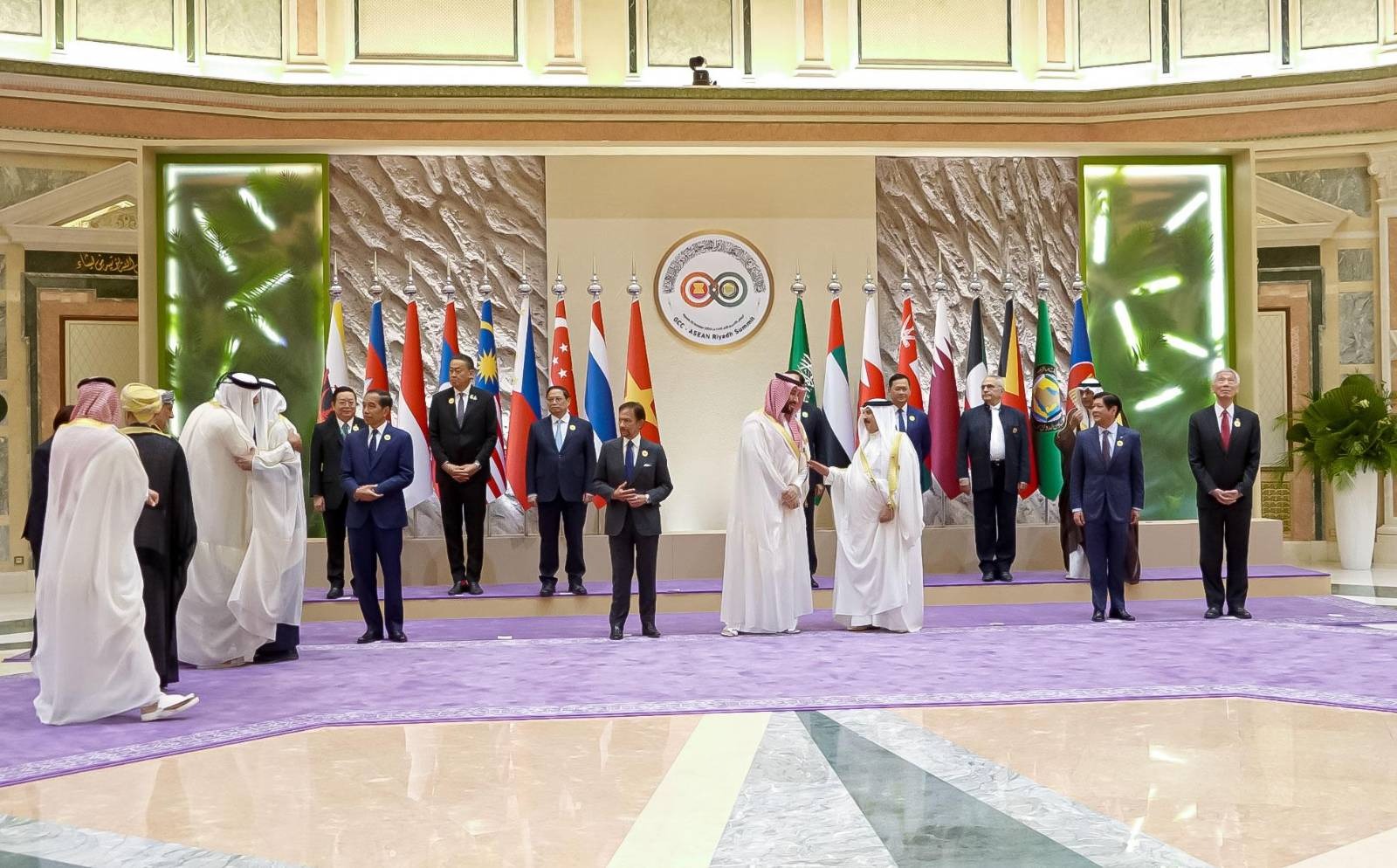
ASEAN-GCC (PCO)
ASEAN-GCC SUMMIT — President Ferdinand 'Bongbong' Marcos joins his fellow leaders from the Association of Southeast Asian Nations (ASEAN) and the Gulf Cooperation Council (GCC) for the first ASEAN-GCC Summit in Riyadh, Kingdom of Saudi Arabia, on Oct. 20, 2023. (Malacañang photo)

The leaders of the Association of Southeast Asian Nations (ASEAN) and the Gulf Cooperation Council (GCC) said this in a joint statement following the first ASEAN-GCC Summit in Riyadh, Kingdom of Saudi Arabia.

In their statement, the leaders said they recognize the importance of oceans and seas in driving growth and prosperity. They likewise reaffirmed the importance of maintaining and promoting peace, stability, maritime safety and security, freedom of navigation and overflight in the region, and other lawful uses of the seas and unimpeded lawful maritime commerce.

They also pushed for the peaceful resolutions of disputes following universally recognized principles of international law, including the 1982 United Nations Convention on the Law of the Sea (UNCLOS) and the relevant standards and recommended practices by the International Civil Aviation Organization (ICAO) and the International Maritime Organization (IMO).

The ASEAN and GCC leaders called for cooperation in preventing and combating transnational crime, cybercrime, counterterrorism, and extremism.


Economic cooperation

In their joint statement, the leaders wished to enhance trade and investment flows by creating mutually beneficial opportunities for joint investments, with particular emphasis on sustainable infrastructure, renewables, petrochemicals, agriculture, manufacturing, health care, tourism, logistics, smart cities, connectivity, and digitalization.

The leaders would prioritize promoting trade and investment relations between the two blocs by enhancing public-private sector engagement and business-to-business relations using available and new physical and online platforms, trade missions, exhibitions, seminars, conferences, and dialogues.

They want to explore cooperation on key economic partnership priorities such as strengthening regional market integration, sustainability, decarbonization, digital transformation, and inclusivity, including MSMEs, public-private sector engagement, and people-to-people ties.

The statement also reaffirmed the positive contributions of Southeast Asian manpower in building the GCC region's sustainable economic growth and development. It encouraged collaboration to promote orderly, safe, regular, and responsible labor mobility while strengthening cooperation to combat trafficking in persons.

The ASEAN and GCC will also explore cooperation and information sharing on information and communications technology (ICT), especially in digital innovation, cybersecurity, data governance, and cross-border data flows.


Peoples' welfare

Based on their statement, the leaders want strong cooperation to protect children's rights and welfare through networking and exchange of policies, knowledge, and best practices.

The leaders likewise encouraged collaboration in promoting gender equality and women's empowerment to eliminate all forms of violence against women, promote women's economic empowerment, and women in the peace and security agenda.

The leaders also declared support for empowering persons with disabilities and older persons.

They likewise encouraged collaboration in building strong and sustainable recovery towards enhanced prevention, preparedness, detection, and response initiatives for all health hazards and threats, including infectious diseases, zoonotic diseases, and health impacts of climate change.


Climate change

With regard to climate change, the ASEAN and GCC stressed the importance and urgency of promoting joint action to mitigate climate change and adapt to its impacts, protect the environment, and develop low-carbon and clean energy technologies, such as renewables, energy efficiency and conservation, carbon abatement, and removal technologies.

The leaders commended the ASEAN and the GCC countries for expressing commitment at COP27 and called for active participation at COP28. With this, they expressed support for the United Arab Emirates hosting COP 28 this December, called for an ambitious and inclusive outcome, and reaffirmed their commitment to the Paris Agreement, stressing the importance of successfully concluding the first Global Stocktake.
 

Related Tags

economic cooperation dispute ASEAN-GCC Summit ASEAN-GCC Climate change
ADVERTISEMENT
.most-popular .layout-ratio{ padding-bottom: 79.13%; } @media (min-width: 768px) and (max-width: 1024px) { .widget-title { font-size: 15px !important; } }

{{ articles_filter_1561_widget.title }}

.most-popular .layout-ratio{ padding-bottom: 79.13%; } @media (min-width: 768px) and (max-width: 1024px) { .widget-title { font-size: 15px !important; } }

{{ articles_filter_1562_widget.title }}

.most-popular .layout-ratio{ padding-bottom: 79.13%; } @media (min-width: 768px) and (max-width: 1024px) { .widget-title { font-size: 15px !important; } }

{{ articles_filter_1563_widget.title }}

{{ articles_filter_1564_widget.title }}

.mb-article-details { position: relative; } .mb-article-details .article-body-preview, .mb-article-details .article-body-summary{ font-size: 17px; line-height: 30px; font-family: "Libre Caslon Text", serif; color: #000; } .mb-article-details .article-body-preview iframe , .mb-article-details .article-body-summary iframe{ width: 100%; margin: auto; } .read-more-background { background: linear-gradient(180deg, color(display-p3 1.000 1.000 1.000 / 0) 13.75%, color(display-p3 1.000 1.000 1.000 / 0.8) 30.79%, color(display-p3 1.000 1.000 1.000) 72.5%); position: absolute; height: 200px; width: 100%; bottom: 0; display: flex; justify-content: center; align-items: center; padding: 0; } .read-more-background a{ color: #000; } .read-more-btn { padding: 17px 45px; font-family: Inter; font-weight: 700; font-size: 18px; line-height: 16px; text-align: center; vertical-align: middle; border: 1px solid black; background-color: white; } .hidden { display: none; }
function initializeAllSwipers() { // Get all hidden inputs with cms_article_id document.querySelectorAll('[id^="cms_article_id_"]').forEach(function (input) { const cmsArticleId = input.value; const articleSelector = '#article-' + cmsArticleId + ' .body_images'; const swiperElement = document.querySelector(articleSelector); if (swiperElement && !swiperElement.classList.contains('swiper-initialized')) { new Swiper(articleSelector, { loop: true, pagination: false, navigation: { nextEl: '#article-' + cmsArticleId + ' .swiper-button-next', prevEl: '#article-' + cmsArticleId + ' .swiper-button-prev', }, }); } }); } setTimeout(initializeAllSwipers, 3000); const intersectionObserver = new IntersectionObserver( (entries) => { entries.forEach((entry) => { if (entry.isIntersecting) { const newUrl = entry.target.getAttribute("data-url"); if (newUrl) { history.pushState(null, null, newUrl); let article = entry.target; // Extract metadata const author = article.querySelector('.author-section').textContent.replace('By', '').trim(); const section = article.querySelector('.section-info ').textContent.replace(' ', ' '); const title = article.querySelector('.article-title h1').textContent; // Parse URL for Chartbeat path format const parsedUrl = new URL(newUrl, window.location.origin); const cleanUrl = parsedUrl.host + parsedUrl.pathname; // Update Chartbeat configuration if (typeof window._sf_async_config !== 'undefined') { window._sf_async_config.path = cleanUrl; window._sf_async_config.sections = section; window._sf_async_config.authors = author; } // Track virtual page view with Chartbeat if (typeof pSUPERFLY !== 'undefined' && typeof pSUPERFLY.virtualPage === 'function') { try { pSUPERFLY.virtualPage({ path: cleanUrl, title: title, sections: section, authors: author }); } catch (error) { console.error('ping error', error); } } // Optional: Update document title if (title && title !== document.title) { document.title = title; } } } }); }, { threshold: 0.1 } ); function showArticleBody(button) { const article = button.closest("article"); const summary = article.querySelector(".article-body-summary"); const body = article.querySelector(".article-body-preview"); const readMoreSection = article.querySelector(".read-more-background"); // Hide summary and read-more section summary.style.display = "none"; readMoreSection.style.display = "none"; // Show the full article body body.classList.remove("hidden"); } document.addEventListener("DOMContentLoaded", () => { let loadCount = 0; // Track how many times articles are loaded const offset = [1, 2, 3, 4, 5, 6, 7, 8, 9, 10]; // Offset values const currentUrl = window.location.pathname.substring(1); let isLoading = false; // Prevent multiple calls if (!currentUrl) { console.log("Current URL is invalid."); return; } const sentinel = document.getElementById("load-more-sentinel"); if (!sentinel) { console.log("Sentinel element not found."); return; } function isSentinelVisible() { const rect = sentinel.getBoundingClientRect(); return ( rect.top < window.innerHeight && rect.bottom >= 0 ); } function onScroll() { if (isLoading) return; if (isSentinelVisible()) { if (loadCount >= offset.length) { console.log("Maximum load attempts reached."); window.removeEventListener("scroll", onScroll); return; } isLoading = true; const currentOffset = offset[loadCount]; window.loadMoreItems().then(() => { let article = document.querySelector('#widget_1690 > div:nth-last-of-type(2) article'); intersectionObserver.observe(article) loadCount++; }).catch(error => { console.error("Error loading more items:", error); }).finally(() => { isLoading = false; }); } } window.addEventListener("scroll", onScroll); });

Sign up by email to receive news.