






Manila Bulletin
 Philippines
National
House receives P6.793-T NEP for 2026; budget deliberations moved up to Aug 18
Philippines
National
House receives P6.793-T NEP for 2026; budget deliberations moved up to Aug 18
Philippines
National
House receives P6.793-T NEP for 2026; budget deliberations moved up to Aug 18
House receives P6.793-T NEP for 2026; budget deliberations moved up to Aug 18
Published Aug 13, 2025 01:27 pm


At A Glance
- The leadership of the House of Representatives has decided to begin its formal deliberations on the P6.793-trillion National Expenditure Program (NEP) for 2026 two weeks earlier than previously announced.
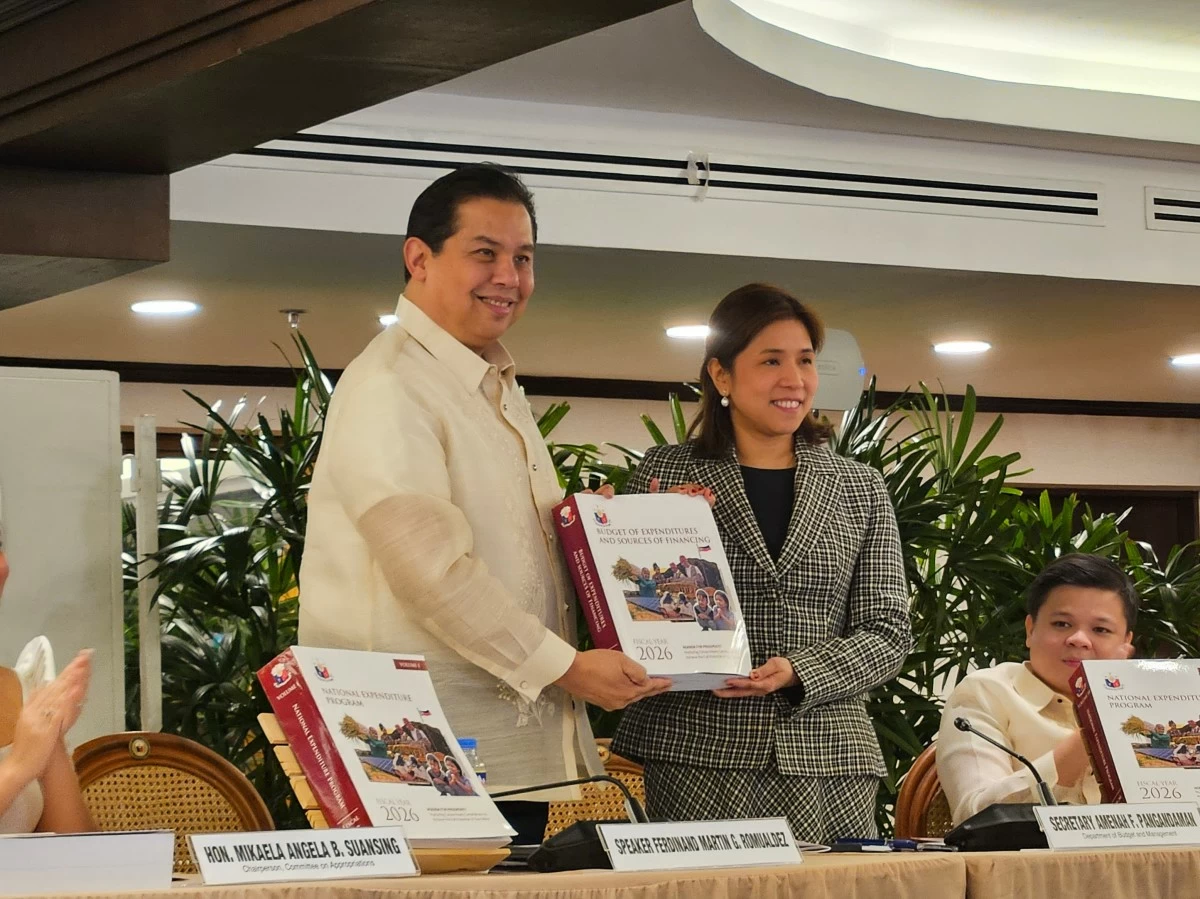
House Speaker Martin Romualdez (left), DBM Secretary Amenah Pangandaman (Ellson Quismorio/ MANILA BULLETIN)
The leadership of the House of Representatives has decided to begin its formal deliberations on the P6.793-trillion National Expenditure Program (NEP) for 2026 two weeks earlier than previously announced.
This was bared by Nueva Ecija 1st district Rep. Mikaela Angela "Mika" Suansing during a press conference Wednesday, Aug. 13--the same day that the House received a copy of the 2026 NEP from the Department of Budget and Management (DBM).
"One important announcement on the part of the House is, deliberations kick off na po (the deliberations will kick off) on Aug. 18 because before we were looking at a later date," said Suansing, chairperson of the House Committee on Appropriations in the 20th Congress.
"But now that we have the NEP with us, we would like to start the deliberations as quickly as possible," she said.
Suansing previously said that the NEP discussions would begin on Sept. 1 with a briefing with the Development Budget Coordination Committee (DBCC).
"So Monday po, we do the DBCC and that allows us a lot of time because as we committed on the part of the House with the reforms that we're putting forward...we would like to do that over the course of the deliberations, that's why we want to allow for more time for the deliberations," said the "Young Guns" bloc member.
"So we're starting on Aug. 18 all the way through Oct. 10. Sa panahon po na yun mahihimay po talaga natin ang budget (We will truly be able to peruse the budget during that time peirod)," Suansing said.
The appropriations committee leads the annual deliberations in the House as far as the General Appropriations Bill (GAB) or proposed national budget is concerned. The GAB is based on the NEP, which originates from the executive branch.
Among those who attended the ceremonial turnover of the NEP Wednesday morning were House Speaker Martin Romualdez, DBM Secretary Amenah Pangandaman, Suansing, and House Majority Leader Ilocos Norte 1st district Rep. Sandro Marcos.
The 2026 NEP--(equivalent to 22 percent of the country’s GDP (gross domestic product)--is 7.4 percent higher than this year’s P6.326-trillion budget, with bigger allocations for education, healthcare, social protection, and food security to sustain the country’s economic momentum.
“Today’s turnover of the 2026 NEP from the DBM is not just a formality. It is the first step in shaping how our government will serve the Filipino people in the year ahead,” Romualdez said.
“[The NEP] is the government’s plan to make the vision of a Bagong Pilipinas real—roads that connect communities, markets where food is affordable, schools that open doors to opportunity, hospitals that save lives, and safe, secure communities for every Filipino,” noted the Speaker.
He added: “A budget is not just a spending plan—it is a mirror of our priorities and a measure of our accountability to the people. And because this is the people’s money, the process of crafting it must be transparent, inclusive, and worthy of public trust.”
Five key reforms
In his speech during the program, Romualdez enumerated five key reforms that the House intends starting with this year's budget cycle. These are all designed to improve the transparency of the process.
Romualdez said the House will remove the “small committee” it formed in the past after approving the budget to collate institutional amendments.
The second reform would be the opening of the House-Senate conference to reconcile their versions of the budget to the public and the media.
“Third, we will invite civil society, people’s organizations, and the private sector to join budget hearings. Ang pambansang budget ay hindi pag-aari ng mga politiko; ito ay pera ng bawat Pilipinong nagbabayad ng buwis (Politicians don't own the national budget: this is the money of every taxpaying Filipino),” Romualdez said.
The fourth would be the strengthening of the House oversight function in the execution of the budget. This would require timely reports from agencies and real-time tracking of major projects.
“And fifth, we will prioritize investments that truly change lives: agriculture for food security, infrastructure for connectivity and jobs, education for opportunity, health for all, and defense and disaster preparedness for national safety,” he said.
He said the planned reforms “are not meant to slow the proces - they are meant to make it better, stronger, and more trusted".
Sandro praises appropriations chief
For his part, Rep. Marcos says the House is aiming to transmit the GAB to the other legislative chamber, the Senate, before the first adjournment of Congress on Oct 10.
"Hopefully by October 9, 8 we will have finished all that needs to be done and then we will to the Senate on the last day before adjournment. This is the ideal situation na hindi tayo magkaroon ng problema (that is devoid of problems)," he said.
Rep. Marcos went on to praise Suansing, Harvard University graduate, for moving up the date of the budget deliberations.
"Thankfully, ang galing ng bagong [appropriations panel] chairwoman natin, si chair Mika Suansing (Thankfully, our new appropriations panel chairwoman, Milka Suansing, is quite good)."
"She left a little bit of a buffer...in the case that we run into some unforeseen obstacles--which we always do--we will be able to make up for that," the majority leader said.