

ADVERTISEMENT

Unspooling the threads of the Chinese diaspora

Winna Go delves into the complexities of migration, identity, and cultural heritage

Published Aug 30, 2024 04:15 pm

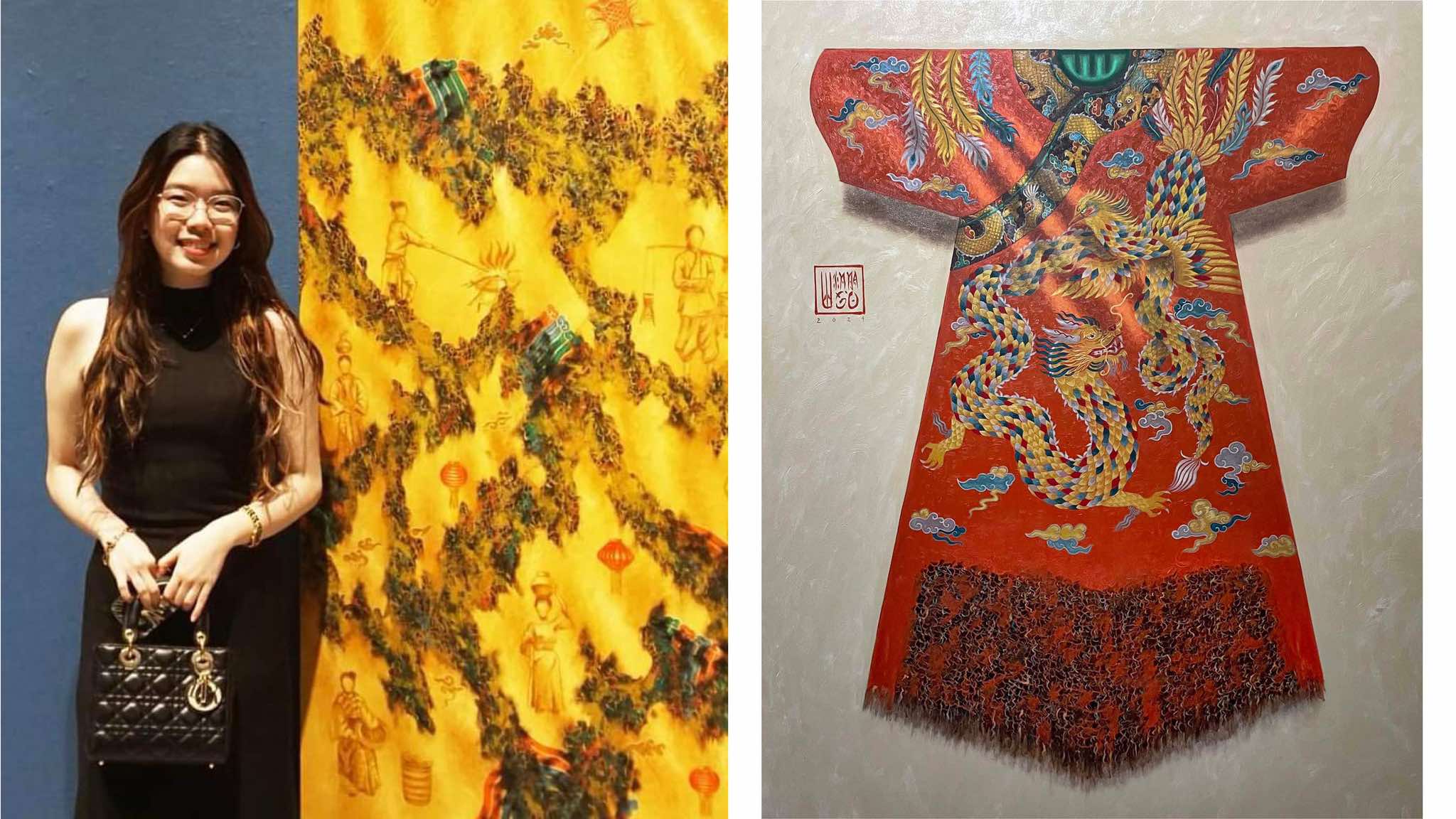
Winna Go’s third solo exhibit “On the Roots and Routes of Diaspora” offered a visual exploration of the Chinese diaspora in Southeast Asia. Through her intricate silk paintings and installations, the visual artist delved into the complexities of migration, identity, and cultural heritage.
456991565_1578415939746701_5337496157784776933_n.jpg
Winna Go and her Equipoise of Being painting

“I was inspired to pursue this trajectory thanks to my Master’s thesis that I wrote when I was taking my graduate studies in Cultural and Creative Industries at Taipei National University of the Arts,” says Go. “I focused on the Sinophone diaspora and culture in Southeast Asia, particularly in the Philippines, and how each community localized and assimilated in their country of choice.”

This topic resonates deeply and personally with the artist, whose ancestors were part of this diaspora. “They were brave enough to leave China back in the 1900s and travel all the way to the Philippines in search for a better life,” she explains. “This exhibit for me is a way of giving homage to the sacrifices of bravery not just of the ancestors of the Chinese Filipino but to everyone else experiencing their own versions of diaspora.”
456135709_753177750203475_4216350079079938758_n.jpg
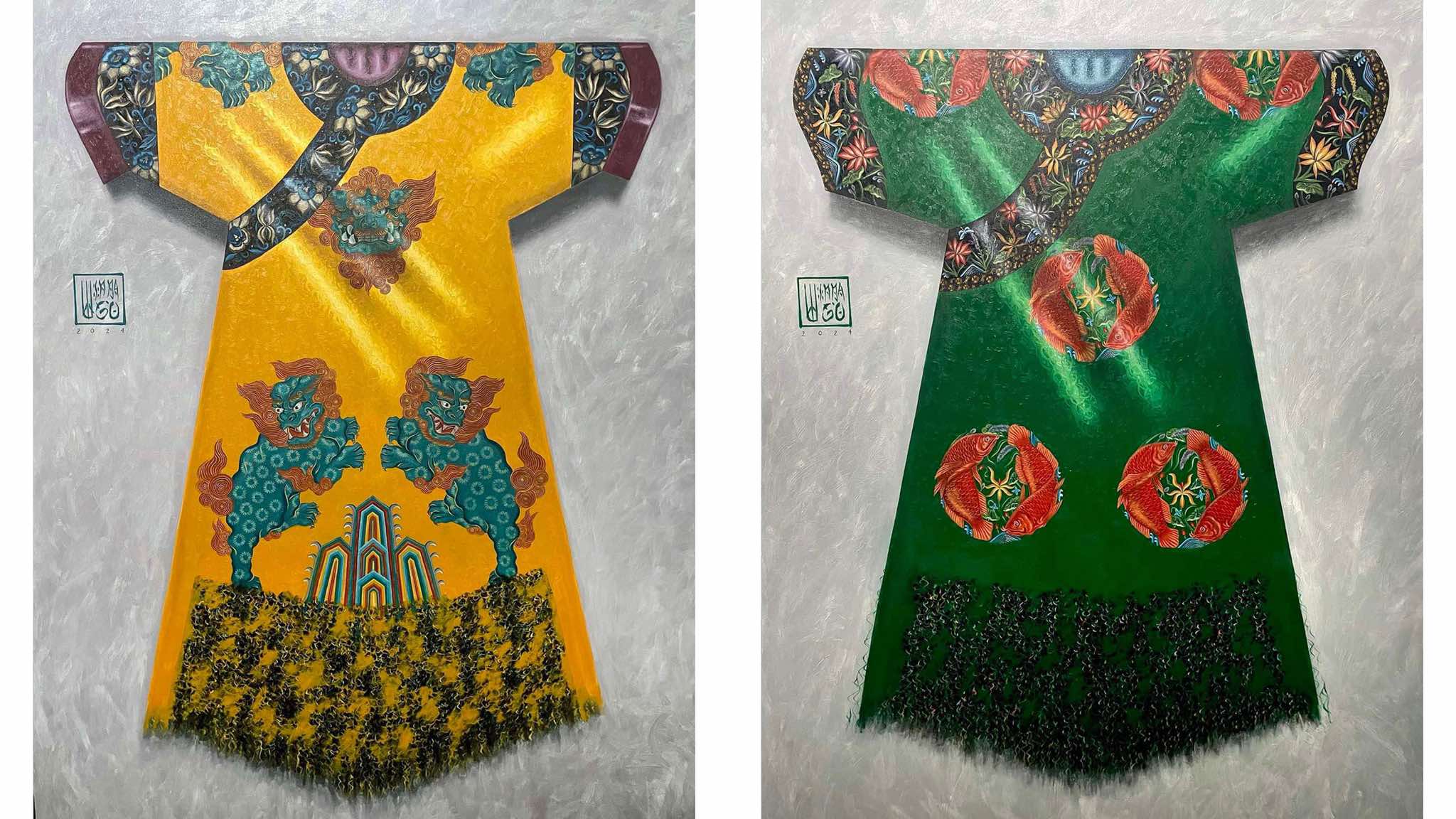
Imperial Guardian Lions and The Fortune Arowanas

Go’s focus on the Chinese diaspora in Southeast Asia reflects growing interest in understanding the experiences of diverse communities and their contributions to the region’s cultural landscape.

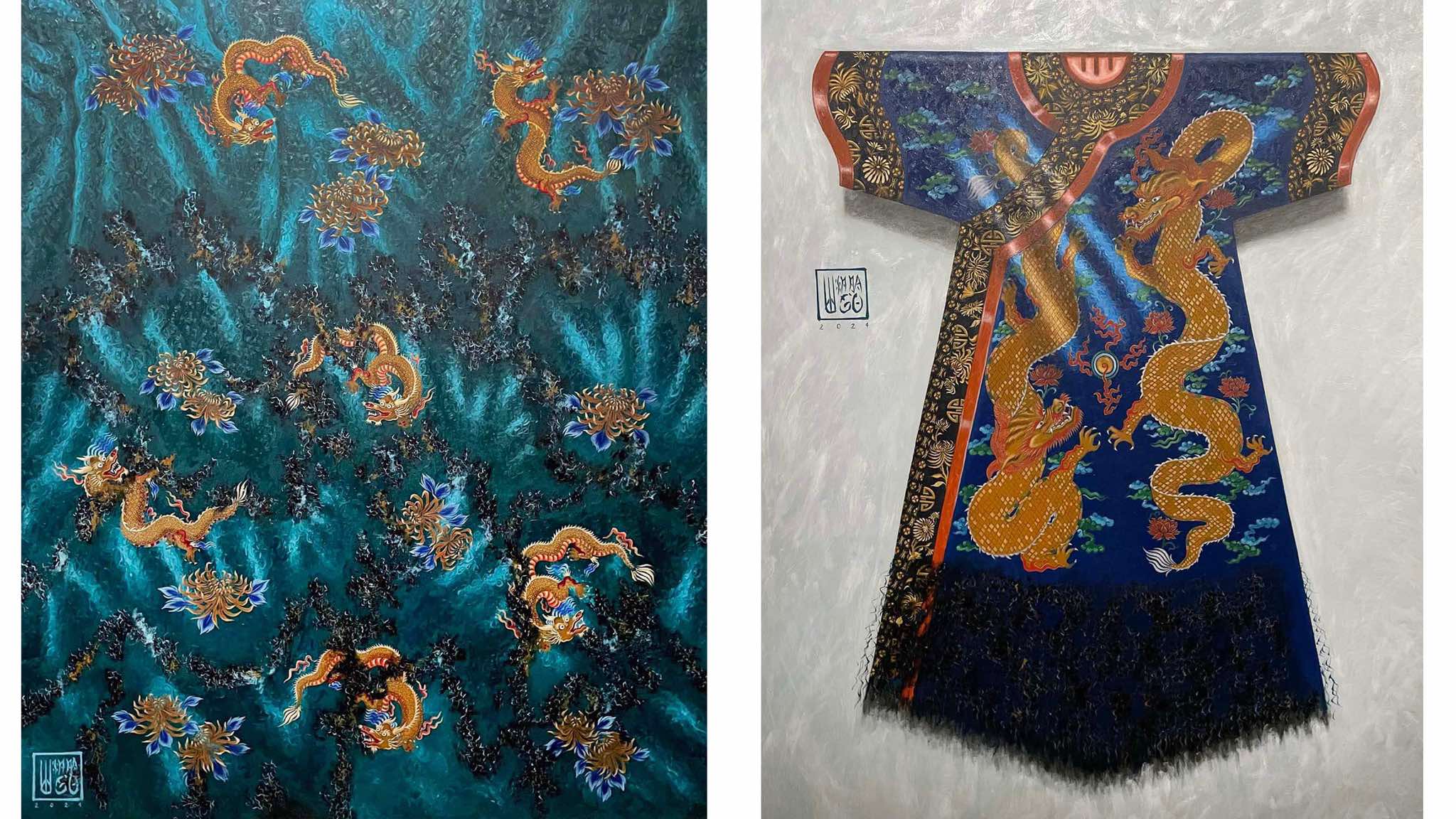
One of the striking features of Go’s work, as exhibited in “On the Roots and Routes of Diaspora” was her use of silk as a medium. “The unraveling of hems or the deConstructed series symbolizes the idea of embracing destruction in order to give room to artistic creation,” she says. “It also represents how culture is no longer homogenous, challenging the mainland’s vision of a unified Chinese identity. In ancient China, the imperial robes could only be worn by the Chinese royal families, the ultimate representation of purity of Chinese identity and culture. By deconstructing the silk, it conveys the re-imagination of the possible, the openness of the cloth to be re-stitched and therefore redefined.”
456500643_1574428240098738_1362357569694141991_n.jpg
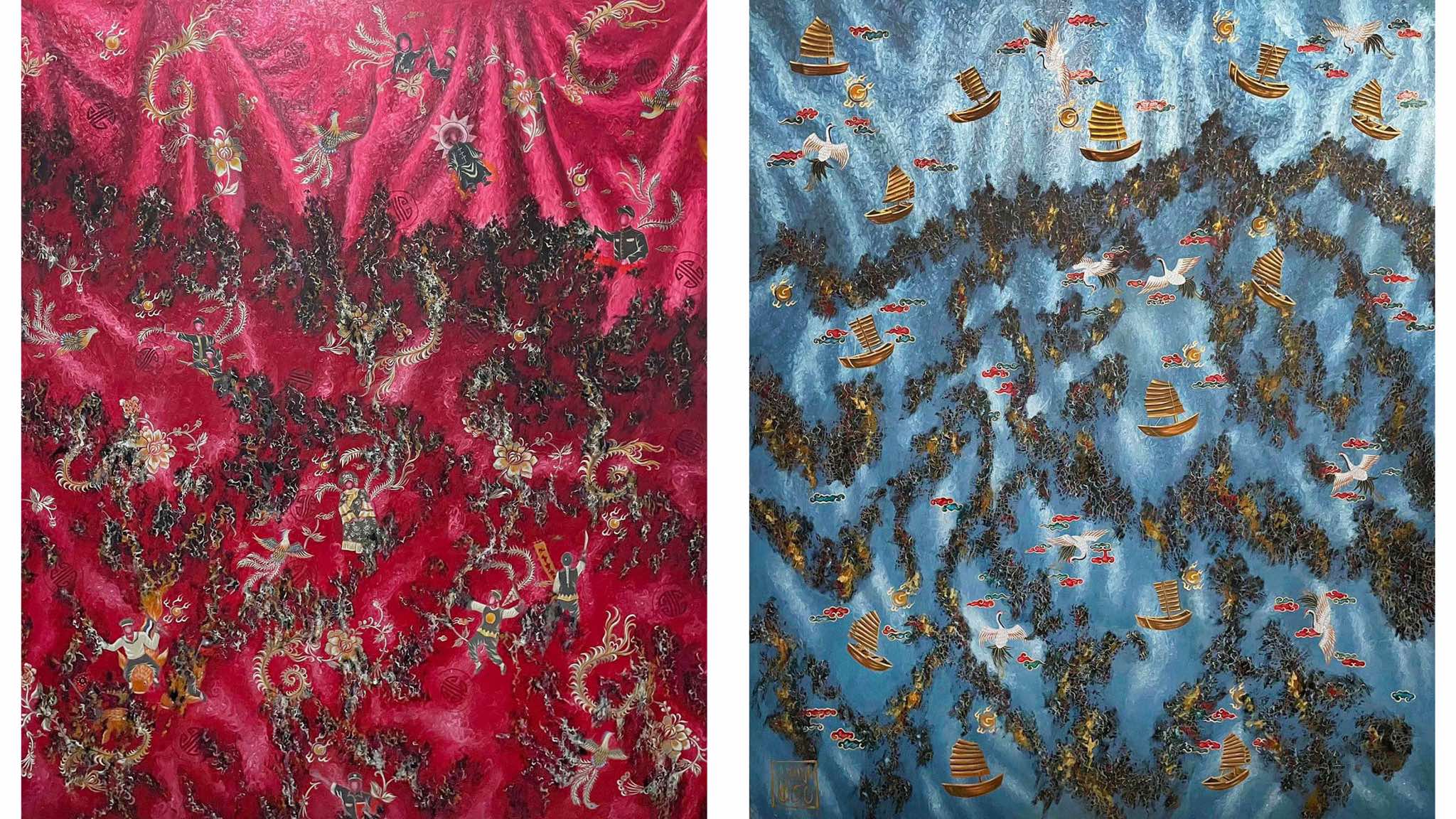
Revolutionary Antecedents and Diaspora in Blue

This theme is particularly relevant in the context of diaspora, where individuals often grapple with the tension between preserving their cultural heritage and adapting to new environments.

Go’s paintings were not only visually stunning but also deeply symbolic. In The Endless Diaspora, a massive 17-foot work on translucent fabric, she depicted a vast, endless sea, representing the uncertainty and challenges faced by migrants.

“I wanted to create an installation that evoked the feeling of migration,” she says. “I then thought about creating a 17-foot-by-20-foot painting of an endless sea without any horizon, which heightens the uncertainty of the routes of diaspora that our ancestors took before. At present, our country is also experiencing a surge of displacement abroad, since a lot of Filipinos are migrating in search for a better life. With this said, the diaspora goes on, traversing cultures and the ‘belligerence of the sea’ without the loss of potency, all the while unspooling the threads of longing that connect a soul to its forsaken—by choice or otherwise—but not entirely forgotten home.” The piece evoked a sense of longing and displacement, highlighting the emotional toll of leaving one’s homeland.
456501267_1190938822172703_2856237000736561576_n.jpg
Endeavored Prosperity and The Azure Dragons

Go’s artworks created a powerful and thought-provoking exhibit by combining visual elements with tactile experiences that resonated with the audience even after they left the gallery.

“I hope the exhibit not only resonated with the Chinese-Filipino community, but to each and everyone who lost their own versions of diaspora. It was also socially relevant considering how labor is the primary export of the Philippines. I also hope that the exhibit served as a medium for introspection, a way to revisit our roots and reconnect with our heritage,” she ends.

“On the Roots and Routes of Diaspora” ran throughout at the Finale Art File Tall Gallery, La Fuerza Compound, Warehouse 17, 2241 Chino Roces Ave., Makati City.

Related Tags

Artist At Work Arts and Culture
ADVERTISEMENT
.most-popular .layout-ratio{ padding-bottom: 79.13%; } @media (min-width: 768px) and (max-width: 1024px) { .widget-title { font-size: 15px !important; } }

{{ articles_filter_1561_widget.title }}

.most-popular .layout-ratio{ padding-bottom: 79.13%; } @media (min-width: 768px) and (max-width: 1024px) { .widget-title { font-size: 15px !important; } }

{{ articles_filter_1562_widget.title }}

.most-popular .layout-ratio{ padding-bottom: 79.13%; } @media (min-width: 768px) and (max-width: 1024px) { .widget-title { font-size: 15px !important; } }

{{ articles_filter_1563_widget.title }}

{{ articles_filter_1564_widget.title }}

.mb-article-details { position: relative; } .mb-article-details .article-body-preview, .mb-article-details .article-body-summary{ font-size: 17px; line-height: 30px; font-family: "Libre Caslon Text", serif; color: #000; } .mb-article-details .article-body-preview iframe , .mb-article-details .article-body-summary iframe{ width: 100%; margin: auto; } .read-more-background { background: linear-gradient(180deg, color(display-p3 1.000 1.000 1.000 / 0) 13.75%, color(display-p3 1.000 1.000 1.000 / 0.8) 30.79%, color(display-p3 1.000 1.000 1.000) 72.5%); position: absolute; height: 200px; width: 100%; bottom: 0; display: flex; justify-content: center; align-items: center; padding: 0; } .read-more-background a{ color: #000; } .read-more-btn { padding: 17px 45px; font-family: Inter; font-weight: 700; font-size: 18px; line-height: 16px; text-align: center; vertical-align: middle; border: 1px solid black; background-color: white; } .hidden { display: none; }
function initializeAllSwipers() { // Get all hidden inputs with cms_article_id document.querySelectorAll('[id^="cms_article_id_"]').forEach(function (input) { const cmsArticleId = input.value; const articleSelector = '#article-' + cmsArticleId + ' .body_images'; const swiperElement = document.querySelector(articleSelector); if (swiperElement && !swiperElement.classList.contains('swiper-initialized')) { new Swiper(articleSelector, { loop: true, pagination: false, navigation: { nextEl: '#article-' + cmsArticleId + ' .swiper-button-next', prevEl: '#article-' + cmsArticleId + ' .swiper-button-prev', }, }); } }); } setTimeout(initializeAllSwipers, 3000); const intersectionObserver = new IntersectionObserver( (entries) => { entries.forEach((entry) => { if (entry.isIntersecting) { const newUrl = entry.target.getAttribute("data-url"); if (newUrl) { history.pushState(null, null, newUrl); let article = entry.target; // Extract metadata const author = article.querySelector('.author-section').textContent.replace('By', '').trim(); const section = article.querySelector('.section-info ').textContent.replace(' ', ' '); const title = article.querySelector('.article-title h1').textContent; // Parse URL for Chartbeat path format const parsedUrl = new URL(newUrl, window.location.origin); const cleanUrl = parsedUrl.host + parsedUrl.pathname; // Update Chartbeat configuration if (typeof window._sf_async_config !== 'undefined') { window._sf_async_config.path = cleanUrl; window._sf_async_config.sections = section; window._sf_async_config.authors = author; } // Track virtual page view with Chartbeat if (typeof pSUPERFLY !== 'undefined' && typeof pSUPERFLY.virtualPage === 'function') { try { pSUPERFLY.virtualPage({ path: cleanUrl, title: title, sections: section, authors: author }); } catch (error) { console.error('ping error', error); } } // Optional: Update document title if (title && title !== document.title) { document.title = title; } } } }); }, { threshold: 0.1 } ); function showArticleBody(button) { const article = button.closest("article"); const summary = article.querySelector(".article-body-summary"); const body = article.querySelector(".article-body-preview"); const readMoreSection = article.querySelector(".read-more-background"); // Hide summary and read-more section summary.style.display = "none"; readMoreSection.style.display = "none"; // Show the full article body body.classList.remove("hidden"); } document.addEventListener("DOMContentLoaded", () => { let loadCount = 0; // Track how many times articles are loaded const offset = [1, 2, 3, 4, 5, 6, 7, 8, 9, 10]; // Offset values const currentUrl = window.location.pathname.substring(1); let isLoading = false; // Prevent multiple calls if (!currentUrl) { console.log("Current URL is invalid."); return; } const sentinel = document.getElementById("load-more-sentinel"); if (!sentinel) { console.log("Sentinel element not found."); return; } function isSentinelVisible() { const rect = sentinel.getBoundingClientRect(); return ( rect.top < window.innerHeight && rect.bottom >= 0 ); } function onScroll() { if (isLoading) return; if (isSentinelVisible()) { if (loadCount >= offset.length) { console.log("Maximum load attempts reached."); window.removeEventListener("scroll", onScroll); return; } isLoading = true; const currentOffset = offset[loadCount]; window.loadMoreItems().then(() => { let article = document.querySelector('#widget_1690 > div:nth-last-of-type(2) article'); intersectionObserver.observe(article) loadCount++; }).catch(error => { console.error("Error loading more items:", error); }).finally(() => { isLoading = false; }); } } window.addEventListener("scroll", onScroll); });

Sign up by email to receive news.