

ADVERTISEMENT

DICT warns of scam involving No Contact Apprehension Policy

Published May 4, 2024 10:22 am

The Department of Information and Communications Technology (DICT) on Saturday, May 4, cautioned the public regarding the No Contact Apprehension Policy (NCAP) cyber attack.
mail-7149606_1280.png

With this, the actors approached their victims, claiming they violated the NCAP and directing them to settle the alleged violation through a website link.

"The public should disregard the said text message, as NCAP enforcement has been suspended since 2022 per the Metro Manila Development Authority (MMDA)," DICT said in a social media post.

In August 2022, the Supreme Court (SC) temporarily stopped the implementation of the Land Transportation Office (LTO) and several cities in Metro Manila of the NCAP for traffic violations due the privacy issues.

READ:

https://mb.com.ph/2022/8/30/sc-stops-temporarily-enforcementof-no-contact-apprehension-policy

Four tips to avoid NCAP Scam

The agency provided four useful tips to guide the public and help them avoid becoming victims of cyber attacks and other online scams.

First on the list is to "ignore suspicious and malicious text messages."
viber_image_2024-05-04_17-12-36-240.jpg
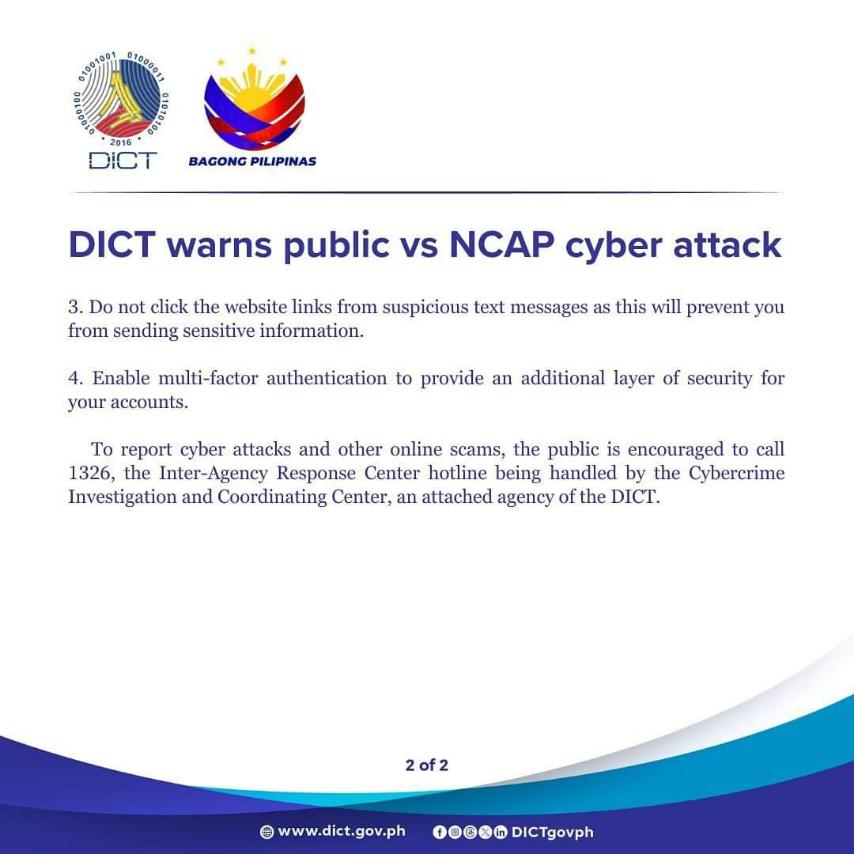
Photo from DICT, alerting the public against the No Contact Apprehension Policy (NCAP) cyber attack.

The DICT also underscored always checking the sender of the text message and verifying the information received by referring to the official social media accounts and websites of the government.

"Do not click the website links from suspicious text messages as this will prevent you from sending sensitive information," DICT said.

The ICT department then suggested to the public to activate multi-factor authentication.

"Enable multi-factor authentication to provide an additional layer of security for your accounts," it said.

Call 1326

Furthermore, the DICT urged the public to report any suspicious activities online by calling "1326."

"To report cyber attacks and other online scams, the public is encouraged to call 1326, the Inter-Agency Response Center hotline being handled by the Cybercrime Investigation and Coordinating Center, an attached agency of the DICT."

Additionally, individuals can report such activities using the following hotline numbers: 0991-481-4225 for DITO users, 0966-976-5971 for Globe users, and 0947-714-7105 for SMART users.

RELATED STORY:

https://mb.com.ph/2023/7/19/scam-watch-pilipinas-urges-netizens-to-save-gov-t-anti-scam-response-hotline-1326

Related Tags

Department of Information and Communications Technology (DICT) cyber attacks online scam
ADVERTISEMENT
.most-popular .layout-ratio{ padding-bottom: 79.13%; } @media (min-width: 768px) and (max-width: 1024px) { .widget-title { font-size: 15px !important; } }

{{ articles_filter_1561_widget.title }}

.most-popular .layout-ratio{ padding-bottom: 79.13%; } @media (min-width: 768px) and (max-width: 1024px) { .widget-title { font-size: 15px !important; } }

{{ articles_filter_1562_widget.title }}

.most-popular .layout-ratio{ padding-bottom: 79.13%; } @media (min-width: 768px) and (max-width: 1024px) { .widget-title { font-size: 15px !important; } }

{{ articles_filter_1563_widget.title }}

{{ articles_filter_1564_widget.title }}

.mb-article-details { position: relative; } .mb-article-details .article-body-preview, .mb-article-details .article-body-summary{ font-size: 17px; line-height: 30px; font-family: "Libre Caslon Text", serif; color: #000; } .mb-article-details .article-body-preview iframe , .mb-article-details .article-body-summary iframe{ width: 100%; margin: auto; } .read-more-background { background: linear-gradient(180deg, color(display-p3 1.000 1.000 1.000 / 0) 13.75%, color(display-p3 1.000 1.000 1.000 / 0.8) 30.79%, color(display-p3 1.000 1.000 1.000) 72.5%); position: absolute; height: 200px; width: 100%; bottom: 0; display: flex; justify-content: center; align-items: center; padding: 0; } .read-more-background a{ color: #000; } .read-more-btn { padding: 17px 45px; font-family: Inter; font-weight: 700; font-size: 18px; line-height: 16px; text-align: center; vertical-align: middle; border: 1px solid black; background-color: white; } .hidden { display: none; }
function initializeAllSwipers() { // Get all hidden inputs with cms_article_id document.querySelectorAll('[id^="cms_article_id_"]').forEach(function (input) { const cmsArticleId = input.value; const articleSelector = '#article-' + cmsArticleId + ' .body_images'; const swiperElement = document.querySelector(articleSelector); if (swiperElement && !swiperElement.classList.contains('swiper-initialized')) { new Swiper(articleSelector, { loop: true, pagination: false, navigation: { nextEl: '#article-' + cmsArticleId + ' .swiper-button-next', prevEl: '#article-' + cmsArticleId + ' .swiper-button-prev', }, }); } }); } setTimeout(initializeAllSwipers, 3000); const intersectionObserver = new IntersectionObserver( (entries) => { entries.forEach((entry) => { if (entry.isIntersecting) { const newUrl = entry.target.getAttribute("data-url"); if (newUrl) { history.pushState(null, null, newUrl); let article = entry.target; // Extract metadata const author = article.querySelector('.author-section').textContent.replace('By', '').trim(); const section = article.querySelector('.section-info ').textContent.replace(' ', ' '); const title = article.querySelector('.article-title h1').textContent; // Parse URL for Chartbeat path format const parsedUrl = new URL(newUrl, window.location.origin); const cleanUrl = parsedUrl.host + parsedUrl.pathname; // Update Chartbeat configuration if (typeof window._sf_async_config !== 'undefined') { window._sf_async_config.path = cleanUrl; window._sf_async_config.sections = section; window._sf_async_config.authors = author; } // Track virtual page view with Chartbeat if (typeof pSUPERFLY !== 'undefined' && typeof pSUPERFLY.virtualPage === 'function') { try { pSUPERFLY.virtualPage({ path: cleanUrl, title: title, sections: section, authors: author }); } catch (error) { console.error('ping error', error); } } // Optional: Update document title if (title && title !== document.title) { document.title = title; } } } }); }, { threshold: 0.1 } ); function showArticleBody(button) { const article = button.closest("article"); const summary = article.querySelector(".article-body-summary"); const body = article.querySelector(".article-body-preview"); const readMoreSection = article.querySelector(".read-more-background"); // Hide summary and read-more section summary.style.display = "none"; readMoreSection.style.display = "none"; // Show the full article body body.classList.remove("hidden"); } document.addEventListener("DOMContentLoaded", () => { let loadCount = 0; // Track how many times articles are loaded const offset = [1, 2, 3, 4, 5, 6, 7, 8, 9, 10]; // Offset values const currentUrl = window.location.pathname.substring(1); let isLoading = false; // Prevent multiple calls if (!currentUrl) { console.log("Current URL is invalid."); return; } const sentinel = document.getElementById("load-more-sentinel"); if (!sentinel) { console.log("Sentinel element not found."); return; } function isSentinelVisible() { const rect = sentinel.getBoundingClientRect(); return ( rect.top < window.innerHeight && rect.bottom >= 0 ); } function onScroll() { if (isLoading) return; if (isSentinelVisible()) { if (loadCount >= offset.length) { console.log("Maximum load attempts reached."); window.removeEventListener("scroll", onScroll); return; } isLoading = true; const currentOffset = offset[loadCount]; window.loadMoreItems().then(() => { let article = document.querySelector('#widget_1690 > div:nth-last-of-type(2) article'); intersectionObserver.observe(article) loadCount++; }).catch(error => { console.error("Error loading more items:", error); }).finally(() => { isLoading = false; }); } } window.addEventListener("scroll", onScroll); });

Sign up by email to receive news.