

ADVERTISEMENT

PhilSA, CIPFI partner to advance environmental conservation with remote sensing

Published Oct 31, 2023 09:51 am

The Philippine Space Agency (PhilSA) and Conservation International Philippines Foundation, Inc. (CIPFI) signed a Memorandum of Agreement (MOA) to work on advancing environmental conservation and management through the application of remote sensing technologies.
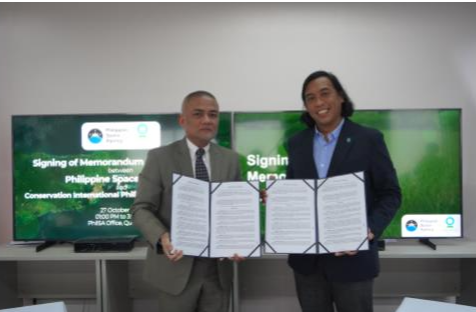
PhilSA 10-31.png
Photo credit to PhilSA

PhilSA Director General Dr. Marciano welcomed and expressed gratitude towards CIPFI, whom he described as “a significant contributor to the space ecosystem that we are trying to build in the country.”

PhilSA highlighted the collaboration as a crucial step towards leveraging satellite and aerial remote sensing for environmental conservation, as well as its impact on the country’s conservation efforts.

"This partnership is seen to contribute further to advancing our space research and development, space education and awareness, and space industry and capacity building key development areas, particularly through the involvement of private sector and non-government organizations,” Marciano said.

Meanwhile, CIPFI Country Executive Director Barbon expressed strong interest in the partnership with PhilSA as it would allow them “to explore technologies that are based on the work in space to develop efficient tools for ecosystem research, protection, sustainable management.”

Barbon said that utilizing space technology to observe mangrove and seagrass beds would aid in developing nature and people-centered programs.

The agreement covers strategic work plan development to support CIPFI’s Community, Conservation, and Natural Climate Solution (CCNCS) Project: Mantalingahan Landscape Conservation Project in Southern Palawan, which aims to improve forest management of its protected landscape.

Among other commitments are the conduct of learning and capacity-building activities related to satellite data processing, programming, and usage of aerial mapping drones for forest monitoring and conservation.

Under the agreement, the CIPFI will provide annual reports to PhilSA, as well as act as a key partner in the implementation of the PhilSA Integrated Network for Space-enabled Actions towards Sustainability (“PINAS”) project in Palawan and other project sites of the CIPFI.

Meanwhile, PhilSA will provide technical assistance for satellite and remote sensing data usage, geospatial and mapping services, satellite data access, and collaborate in research and development and space data mobilization activities.

PhilSA SIIB Director Dr. Blanco closed the ceremony by emphasizing that PhilSA and CIPFI still have many things to do to protect and manage the country’s environment using space science and technology and that they look forward to a productive partnership and implementation of the memorandum.

PhilSA Director General Dr. Joel Joseph Marciano, Jr. and CIPFI Country Executive Director Wilson John Barbon formalized this cooperation on Oct. 27 at the PhilSA office in Quezon City.

The signing ceremony was attended by PhilSA Space Information Infrastructure Bureau (SIIB) Director Ariel Blanco, Dr.Eng., and CIPFI Policy and Governance Adviser Edward Lorenzo as witnesses.

Related Tags

philippine space agency (PhilSA)
ADVERTISEMENT
.most-popular .layout-ratio{ padding-bottom: 79.13%; } @media (min-width: 768px) and (max-width: 1024px) { .widget-title { font-size: 15px !important; } }

{{ articles_filter_1561_widget.title }}

.most-popular .layout-ratio{ padding-bottom: 79.13%; } @media (min-width: 768px) and (max-width: 1024px) { .widget-title { font-size: 15px !important; } }

{{ articles_filter_1562_widget.title }}

.most-popular .layout-ratio{ padding-bottom: 79.13%; } @media (min-width: 768px) and (max-width: 1024px) { .widget-title { font-size: 15px !important; } }

{{ articles_filter_1563_widget.title }}

{{ articles_filter_1564_widget.title }}

.mb-article-details { position: relative; } .mb-article-details .article-body-preview, .mb-article-details .article-body-summary{ font-size: 17px; line-height: 30px; font-family: "Libre Caslon Text", serif; color: #000; } .mb-article-details .article-body-preview iframe , .mb-article-details .article-body-summary iframe{ width: 100%; margin: auto; } .read-more-background { background: linear-gradient(180deg, color(display-p3 1.000 1.000 1.000 / 0) 13.75%, color(display-p3 1.000 1.000 1.000 / 0.8) 30.79%, color(display-p3 1.000 1.000 1.000) 72.5%); position: absolute; height: 200px; width: 100%; bottom: 0; display: flex; justify-content: center; align-items: center; padding: 0; } .read-more-background a{ color: #000; } .read-more-btn { padding: 17px 45px; font-family: Inter; font-weight: 700; font-size: 18px; line-height: 16px; text-align: center; vertical-align: middle; border: 1px solid black; background-color: white; } .hidden { display: none; }
function initializeAllSwipers() { // Get all hidden inputs with cms_article_id document.querySelectorAll('[id^="cms_article_id_"]').forEach(function (input) { const cmsArticleId = input.value; const articleSelector = '#article-' + cmsArticleId + ' .body_images'; const swiperElement = document.querySelector(articleSelector); if (swiperElement && !swiperElement.classList.contains('swiper-initialized')) { new Swiper(articleSelector, { loop: true, pagination: false, navigation: { nextEl: '#article-' + cmsArticleId + ' .swiper-button-next', prevEl: '#article-' + cmsArticleId + ' .swiper-button-prev', }, }); } }); } setTimeout(initializeAllSwipers, 3000); const intersectionObserver = new IntersectionObserver( (entries) => { entries.forEach((entry) => { if (entry.isIntersecting) { const newUrl = entry.target.getAttribute("data-url"); if (newUrl) { history.pushState(null, null, newUrl); let article = entry.target; // Extract metadata const author = article.querySelector('.author-section').textContent.replace('By', '').trim(); const section = article.querySelector('.section-info ').textContent.replace(' ', ' '); const title = article.querySelector('.article-title h1').textContent; // Parse URL for Chartbeat path format const parsedUrl = new URL(newUrl, window.location.origin); const cleanUrl = parsedUrl.host + parsedUrl.pathname; // Update Chartbeat configuration if (typeof window._sf_async_config !== 'undefined') { window._sf_async_config.path = cleanUrl; window._sf_async_config.sections = section; window._sf_async_config.authors = author; } // Track virtual page view with Chartbeat if (typeof pSUPERFLY !== 'undefined' && typeof pSUPERFLY.virtualPage === 'function') { try { pSUPERFLY.virtualPage({ path: cleanUrl, title: title, sections: section, authors: author }); } catch (error) { console.error('ping error', error); } } // Optional: Update document title if (title && title !== document.title) { document.title = title; } } } }); }, { threshold: 0.1 } ); function showArticleBody(button) { const article = button.closest("article"); const summary = article.querySelector(".article-body-summary"); const body = article.querySelector(".article-body-preview"); const readMoreSection = article.querySelector(".read-more-background"); // Hide summary and read-more section summary.style.display = "none"; readMoreSection.style.display = "none"; // Show the full article body body.classList.remove("hidden"); } document.addEventListener("DOMContentLoaded", () => { let loadCount = 0; // Track how many times articles are loaded const offset = [1, 2, 3, 4, 5, 6, 7, 8, 9, 10]; // Offset values const currentUrl = window.location.pathname.substring(1); let isLoading = false; // Prevent multiple calls if (!currentUrl) { console.log("Current URL is invalid."); return; } const sentinel = document.getElementById("load-more-sentinel"); if (!sentinel) { console.log("Sentinel element not found."); return; } function isSentinelVisible() { const rect = sentinel.getBoundingClientRect(); return ( rect.top < window.innerHeight && rect.bottom >= 0 ); } function onScroll() { if (isLoading) return; if (isSentinelVisible()) { if (loadCount >= offset.length) { console.log("Maximum load attempts reached."); window.removeEventListener("scroll", onScroll); return; } isLoading = true; const currentOffset = offset[loadCount]; window.loadMoreItems().then(() => { let article = document.querySelector('#widget_1690 > div:nth-last-of-type(2) article'); intersectionObserver.observe(article) loadCount++; }).catch(error => { console.error("Error loading more items:", error); }).finally(() => { isLoading = false; }); } } window.addEventListener("scroll", onScroll); });

Sign up by email to receive news.