ADVERTISEMENT

Affordable, powerful and connected

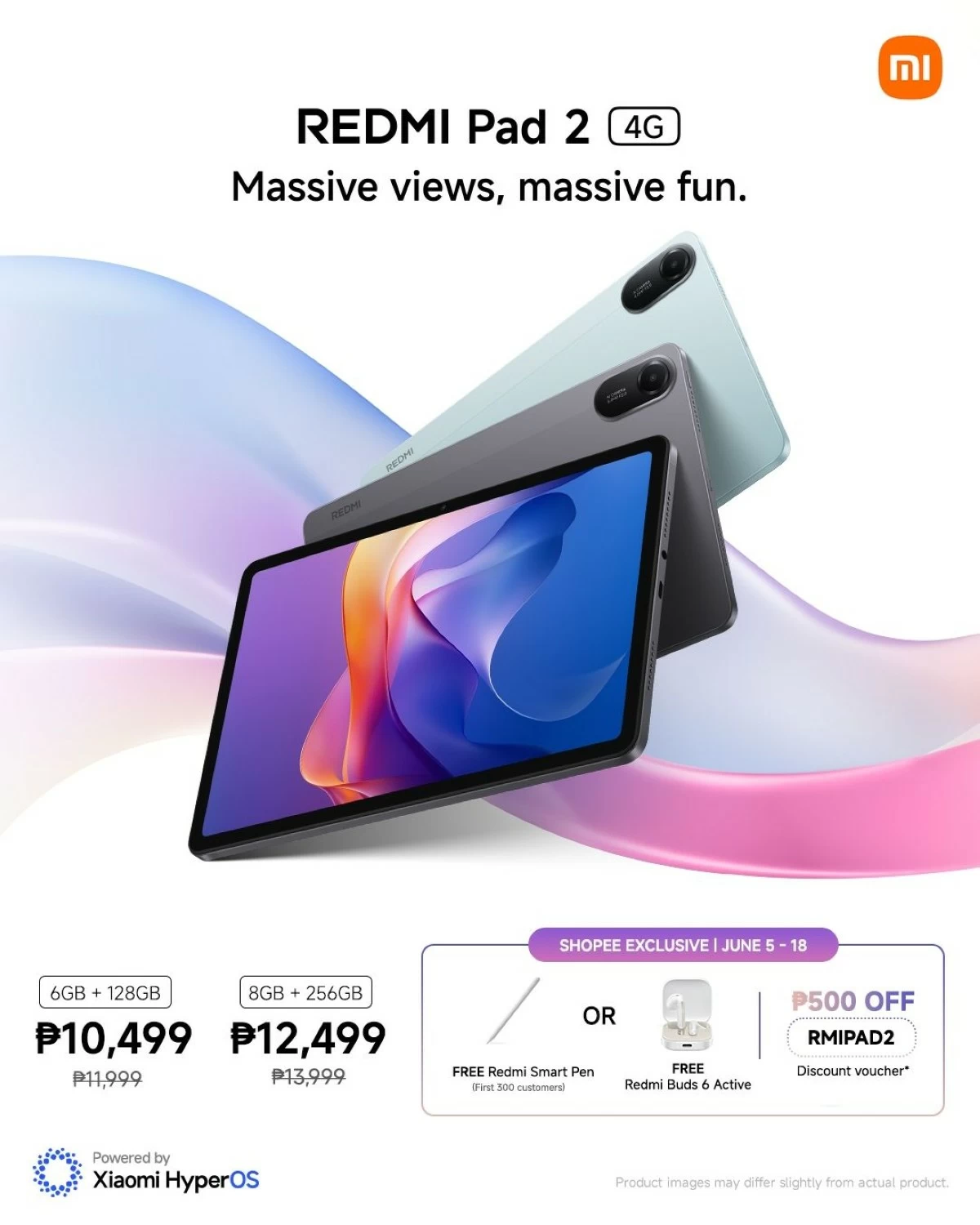
Redmi Pad 2 4G lands in the PH starting at P10,499.

Published Jun 6, 2025 05:08 pm
Xiaomi unveiled the Redmi Pad 2 4G — an entry-level entertainment tablet designed to bring upgraded features to a wider audience.
Featuring a high-definition display, robust battery life, powerful performance, and running on the latest Xiaomi HyperOS 2, the Redmi Pad 2 4G delivers an immersive experience for everyday entertainment.
Vivid visuals and rich sound, built for everyday enjoyment
The Redmi Pad 2 4G features an expansive 11-inch 2.5K display,¹ offering crystal-clear detail and vibrant colors for streaming, browsing, and casual gaming.
With a pixel density of 274 ppi and a 90Hz AdaptiveSync refresh rate,² visuals stay exceptionally smooth even during fast-moving scenes. Featuring DC dimming and TÜV Rheinland certifications for Low Blue Light (Software Solution), Flicker Free, and Circadian Friendly, the Redmi Pad 2 4G ensures all-day eye comfort. Complementing the display is a quad-speaker setup with Dolby Atmos and Hi-Res Audio, delivering an immersive sound experience for music, movies, and games.
Seamless interaction with Xiaomi HyperOS 2
Powered by Xiaomi HyperOS 2, the Redmi Pad 2 4G delivers a connected experience that integrates effortlessly across Xiaomi phones and tablets.
With Xiaomi Interconnectivity features such as call sync, network sync, and shared clipboard,³ the tablet enables more intuitive workflows and greater flexibility across screens. Call sync allows incoming phone calls to be answered directly on the tablet, allowing you to stay connected without switching devices. When Wi-Fi is unavailable, network sync steps in, enabling quick access to your phone's hotspot with a single tap. Meanwhile, shared clipboard makes it easier to copy and paste text and images between your phone and tablet, as though working on the same device. Together, these features streamline daily workflows and enhance cross-device convenience.
Reliable performance and mobility with a sleek design
Equipped with the MediaTek Helio G100-Ultra processor, the Redmi Pad 2 4G delivers strong performance and an immersive experience for everyday entertainment.
A massive 9000mAh battery supports long viewing sessions and extended use with fewer charging breaks. For those who need connectivity on the go, the Redmi Pad 2 4G offers the same entertainment-focused experience, featuring dual-SIM and dual 4G support.⁵ From watching shows during commutes to enjoying music or videos in outdoor settings, the Redmi Pad 2 4G enables on-the-go access to content without relying on Wi-Fi. The Redmi Pad 2 4G also features a metal unibody design,⁴ offering users a sophisticated tactile experience.
The Redmi Pad 2 4G also supports key accessories that enhance its versatility for entertainment and creativity.⁶ The Redmi Smart Pen offers a 60Hz refresh rate⁷ and millisecond-level low latency⁸ — delivering precise input for writing, sketching, and note-taking. Requiring just 10 grams of activation force,⁹ it enables a natural, pen-on-paper experience. Meanwhile, the Redmi Pad 2 Cover adds 360° protection and supports smart wake and sleep functionality, while its adjustable stand ensures stable, hands-free viewing with added comfort.
Price and availability
The Redmi Pad 2 4G is available on the official Xiaomi store on Shopee and Lazada, as well as authorized Xiaomi stores nationwide in Graphite Gray,¹⁰ with two variants: 6GB+128GB (P10,499), and 8GB+256GB (P12,499)¹. A free Redmi Smart Pen or Redmi Buds 6 Active is also available as a Shopee exclusive from June 5 to 18, along with P500 off with the special voucher code RMIPAD2. Enjoy immersive entertainment and get your own Redmi Pad 2 4G today!
ADVERTISEMENT
.most-popular .layout-ratio{ padding-bottom: 79.13%; } @media (min-width: 768px) and (max-width: 1024px) { .widget-title { font-size: 15px !important; } }

{{ articles_filter_1561_widget.title }}

.most-popular .layout-ratio{ padding-bottom: 79.13%; } @media (min-width: 768px) and (max-width: 1024px) { .widget-title { font-size: 15px !important; } }

{{ articles_filter_1562_widget.title }}

.most-popular .layout-ratio{ padding-bottom: 79.13%; } @media (min-width: 768px) and (max-width: 1024px) { .widget-title { font-size: 15px !important; } }

{{ articles_filter_1563_widget.title }}

{{ articles_filter_1564_widget.title }}

.mb-article-details { position: relative; } .mb-article-details .article-body-preview, .mb-article-details .article-body-summary{ font-size: 17px; line-height: 30px; font-family: "Libre Caslon Text", serif; color: #000; } .mb-article-details .article-body-preview iframe , .mb-article-details .article-body-summary iframe{ width: 100%; margin: auto; } .read-more-background { background: linear-gradient(180deg, color(display-p3 1.000 1.000 1.000 / 0) 13.75%, color(display-p3 1.000 1.000 1.000 / 0.8) 30.79%, color(display-p3 1.000 1.000 1.000) 72.5%); position: absolute; height: 200px; width: 100%; bottom: 0; display: flex; justify-content: center; align-items: center; padding: 0; } .read-more-background a{ color: #000; } .read-more-btn { padding: 17px 45px; font-family: Inter; font-weight: 700; font-size: 18px; line-height: 16px; text-align: center; vertical-align: middle; border: 1px solid black; background-color: white; } .hidden { display: none; }
function initializeAllSwipers() { // Get all hidden inputs with cms_article_id document.querySelectorAll('[id^="cms_article_id_"]').forEach(function (input) { const cmsArticleId = input.value; const articleSelector = '#article-' + cmsArticleId + ' .body_images'; const swiperElement = document.querySelector(articleSelector); if (swiperElement && !swiperElement.classList.contains('swiper-initialized')) { new Swiper(articleSelector, { loop: true, pagination: false, navigation: { nextEl: '#article-' + cmsArticleId + ' .swiper-button-next', prevEl: '#article-' + cmsArticleId + ' .swiper-button-prev', }, }); } }); } setTimeout(initializeAllSwipers, 3000); const intersectionObserver = new IntersectionObserver( (entries) => { entries.forEach((entry) => { if (entry.isIntersecting) { const newUrl = entry.target.getAttribute("data-url"); if (newUrl) { history.pushState(null, null, newUrl); let article = entry.target; // Extract metadata const author = article.querySelector('.author-section').textContent.replace('By', '').trim(); const section = article.querySelector('.section-info ').textContent.replace(' ', ' '); const title = article.querySelector('.article-title h1').textContent; // Parse URL for Chartbeat path format const parsedUrl = new URL(newUrl, window.location.origin); const cleanUrl = parsedUrl.host + parsedUrl.pathname; // Update Chartbeat configuration if (typeof window._sf_async_config !== 'undefined') { window._sf_async_config.path = cleanUrl; window._sf_async_config.sections = section; window._sf_async_config.authors = author; } // Track virtual page view with Chartbeat if (typeof pSUPERFLY !== 'undefined' && typeof pSUPERFLY.virtualPage === 'function') { try { pSUPERFLY.virtualPage({ path: cleanUrl, title: title, sections: section, authors: author }); } catch (error) { console.error('ping error', error); } } // Optional: Update document title if (title && title !== document.title) { document.title = title; } } } }); }, { threshold: 0.1 } ); function showArticleBody(button) { const article = button.closest("article"); const summary = article.querySelector(".article-body-summary"); const body = article.querySelector(".article-body-preview"); const readMoreSection = article.querySelector(".read-more-background"); // Hide summary and read-more section summary.style.display = "none"; readMoreSection.style.display = "none"; // Show the full article body body.classList.remove("hidden"); } document.addEventListener("DOMContentLoaded", () => { let loadCount = 0; // Track how many times articles are loaded const offset = [1, 2, 3, 4, 5, 6, 7, 8, 9, 10]; // Offset values const currentUrl = window.location.pathname.substring(1); let isLoading = false; // Prevent multiple calls if (!currentUrl) { console.log("Current URL is invalid."); return; } const sentinel = document.getElementById("load-more-sentinel"); if (!sentinel) { console.log("Sentinel element not found."); return; } function isSentinelVisible() { const rect = sentinel.getBoundingClientRect(); return ( rect.top < window.innerHeight && rect.bottom >= 0 ); } function onScroll() { if (isLoading) return; if (isSentinelVisible()) { if (loadCount >= offset.length) { console.log("Maximum load attempts reached."); window.removeEventListener("scroll", onScroll); return; } isLoading = true; const currentOffset = offset[loadCount]; window.loadMoreItems().then(() => { let article = document.querySelector('#widget_1690 > div:nth-last-of-type(2) article'); intersectionObserver.observe(article) loadCount++; }).catch(error => { console.error("Error loading more items:", error); }).finally(() => { isLoading = false; }); } } window.addEventListener("scroll", onScroll); });

Sign up by email to receive news.